
The microenvironment at the maternal-fetal interface is optimized to facilitate the development and survival of the fetus during pregnancy. It involves a balance between cell populations and interactions of the fetal placenta with various cell types (ie, stromal cells, endothelial cells, immune cells, and fibroblasts) that are embedded in the maternal endometrium/decidua. Aberrant shifts in cell populations and deranged cell-cell interactions are closely related to pregnancy disorders. Thus, analysis of the dynamic changes in cell populations and their interactions at the maternal-fetal interface in normal and complicated pregnancies is essential to provide insights into the fundamental processes involved in the establishment and maintenance of normal pregnancy, and how these processes are dysregulated. Thus, informing novel pathways for therapeutic targets of pregnancy complications. Single-cell sequencing (SCS) is a powerful tool for transcriptome analysis at single-cell resolution. Combined with information on the developmental trajectory and function of different cell populations, SCS can provide an unparalleled opportunity for refining the spatiotemporal cell atlas to elaborate dynamic changes in cell populations and their interactions in tissues that consist of highly heterogeneous cell populations such as the maternal-fetal interface. This minireview briefly summarizes traditional methods and their limitations for analyzing maternal-fetal interface cell-cell interactions, and introduces the current applications, advantages, limitations, and prospective applications of SCS in research on maternal-fetal interactions.



Copyright © 2022 Reproductive and Developmental Medicine, Published by Wolters Kluwer Health, Inc.
This is an open-access article distributed under the terms of the Creative Commons Attribution-Non Commercial-No Derivatives License 4.0 (CCBY-NC-ND), where it is permissible to download and share the work provided it is properly cited. The work cannot be changed in any way or used commercially without permission from the journal.
Normal fetal development requires complex interactions between placental and maternal decidual cells. In the early stages of pregnancy, the endometrium is transformed into the decidua under the coordinated action of steroid hormones such as estrogens and progesterone. Once a blastocyst is implanted, extravillous trophoblast cells (EVTs) invade the maternal decidua and blood vessels. The depth of trophoblast invasion is finely controlled by various cell types in the decidua[1]. Meanwhile, the presence of special immune cell populations in the maternal placenta (decidua), the point of integration for two semi-allogeneic individuals, make the decidua a special immune site, that is usually in a state of relative immunosuppression. These immune cells include decidual natural killer (dNK) cells, macrophages (dM), regulatory T cells (Tregs), and dendritic cells (dDCs), etc.[2]. Decidual cells within this specific microenvironment communicate with placental trophoblast cells to form the maternal-fetal interface. Interactions among different decidual cells and trophoblast cells optimize the mother-fetal exchange of gases (O2 and CO2), nutrient delivery to the fetus, and fetal and placental metabolic wastes removal to support fetal development and survival. Every pair of interacting cells from maternal and fetal interests can be regarded as units with interaction networks. The joint detection of the cell-cell crosstalk is conducive to our understanding of the construction of maternal-fetal interface networks.
Disturbances in cellular and molecular compositions can result in a dysfunctional maternal-fetal interface, which is a common cause of nearly all pregnancy disorders. The normal communication of various cell types at the maternal-fetal interface is conducive to the maintenance of a normal pregnancy. For example, the premature activation of T cells is associated with premature delivery[3], impaired activation of dNK cells is associated with preeclampsia (PE)[4], and the increase in CD56+CD16+/CD56+CD16- NK cells in the decidua is commonly found in patients with recurrent spontaneous abortion (RSA)[5]. These studies show that changes in immune tolerance disturbs the normal pregnancy process, demonstrating the indispensable role that decidual immune cells play in pregnancy.
Herein, we provide an overview of some traditional methods and the findings of new single-cell studies that have been applied to investigate the cellular and molecular mechanisms underlying maternal-fetal interactions to provide a clear focus for future maternal-fetal interface research.
Traditional methods involve the use of various antibody-based immunological methods to investigate maternal-fetal interactions. For instance, immunohistochemistry (IHC), immunofluorescence (IF), and flow cytometry (FCM) with antibodies against surface marker proteins of specific cell types have been used to detect changes in both the number and proportion of cells at the maternal-fetal interface[6,7]. Combining these antibody-based methods with the isolated culture of specific cell types in vitro and western blotting (WB) can also provide insights into the expression of related proteins in specific cell types according to gestational age[8,9,10]. In situ hybridization (ISH) and northern blotting can provide information regarding cell-specific spatiotemporal changes in the mRNAs of the relevant cells[11]. Data obtained with these traditional methods mainly focuses on changes in the number of cells and proteins or mRNAs of a limited number of genes and their functions. The data obtained from these methods are mostly unilateral with limited application to the analysis of the diversity of the maternal-fetal interface.
Analyzing gene expression at transcriptome and proteome levels can more effectively identify pathological changes related to defined clinical phenotypes and develop biomarkers or targets for their prediction, diagnosis, and treatment[12]. The quantitative analysis of a large number of genes in tissues and cells at the same time was first realized using microarray in the 1990s, which had been used in mRNA expression profiling of genes at the maternal-fetal interface[13,14]. A more powerful next-generation sequencing (NGS, also known as high-throughput sequencing) was invented in 2005[15], which makes complete gene expression profiling a reality by sequencing the whole transcriptome. The application of NGS to investigate the maternal-fetal interface has yielded many gratifying results. For example, NGS has identified candidate genes related to cell proliferation and cell cycle regulation in placental tissues during the early stages of pregnancy, showing rapid growth during this period[16]. Comparisons of placental transcriptomes of normal and pathological pregnancies according to gestational age have revealed specific genes related to placental development and function that may be biomarkers of pregnancy complications[17]. Sex dimorphism in the placental transcriptome provides insights into the poor pregnancy outcomes of male fetuses[18].
Although studies using microarray and NGS have provided an important understanding of the maternal-fetal interface at the transcriptome level, these two methods also have limitations. Microarray detects transcripts with predesigned probes, making the discovery of unknown targets impossible, and the high background hybridization of microarray makes it difficult to accurately determine the levels of different transcripts in the same array[19,20,21]. NGS technology only provides the virtual average value of different cell components; it cannot distinguish the types and functions of various cells, nor can it identify and predict cell-cell interactions.
Gene expression in a cell is regulated in a spatiotemporal manner under the influence of physiological and pathological conditions, and even the same cell type often displays heterogeneous gene expression[22]. Therefore, accurately detecting the gene expression profile of each cell in a tissue is critical to comprehensively understand the differentiation trajectory, function, and fate of the cell and to clarify the complex regulatory networks among different cells. Single-cell gene expression profile analysis technology, namely, single-cell sequencing (SCS), was designed to meet this challenge of rapidly determining the precise expression patterns of tens of thousands of genes at single-cell resolution. SCS can also identify cell subtypes in different tissues and study their mutual regulatory relationships[23,24,25] (Supplementary Table 1; http://links.lww.com/RDM/A9).
The first genome-wide single-cell DNA[26] and RNA[27] sequencing methods for mammalian cells were developed in 2011 and 2009, respectively. Single-cell RNA-seq (scRNA-seq) is often used and readily available on several platforms (eg, Fluidigm C1, Drop-seq, 10× Genomics Chromium Next GEM Single Cell 5′/3′, Takara Bio SMART-seq). The RNA method was used to study gene expression during early embryonic development. It involves mechanical separation of a single oocyte and reverse transcription of RNA into cDNA, which was amplified and then sequenced by NGS technology[27]. The sequenced data were matched with a single cell using a cell-specific barcode, and a unique molecular identifier (UMI) was added to the primer oligonucleotide for reverse transcription to prevent a possible imbalance of the cDNA proportion in the amplification process. Sequencing results can be compared to those of specific genes. This single-cell resolution detection method greatly enhances the ability to detect transcriptome complexity. Currently, the Chromium platform, a microfluidic-based SCS method, from 10× Genomics has been selected by many researchers because of its ability to capture a large number of cells[28]. Alternative methods include the plate-based Smart-seq protocol, which liberalizes the restrictions on cell volume, and single-nucleus RNA sequencing (snRNA-seq), which enables the sequencing of frozen samples[29,30]. ScRNA-seq has been used to reveal heterogeneity among various cell types and to elucidate molecular interactions within a population of cells in different states.
To date, over 10 scRNA-seq studies have reported on the placenta, with samples ranging from as early as the sixth week of gestation to full term, in normal and/or pregnancy with complications (Supplementary Table 2; http://links.lww.com/RDM/A9).
Given that trophoblast cells are most proximal to the maternal interface, some researchers have begun to focus on their analysis. The first scRNA-seq from human placental samples published in 2017 used the Fluidigm C1 system, and villous tissue was taken from term, cesarean-delivered placentas collected from two women. These data were complemented by two transcriptomes of syncytiotrophoblasts collected from a single placenta by laser microdissection. The transcriptomes of primary undifferentiated endometrial stromal fibroblasts (ESF) and the transcriptome of in vitro differentiated primary decidual cells from two patients resulted in 87 single-cell transcriptomes. The interaction between trophoblast cells and decidual cells was inferred from the five cell clusters obtained. These findings suggested that the interaction between the uterine decidua and adjacent trophoblast cells increased during decidualization, and that some cell clusters had cell type specificity. However, these inferences are still hypothetical. The application value was limited because of the small number of cells obtained. At the same time, owing to material limitation, the transcriptome of decidual cells in vivo was not involved[31]. This is the first characterization of the cell communication network at the human maternal-fetal interface, showing the advantage that the high resolution of single-cell transcriptome has in the identification of rare cell types that cannot be detected in tissue-level transcriptomes.
Liu et al.[32] performed scRNA-seq on 1471 cells using first and second trimester (8 and 24 weeks) placental samples with the SMART-seq2 platform. Using a magnetic-activated cell sorting workflow, four populations of cells from the villi were harvested: EVTs (HLA-G), cytotrophoblasts (CDH1), syncytiotrophoblasts (mouth-pipetted based on size), and villous stromal cells (HLA-G and CDH1-). These cell types include fusion-competent cytotrophoblasts CTBs, which are characterized by cell cycle exit, high expression of Syncytin-2 and adhesion genes, and expression of hormone genes, including INSL4 and CGA. The different cell types’ cell type-specific genetic and epigenetic signatures and potential functions were obtained. Strongly expressed APOE, C1QC, and CSF1R macrophages were in an activated state, which might be responsible for clearing cellular debris during placental development[32].
Another article in 2017 focused on term placentas (two female and two male offspring) using the 10× Genomics platform. Single nucleotide polymorphism analysis or Y chromosome transcription was used to distinguish between maternal- and fetal-derived cells. To verify the developmental continuity of trophoblast subtypes at the transcriptome level, the differentiation relationship of trophoblast cells was reconstructed by pseudotime analyses, a method used to predict cell differentiation trajectory, and the highly expressed genes of each branch were analyzed. It predicted differentiation paths starting at villous cytotrophoblasts (VCTs) branching toward either EVTs or syncytiotrophoblasts driven by SLC1A2, ADHFE1, and DEPDC1B transcription. Finally, bulk RNA-seq data from cell-free RNA identified differences in pathology in plasma from women with PE and healthy controls. This provides an opportunity for the application of SCS results: to establish cell type-specific gene markers at single placental cell level, and to isolate and analyze the dynamic changes of trophoblast and non-trophoblast cell components in maternal plasma[33].
To study the maternal-fetal receptor-ligand relationship more specifically, Vento-Tormo et al.[34] presented a new database of curated complexes called CellPhoneDB (www.CellPhoneDB. org/), that predicted cell-cell interactions and inferred syncytiotrophoblast interactions with EGFR, NRP2, and MET receptors and EVT interactions with CXCL6, TGFB1, and PAPPA. In addition, they performed scRNA-seq on 70,325 cells from 11 deciduas, five placentas and six matched peripheral blood mononuclear cells. Vento-Tormo et al.[34] not only improved the cell map of maternal-fetal interface with 21 clusters of immune and 17 non-immune cells, but also turned people’s attention to the further exploration of decidual microenvironments. Huang et al.[35] analyzed 29,231 decidual cells before and after delivery and found that the functions of the active extravillous trophoblast group in delivery focused on cell death regulation and vasculature development, involving interleukin-17, activator protein 1, and interleukin-6 signaling pathways. Decidual stromal cells (DSCs) are also involved in the activator protein 1 pathway, suggesting that DSCs in delivery may be regulated through this pathway. The differences in the proportions of different functional subgroups of decidual T cells, that may be closely related to the maternal-fetal immune tolerance response during labor onset, highlights the important roles of decidual immune cells[35].
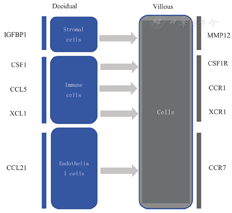
These analyses of normal pregnancies point to a unique environment in which inflammation is inhibited and invasion is promoted. Relying on immune and stromal cell subsets, homeostasis of the maternal-fetal interface is maintained. The rapid development of scRNA-seq technology provides an unprecedented opportunity to predict ligand-receptor interactions at high resolution. A summary of the receptor-ligand interactions between maternal decidual cells and fetal trophoblast cells during the early stages of a normal pregnancy are shown in Fig. 1. However, it should be noted that the results do not represent all interactions between the ligands and receptors. As the spatiality between cells has not been considered, a combination with spatial reconstruction method can be considered for future applications[36].
Considering the effects of cell number and function changes on pregnancy, as in RSA, Wang et al.[37] characterized the decidual immune landscape at the single-cell level. Through the comparison of six peripheral blood samples and six decidual tissue samples in the 10× Genomics Chromium platform, this article indicated an overall enhanced systematic pro-inflammatory immune state of patients with RSA. Specifically, the differentiation of CD8T naive cells to CD8T effector cells was significantly enhanced, the number of NK dim cells was preferentially increased, and the expression of inflammation-related genes was upregulated. A notable finding was the increased frequency of MAIT cells with enhanced expression of IRF1 and RORA in the peripheral blood of patients with RSA. A newly identified CD56+CD16+dNK subset, which does not express the tissue-resident marker CD49a but strongly expresses LILRB, indicated their "memory" of pregnancy outcomes. It was proposed that patients with an abundance of CD56+CD16+dNK cells are more likely to experience pregnancy failure in subsequent pregnancies. In contrast, macrophages, which accounted for approximately 20% of leukocytes at the maternal-fetal interface, showed increased expression of genes encoding immunoinflammatory factors and relevant signaling molecules, such as CXCL8, TNF, IFIT2, JUN, and JUNB[37].
Similarly, Guo et al.[38] and Chen et al.[39] presented single-cell transcriptomes of the decidual immune microenvironment in patients with RSA. They first studied the CD45+ cells from first-trimester decidual samples with normal embryonic karyotype. Guo et al.[38] compared healthy and RSA samples and identified a particular subset of dNK cells (dNK1) that promote normal pregnancy by secreting growth-promoting factors that were significantly decreased in patients with RSA. They also discovered the tendency of macrophages in samples from patients with RSA to recruit T cells with an inflammatory signature, whereas healthy people macrophages tend to recruit NK cells to maintain immune tolerance[38]. In a study by Chen et al.[39], macrophages also highly expressed pro-inflammatory (FABP5 and EIF5A) and anti-inflammatory genes (APOE and MS4A7), suggesting that lipid metabolism and EIF5A-related transcriptional regulation are involved in the regulation of macrophage function. At the same time, the article also mentioned an "activated" dDCs, while a small subpopulation mainly originated from RSA decidua[39].
In addition to immune cells, communication between stromal cells and other cell types was also obstructed in RSA samples. Du et al.[40] suggested that stromal cells did not undergo sequential and sufficient decidualization to support fetal growth. Derailed stromal cell differentiation contributes to abrupt decidual cell composition, creates unhealthy circumstances, and ultimately leads to pregnancy loss[40].
Overall, the single-cell transcriptional map of the maternal-fetal interface during the early stages of pregnancy has been comprehensively characterized. The cells of fetal villi can be divided into trophoblast cells (including VCTs, SCTs, and EVTs), fibroblasts, and fetal macrophages (also known as Hofbauer cells). Decidual tissue can be divided into DSCs, endometrial epithelial cells, endothelial cells, and decidual immune cells (including NK cells, T cells, macrophages, dendritic cells, B cells, etc.). Even when the same type of cells are in different positions, they play different roles, suggesting that these cells will present different gene expression patterns according to their different tissue environments[41].
Owing to the advantages of scRNA-seq in the study of cell heterogeneity, the number of cell types captured in a single experiment at the maternal-fetal interface is gradually increasing. The cell differentiation trajectory of subtypes is also more vividly displayed by visualization software. The softwares currently in use include Monocle[42], Palantir[43], and RNA Velocity[44]. Cell differentiation is a complex process that requires several steps. In scRNA-seq technology, the algorithm of single-cell change is used to reclassify the obtained cell subpopulations according to the process of cell differentiation in order of "pseudotime," which means the rearrangement of the software algorithm, to obtain an analysis method showing continuous lineage development, that is, pseudotime analysis. It can reveal all transcriptional changes during cell differentiation[42]. The differentiation trajectory was visualized using pseudotime analysis, and the genes regulating this process were studied to reconstruct the related developmental relationships. As an unsupervised analysis method that completely depends on the software algorithm, it does not need to master the relevant differentiation background knowledge in advance and can be applied in a very wide range. However, this analysis method is limited to specific cell subsets. Simultaneously, the choice of analysis software requires a clearer evaluation method to judge the accuracy of the results. At present, the determination of the trajectory direction still depends on relevant background knowledge, and automatic determination using software has not been realized.
Initially, the application of scRNA-seq technology in placental tissue was limited to the exploration of trophoblast lineage development and discovery of new placental functions. It should be noted that the final cell classification will be different depending on the experimental purpose, the selection of sorting methods before sequencing, and the difference in marker genes, and studies of the maternal-fetal interface are more inclined to sequence both the placenta and decidua.
However, we cannot ignore the insufficient number of samples (often less than 10), restriction of sampling, impact of in vitro research on the sequencing results, and dynamic changes in placental cell proportion and gene expression. In addition, the analysis of receptor-ligand interaction is still in the inference stage, and some data do not consider whether it is feasible at tissue level, even though some studies will be verified by the results from IF, FCM, IHC, etc. The authenticity of massive amounts of data still needs to be confirmed by further research.
With the development of technology, we can analyze the microenvironment of the maternal-fetal interface in a deeper and more diverse manner. Current single-cell omics approaches include targeting DNA, RNA, proteins, and epigenetic context. In addition, spatial transcriptome can be used to locate specific cell types in situ in intact tissue sections or to encode positional information onto transcripts before NGS[45]. A comprehensive study on the human endometrium during the proliferative and secretory phases of the menstrual cycle has begun to explore the spatial transcriptional map of the female reproductive system[46]. Our understanding of gene expression and cellular phenotype regulation will undoubtedly be improved by studying epigenomics, proteomics, and metabolomics at the single-cell level.
By studying placental tissue, the main source of fetal free nucleic acids is in the maternal plasma, using SCS technology, circulating cell-free nucleic acids can be linked to cellular origin. Cell type-specific gene markers can be established at the level of single placental cells, which opens up a new way to clarify cell dynamics for noninvasive molecular diagnosis[47]. It has been reported that the levels of free-cell DNA and selected placenta-specific RNA transcripts are significantly increased during pregnancy complications[48,49,50,51]. For example, amniotic fluid, which plays an important role during pregnancy and is in direct contact with the placenta and fetal membranes, can indirectly reflect fetal health and can be detected by evaluating its molecular composition[52,53,54,55]. Cell-free mRNA (cfRNA) analysis of amniotic fluid directly contributes to fetal and apoptotic amniotic cells[56]. Currently, it can be used as a supplement for fetal lung maturity assessment[57], and biomarkers related to some diseases have been identified[58].
The current research results have roughly outlined the overall framework of the immune environment and cell-cell communications during normal pregnancy and some pathological pregnancies, providing new insights into the potential etiological mechanism of placental pathology and opening up a new way to formulate therapies to treat or prevent complications in pregnancy. An ideal cellular map of the placenta and decidua is necessary to achieve a pathology-free pregnancy. Details of pregnancy complications and abnormal molecules caused by lifestyle changes will also refresh and increase our understanding of pregnancy pathologies. It is believed that SCS technology will be applicable in all aspects of medical research in more diverse ways in the future.

We would like to acknowledge Prof. Dong-Bao Chen from University of California Irvine, USA, who participated in revising the article. We also thank Dr. Ming-You Dong from Youjiang Medical College for Nationalities, China, for Table 1 preparation.
All authors declare no conflict of interest.
Wei PR, Yang YH. Single-cell sequencing analysis of the maternal-fetal interface. Reprod Dev Med 2023;7(2):122-127. doi: 10.1097/RD9.0000000000000045


