
Hidden hearing loss (HHL), an auditory dysfunction that has gained much recent attention, has the hallmarks of speech discrimination and intelligibility deficits with normal or near-normal hearing thresholds. The pathological mechanisms of HHL are complicated and are not yet fully understood. HHL can be resulted from disorders of the central nervous system such as auditory cortex, and/or pathological changes of inner ear. Thus far, 2 pathological phenomena, synaptopathy and auditory nerve demyelination, have been reported as underlying causes of otogenic HHL. Here, we review the clinical and physiological characteristics of HHL as well as the molecular pathological mechanisms of otogenic HHL and aim to allude to potential therapy targets for clinical applications in the future.



版权归中华医学会所有。
未经授权,不得转载、摘编本刊文章,不得使用本刊的版式设计。
除非特别声明,本刊刊出的所有文章不代表中华医学会和本刊编委会的观点。
Hearing loss can be caused by aging, excessive noise, ototoxic drugs, and gene mutations. Pure tone audiometry is the most widely used hearing examination, and can help to diagnose hearing loss due to the loss of cochlear hair cells and/or spiral ganglion neurons (SGNs). However, many people with normal hearing thresholds on pure tone audiometry have great difficulty in following conversations in noisy environments, which indicates that they have deficits in speech discrimination and intelligibility. This type of hearing loss has gained much recent attention and has been defined as "hidden hearing loss (HHL)" .[1,2] HHL can be resulted from disorders of the central nervous system such as auditory cortex, and/or pathological changes of inner ear. We reviewed the clinical and physiological characteristics of HHL as well as the molecular pathological mechanisms of otogenic HHL (HHL resulted from the pathological changes in the cochlea) and aimed to allude to potential therapy targets for clinical applications in the future.
In studies using animal models, selective immunostaining, confocal microscopy, and electrophysiological examinations have been used to determine the pathophysiological changes associated with HHL. Such studies have shown that HHL of cochlear origin can be caused by cochlear synaptopathy or the demyelination of cochlear nerves, as shown by electrophysiological results that reveal preserved cochlear microphonics and otoacoustic emissions, but abnormal auditory brainstem responses (ABRs) and SGNs compound action potentials (AP).[1,3,4,5,6,7,8,9] In humans, however, invasive approaches are unfeasible for clinical application and much less is known about the pathophysiological basis of HHL. That said, previous animal studies and clinical trials have identified three main measures that may become promising in the clinical diagnosis of HHL – electrocochleography, speech-in-noise (SIN) perception, and the frequency following response.
Using electrocochleography, animal studies have identified several HHL features associated with both synaptopathy and auditory nerve demyelination. These include a reduction of ABR wave-I amplitudes, and an increase of wave-I latency and the ratio between the peak of the summating potential and AP (SP/AP).[3,7,9] Similarly, alterations in the ABR have been detected in humans reporting high levels of noise exposure or a history of firearm use.[10] An electrocochleography study with a group of young people revealed that the SP/AP ratio is significantly increased in the group of people at the higher risk of noise exposure, even though they had a normal threshold according to audiometry results.[11]
SIN perception is a simple clinical test that measures the understanding abilities of individuals in specific listening situations, such as in the presence of masking noise, or time-compression and reverberation.[12] SIN test protocols are already available to evaluate speech understanding abilities.[13] However, SIN ability varies considerably, even among healthy populations reported by Charles Liberman article.[14] Thus, owing to large individual differences and a lack of robust evidence for its diagnostic efficacy, the SIN test could be a reference test rather than that used for a qualitative diagnosis.
The frequency following response is a consecutive response to a periodic stimulus, and reflects phase-locked neural activity in the rostral brainstem (in the region of the lateral lemniscus/inferior colliculus). A reduction in synchrony to amplitude modulation tends to indicate synaptopathy. Despite its objectivity and robust response, it might be affected by variability in central processes.[15]
Clinical assessments introduced previously provide an incomplete picture of the sites of involvement and the perceptual impacts of HHL. Profound understanding of the cellular changes that lead to these outcomes plays a pivotal role in the diagnosis and therapeutic strategy selection for HHL.
An electronic search of the Medline database for literature describing animal models of HHL from 1946 to 2019 was performed using the following conditions: hearing loss AND synapse, hearing loss AND Schwann cell, hidden hearing loss AND synaptopathy, hidden hearing loss AND neuropathy, demyelination AND hearing loss, hearing loss AND therapy, hidden hearing loss AND diagnosis. The results were further screened by title and abstract to only present rats, mice and non-human primates. Irrevelant experiments and review articles were also excluded.
In addition, an electronic search of the Medline database for methods of HHL in human was completed. This included publications prior to May, 2019, with the following search criteria: hearing loss, synaptopathy, neuropathy, demyelination, therapy, diagnosis. Subsequent searches were completed that were specifically relevant to each method discussed in the HHL with the following terms: regeneration, reformation, hearing loss prevention and cure. The articles that did not correspond to human models of HHL were excluded.
Cochlear ribbon synapses are those between the inner hair cell (IHC) and the terminal swelling of the afferent fiber of SGNs (Fig. 1). Each IHC contacts with 10 to 20 nerve terminals. Cochlear ribbon synaptic pairs consist of pre-synaptic ribbons that are located near the membrane of IHCs, and post-synaptic α-amino-3-hydroxy-5-methyl-4-isoxazolepropionic acid glutamate receptors are located at the nerve terminal.
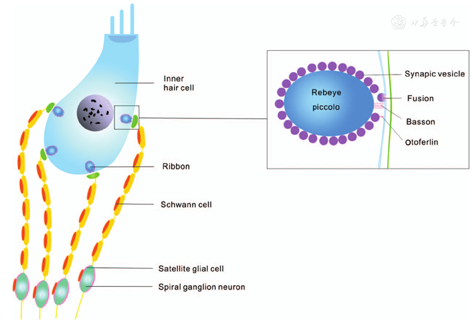
The ribbon is composed of ribeye proteins and piccolo proteins and is anchored to the release site of membrane by bassoon in the IHC, and is surrounded by glutamate-containing synaptic vesicles.[16] Synaptic vesicle fuse with the presynaptic membrane and release glutamate into the synaptic cleft, which then generates an AP at the postsynaptic membrane.[17]
According to the differences in anatomy, glutamate responsiveness, myelination, and synapse number, mammalian SGNs are mainly categorized into type-I and type-II SGNs. Type-I SGNs send myelinated afferent nerve fibers (ANFs) to the organ of Corti, where they contact with IHCs and form IHC-SGN synaptic connections. Type-II SGNs send unmyelinated ANFs to the organ of Corti, where they exhibit abundant branches and contact with outer hair cells. Type-I and type-II SGNs constitute ~95% and ~5% of all ANFs, respectively. Recent research using single cell RNA sequencing has proposed there to be three molecular subtypes of type-I SGNs according to gene expression pattern, but the differences of roles among these subtypes are still unclear.[18]
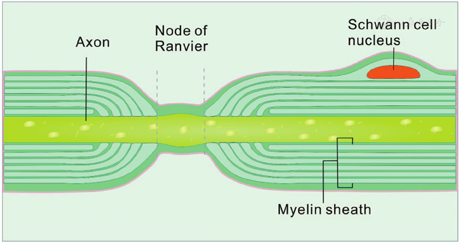
Type-I ANFs are myelinated projections covered by Schwann cells that have type-I SGN terminals that are covered by satellite glial cells. The unmyelinated portion of ANFs, between two Schwann cells, is connected by the nodes of Ranvier (Fig. 2). The nodes of Ranvier are completely separated from each other and rich in ion channels that are responsible for the rapid and efficient propagation of APs.[19,20,21] The myelinating glial cells, which are Schwann cells in the auditory system, engage in complex interactions with axonal segments and Schwann cells wrap around the axonal segments leaving the axolemma relatively uncovered at the regularly spaced nodes of Ranvier.[22]
A multitude of animal experiments have revealed that cochlear ribbon synapses are more vulnerable than hair cells to noise or aging-induced injury,[23] that is to say, it is the connections between SGNs and IHCs that degenerate first.[8,24,25] The primary neural degeneration or partial de-innervation from IHCs has potential effects on hearing function that are not reflected by standard threshold metrics.[24] Moderate noise exposure, aging, as well as ototoxic drugs can result in HHL.
Noise exposure: The pathophysiological alterations in synapses can be detected instantly after noise exposure and deteriorates with increasing post-exposure time.[26] Temporary threshold shift (TTS) emerges after continuous exposure at lower noise levels and gradually recovers.[8,24] In guinea pigs, a 2-hour exposure to 103 dB sound pressure level (SPL) contributed to a TTS of 39.3 dB (4–32 kHz) within 24 hours accompanied by 45.1% initial synaptic loss.[2,6] In mice, 2-hour exposure to 100 dB SPL has been found to lead to a TTS of 20 to 40 dB that was associated with a 50% decrease in ribbon counts within 24 hours.[25] One resulting suggestion is that a threshold shift of 30 to 32 dB (16–40 kHz) 24 hours after 8–16 kHz octave band 109 dB SPL noise exposure may be a critical synaptopathic boundary.[27] Alterations in SGN AP which can be indicated by ABR wave-I amplitudes have been reported in mices and guinea pigs when normal presynaptic ribbons are damaged.[8,25,27,28] Nevertheless, whether or not synaptopathy occurs after noise exposure depends on different noise exposure levels and durations. In TTS accompanied by cochlear synaptopathy, it is likely that the behavioral consequences of noise-induced synaptopathy are related with the loss of synapses, but also the malfunction of survived/repaired synapses after TTS.[24] It has been suggested that deficits in signal coding in noisy environments in animal models may be a result of the selective loss of low-spontaneous-rate auditory nerve fibers.[5] However, there is not yet extensive evidence to support this.
Aging: Synapses between IHCs and the auditory nerve are the most vulnerable elements to normal aging. Immunochemistry has revealed a progressive loss of the synapses puncta C-terminal binding protein 2 and gluA2 throughout the lifespan in mice.[29] Likewise, elderly people who complain about not understanding speech in noisy settings have been identified to have SIN deficits accompanied by normal audiometry.[30]
Furthermore, there has been detailed research involving molecular changes of cochlear synaptopathy in animal models. Cellular mechanistic studies of acquired synaptopathy have concentrated on candidate pathways[1] associated with glutamate excitotoxicity and calcium signaling.[31] Previous studies have reported a strong likelihood that glutamate excitotoxicity underlies the synaptic loss that leads to the hearing impairment and/or subsequent gradual neural degeneration.[31,32] The pathophysiological features of synaptopathy include a massive ion influx of sodium and potassium into afferent SGN terminals shortly after noise exposure, which cause acute neuronal swelling in ANF terminals; however, delayed Ca2+ influx can initiate a cascade of metabolic disturbance and ultimately rupture postsynaptic structures.[31,33,34] Recent studies have implicated T-type calcium channels rather than L-type calcium channels as playing an important role in noise-induced hearing loss.[35] Calcium overload could lead to an excessive release of glutamate into the synaptic clefts and damage the synaptic structures, and could also cause an accumulation of cytoplasmic reactive oxygen species that triggers mitochondria-mediated apoptotic and necrotic pathways.[36]
Disorders of auditory nerve function associated with HHL mainly occur at Schwann cell-myelinated auditory nerve fibers (formed by dendrites) and axons coursing centrally, which is also called myelin disorder. Detailed etiology is mainly pertinent to the following reasons. Exposure to loud sound induces deficits in AP propagation and conduction speed.[3,7] In animal models, noise exposure-induced morphological changes have been observed, including depletion of myelin sheath thickness and a series of anomalies in the heminode structure of the auditory nerve involving an increased distance between the nodes of Ranvier and juxtaparanodes and slightly retracted paranodes.[7] The conduction speed and shape of AP are likely to be affected by noise injury owing to the scattered distribution of ion channels in axolemma and loss of uniformity of axon diameter.[37] Electrophysiology in animal models has found that demyelination can adversely affect auditory neural synchrony, which has been ascribed to slight changes in intermodal length.[38] Myelin defects could also contribute to coding deficits, including temporal processing and auditory perception, which are critical for sound encoding.[2,4,38,39] Poorer perceptual abilities and impaired speech discrimination can also be detected in patients with auditory neuropathy. Noise exposure in mice (an octave-band noise of 8 to 16 kHz at 100 dB SPL for 2 hours, with both ears open) directly impairs threshold adaptation, but the preserved function of gain adaptation surprisingly aggravates coding deficits in loud environments.[38] Conversely, patients with Guillain-Barré syndrome have been found to have sensorineural hearing loss, although the morbidity of hearing impairment is rare. Electrophysiological (ABR) and radiological (magnetic resonance imaging) changes in these patients with Guillain-Barré syndrome indicated that demyelination in the acoustic nerves, rather than axonal degeneration, was responsible for the sensorineural hearing loss.[40]
Research into the cellular mechanisms of demyelination in noise-induced HHL have primarily focused on Schwann cells.[7,9] Transient depletion of cochlear Schwann cells in a transgenic mouse model has been found to result in permanent heminodal disruption and auditory deficits that are characterized by normal auditory thresholds but with a reduced suprathreshold AP amplitude and increased SP/AP ratio, as well as an increased ABR latency.[9] Moreover, this study showed that the effects of noise and demyelination on HHL are additive.[9] In another study, a deficiency in the RNA splicing regulator Quaking, which is expressed in Schwann cells and satellite ganglion cells in the rodent and human cochlea, can result in demyelination and disruption of paranodal structures of the auditory nerve in adult mice.[7]
Synapse regeneration is a sophisticated process that allows reinnervation of IHCs with SGN terminals, reformation of presynaptic and postsynaptic puncta, and reorganization of neurotransmission and sound-evoked neural responses. For the rehabilitation of auditory function, newly regenerated synapses need to have a normal density, suitable localization, and specific spontaneous firing properties.
Spontaneous repair or regeneration of cochlear synapses after injury has been observed, but is incomplete.[2,4,31,39] One study found that the spontaneous incomplete regeneration of cochlear synapses in noise-induced HHL may underlie the subsequent coding deficits, including temporal coding and intensity coding.[4]
Inhibition of glutamate excitotoxicity by the use of specific glutamate receptor antagonists might prevent cochlear synaptopathy and attenuate HHL.[41] Approaches targeting the 5'- adenosine monophosphate-activated protein kinase/kainic acid or N-methyl-D-aspartate glutamate receptor, including 6,7- dinitroquinoxaline-2,3-dione, kynurenate, and MK-801, are considered to be effective in the alleviation of SGN injury and synaptopathy, and hence the attenuation of HHL.[32,42] Calcium homeostasis also plays a significant role in synapse regeneration.[35,43] Inhibitors of T-type voltage-gated calcium channels have been shown to be effective against noise-induced hearing loss.[35] However, given the possible neurotoxicity of these compounds, clinical use of these inhibitors may be restricted in the near future.
Animal studies have revealed that neurotrophins may be promising in synapse regeneration owing to their broadly accepted role in preventing hearing loss.[44,45,46,47,48,49,50] One study showed that neurotrophin-3 (NT-3) overexpression in supporting cells may exert a significant effect on synapse regeneration after noise exposure in transgenic mice.[51] NT-3/tropomyosin receptor kinase C signaling has been identified as a potent therapeutic target in promoting synapse regeneration.[51] In recent work, exogenous NT-3 overexpression in the mouse cochlea by gene transfection through the round window before noise exposure has been found to be an effective therapeutic method against synaptopathy.[45,46,49] The safety and efficacy of NT-3 in humans have been confirmed in one report, which found that the adverse effects of NT-3 systemic administration are mild.[50]
Other endogenous trophic factors that have neuroprotective properties might also be helpful for synapse regeneration. Glial cell line-derived neurotrophic factor has been reported to provide protection and enhance axonal regeneration.[52,53] Its efficacy may rely on its ability to modulate calcium signaling, or even to reduce free radical generation and activate the antioxidant enzyme systems, which suppresses apoptosis and promotes neuronal survival.[53] Fibroblast growth factor 22 has also been reported to prevent cochlear synaptopathy against gentamycin-induced hearing loss.[54] Some intrinsic factors, such as insulin-like growth factor-1 and macrophage migration inhibitory factor, have been shown to be effective in synapse repair and regeneration.[55,56] The WW domain-binding protein 2, a pivotal molecule in hormonal signaling, has been identified as a potential therapeutic target.[33] Deficiency of WW domain-binding protein 2 protein can cause a primary defect at IHC afferent synapses. However, further investigations are required to better understand the roles of these factors in cochlear synapse regeneration.
No effective therapy for auditory nerve demyelination in clinical settings has yet been identified. However, the identification of auditory nerve demyelination has allowed targeted therapies to be developed and utilized in the experimental arena. Fortunately, accumulating evidence indicates that some molecules have the potential to curb demyelination. It is now well accepted that a series of cell signaling derivations from the axonlemma can exert a significant influence on myelination and Schwann cell function, which will now be briefly reviewed.
Nrg1/ErbB signaling plays a profound role during the development of Schwann cells and the myelination process.[57] The calcineurin-nuclear factor of activated T-cell signaling, which is essential for NRG/ErbB signaling, determines the neural crest diversification and Schwann cell differentiation.[58] Another in vivo study found that dysregulation in Notch signaling pathways, which controls the differentiation and proliferation of Schwann cells, induces myelin breakdown.[59] Consistent mitogen-activated protein kinase/extracellular-signal-regulated kinase activation in mature Schwann cells could induce consecutive myelination; furthermore, it can reverse the demye-lination that follows Shp2 and ErbB3 ablation.[60] Signal transducer and activator of transcription 3 activation is required for the long-term survival, maintenance, and repair of Schwann cells during the generation process of injured peripheral nerves.[61] Similarly, Sox2 can manipulate Schwann cells’ sorting after nerve injury in adult peripheral nerve system and promote the survival of satellite glial cells in vitro.[60,62] Reduced histone deacetylase 3 expression in Schwann cells results in severe neuropathies; histone deacetylase 3 controls the homeostatic properties of Schwann cells, which is essential for the stability of the myelin sheath.[63] Nectin-like 4 is responsible for appropriate axon-Schwann cell adhesion, myelin thickness, and the organization of the internodal territories, which are essential for orientating myelination and forming polarization during the regeneration after injury.[64] The extracellular matrix, including laminins and collagens, can regulate Schwann cell proliferation and survival, as reported recently.[65] However, the roles of these potential candidates in HHL are unknown and further investigations are required.
Patients with HHL have normal audiogram and hearing deficits in speech discrimination and intelligibility. The pathogenesis of HHL is very complex and relatively insidious. Although there are several diagnostic methods, there are no definite diagnostic criteria at present; it is therefore important to develop a set standard to diagnose HHL. No effective clinical treatment for HHL has yet been identified or developed, so its prevention is extremely important. High-risk groups such as musicians and soldiers should take certain hearing protection measures, such as using earplugs or noise-reducing earphones.
None.
DC and GJ retrieved the literature and wrote the manuscript. YN and YC designed, reviewed and modified the manuscript. All authors approved the final version of the manuscript.
This work was supported by the National Natural Science Foundation of China (No. 81771010, 81570911) and the Nature Science Foundation (No. 17ZR1404600) from Shanghai Science and Technology Committee, China.
The authors declare that they have no conflicts of interest.


