
Pancreatic ductal adenocarcinoma (PDAC) is a lethal, aggressive, and incurable disease. The patients with PDAC are often diagnosed at the advanced stage, leading to poor overall survival because of no current effective treatment. Further exploration of the mechanism is needed urgently to provide insights on the prevention, detection, or intervention of pancreatic cancer. Oncogenic KRAS and mutated tumor suppressor genes serve essential roles in PDAC tumorigenesis. Different groups of scientists indicated that yes-associated protein and transcriptional coactivator with PDZ-binding motif, which are the main effectors of the Hippo pathway, are the center in the development of PDAC. Here, we will focus on the recent advances of the molecular mechanisms of core components in the Hippo kinases cascade and discuss their clinical implications.



© 2020 Chinese Medical Association. Production and hosting by Elsevier B.V. This is an open access article under the CC BY-NC-ND license
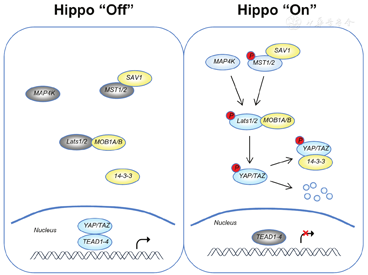
The Hippo pathway was initially discovered in the screen for tissue growth in Drosophila melanogaster. The core of the mammalian Hippo pathway consists of a kinase cascade and transcription coactivators (Fig. 1). Activation of large tumor suppressor kinase 1/2 (LATS1/2) and inactivation of yes-associated protein (YAP)/transcriptional coactivator with PDZ-binding motif (TAZ) represent the major transcriptional output of the Hippo pathway. Once activated, the Hippo pathway, mammalian STE20-like 1/2 (MST1/2) phosphorylate their adaptor protein salvador 1 (SAV1) and LATS1/2, enabling LATS1/2 to autophosphorylate at its activation loop.[1,2] MST1/2 also phosphorylate MOB kinase activator 1A/B (MOB1A/B) at threonine 35, which facilitates MOB1A/B to bind the autoinhibitory region of LATS1/2 and promotes LATS1/2 activation.[3] Acting parallel to MST1/2, mitogen-activated protein kinase kinase kinase kinase (MAP4Ks) can directly activate LATS1/2.[4] Activated LATS1/2, in turn, phosphorylate YAP and TAZ, leading to the cytoplasmic retention induced by 14-3-3 and degradation mediated by Skp, Cullin, F-box containing complex (SCF).[5,6,7,8,9] TEA-domain DNA-binding transcription factors (TEAD) family is essential in the YAP-dependent transcriptional output of the Hippo pathway in mammals.[9,10] Connective tissue growth factor (CTGF) and cysteine-rich angiogenic inducer 61 (CYR61) are the well known direct target genes of the YAP- TEAD complex.
Cancer originating from the pancreas includes exocrine tumors and endocrine tumors. Pancreatic cancer ranks the fourth leading cause of cancer-related deaths in both men and women in the United States, 2019.[11] And the overall 5-year survival rate is 9%.[11] The poor survival of patients with pancreatic cancer is large because of the high prevalence of advanced stage when diagnosed. The patients with advanced pancreatic cancer only had a median survival period was around 6.8 to 11.1 months when treated with first-line therapy.[12]
Pancreatic ductal adenocarcinoma (PDAC) is the most common type in pancreatic cancer, and it begins in the cells lining the pancreatic ducts or originates from the acinar cells.[13] The mature acinar cells transdifferentiate into ductal-like cells undergoing a reprogramming process named acinar-to-ductal metaplasia (ADM).[14] The ductal cell marker CK19 and pancreatic progenitor cell markers Pdx1 and Nestin can be expressed in acinar cells undergoing ADM. It is well established that acinar-to-ductal reprogramming is a vital precursor to pancreatic intraepithelial neoplasia (PanIN). PanIN is the putative progenitor to invasive pancreatic cancer.[15] Notably, pancreatic stellate cells (PSCs) serve as the crucial participants in pancreatic cancer.[16] In a healthy pancreas, the PSCs maintain quiescently. Once activated, PSCs turn to the myofibroblastic phenotype, have absent or remnant vitamin A cytoplasmic vesicles, and high expression levels of alpha-smooth muscle actin. The transformation from quiescent to activate in PSCs contributes to the increase in cell proliferation and migration.[16]
The Hippo pathway serves important regulatory functions in organ development, regeneration, stem cell biology, immunity, and tumorigenesis.[6,17,18,19,20,21,22] The several core members of Hippo signaling kinase cascade, LATS1/2, YAP, and TAZ in particular, have emerged as oncogenes or tumor suppressors in various cancer, such as non-small cell lung carcinoma, hepatocellular carcinoma, breast cancer, and prostate cancer.[18,19,22,23] Recent studies have implicated the Hippo pathway is increasingly recognized as a potent oncogenic signaling pathway in pancreatic cancer. Here, we summarize the role of the Hippo pathway in the initiation and development of pancreatic cancer.
The Hippo pathway is required in pancreas development.[24,25,26,27,28] TEAD1 and YAP activate key regulators of pancreatic progenitors.[26] Functions of Hippo signaling become active during pancreas secondary transition.[24,27]
Mst1/2 is the suppressor of cell proliferation in the pancreas. Deleting Mst1/2 in the pancreas of mice leads to the atrophic phenotype and the reduced pancreatic mass due to the dedifferentiation of ADM progress.[24,25] Pancreatic deletion of Mst1/2 or Lats1/2 results in the increased Yap/Taz expression and decreased the abundance of phosphor-YAP in a posttranslational manner.[24,25,28] During embryonic development, Lats1/2 suppress the nuclear factor-κB (NF-κB) signaling via controlling the subcellular localization of YAP/TAZ, thereby maintaining pancreatic progenitors to coordinate cell proliferation, cell differentiation, and epithelial morphogenesis.[28] As the downstream effector of Mst1/2 and Lats1/2, Yap repression is essential for acinar and endocrine differentiation.[25,28,29] YAP not only downregulated during endocrine differentiation,[29] but also is absent or weak expression in the endocrine compartment of the pancreas.[24] The inhibition of YAP enhances the differentiation of stem cell-derived insulinproducing beta cells, which are the potential and functional beta cells for therapies for diabetes.[29] Taken together, YAP serves a negative role in the regulation by Hippo signaling during the normal lineage differentiation and morphogenesis of pancreas development.
Interestingly, some researches indicated converse opinion on the role of YAP in pancreas development. One group reported that the deletion of Yap in mice from pancreatic epithelium showed no apparent difference in histology, pancreatic cell lineage markers, and glucose metabolism compared with the control group in genetically engineered mice.[30] The reasonable assumption is another factor(s) may compensate for the negative regulation in pancreatic development after deleting YAP. Moreover, another group reported that the stabilization of YAP is necessary for the endocrine specification and progenitor survival.[27] Sphingosine-1-phosphate (S1P), which is the sphingolipid metabolite, stabilizes and attenuates YAP through the G protein-coupled receptor (GPCR) S1PR2/Gαi subunits axis, which promote progenitor survival and endocrine cell specification.[27] These results were based on the organotypic cultures of embryonic pancreata,[27] which were different from other groups using genetically engineered mice models (GEMMs).[24,25] These findings showed that the relationship between the Hippo pathways and pancreatic development requires further study. To illustrate the role of YAP in the development of the pancreas, stage-specific overexpression or deletion of Yap in mice is 1 potential solution.
There is no doubt that the Hippo pathway contributes to the tumor progression of PDAC. The components of the Hippo pathway serve as prognostic markers of survival in patients with PDAC, such as YAP, MAP4K4, and CTGF.[30,31,32,33,34,35,36,37,38,39] The hyperactivity and increased-expression of YAP are associated with poorer survival of patients with PDAC.[38] Several studies confirmed that YAP and TAZ are the oncogenic genes in pancreatic cancer. The knockdown or knockout of either one gene inhibits the progression of pancreatic cancer, such as cell growth, migration, invasion, and Epithelial-mesenchymal transition (EMT).[39,40]
Notably, the expression of YAP and TAZ are different in pancreatic cancers and normal tissues. The first feature of the differences is the expression level. YAP and TAZ can be detected in normal human pancreas (centroacinar and ductal cells), but they are absent or low expressions in the acinar cells or islets of Langerhans.[24,30,34,40] Compared with normal pancreas, YAP and TAZ show elevated expression levels in the diseased pancreas.[30,33,34,35,39,40] The expression pattern is the second feature. The high expression of YAP and TAZ is detectable in the early stage of pancreatic cancers, such as pancreatitis, ADM lesions, and PanIN.[34,40] But YAP and TAZ show downregulation in advanced pancreatic cancer samples compared with the samples of early stage.[39,40] Loss of Yap1/Taz has significantly impaired ADM formation.[40] Apart from different expression levels, the cellular localization of YAP and TAZ differs in PDAC and normal pancreas. They shift from a nuclear/cytoplasmic localization pattern in normal pancreas[34,40] to a more prominent nuclear localization pattern in cancer tissues,[33,34,36] which indicates low phosphorylation of YAP/TAZ and high transcription level of TEAD family.
YAP and TAZ are the classic effectors of the Hippo pathway, and they are regulated by a multitude of upstream signals. Physical signals such as cell density, stiffness, and cell attachment regulate YAP and TAZ activity in LATS-dependent or LATS-independent manner. Though GPCRs, soluble factors such as lysophosphatidic acid (LPA), S1P, hormones and Wnt ligands regulate YAP and TAZ activation and stabilization. Stress signals such as energy stress, endoplasmic reticulum stress, and hypoxic stress inhibit YAP and TAZ.[41] In PDAC, YAP and TAZ are the central downstream effectors of various pathways (Fig. 2).
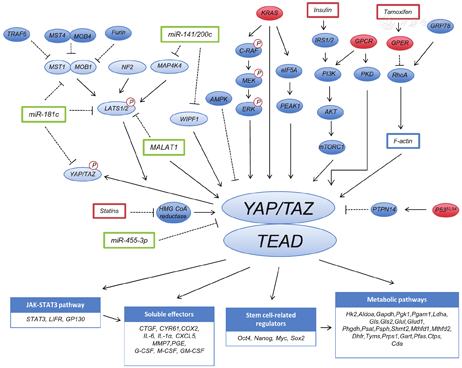
Activating mutations in KRAS play an essential role in PDAC initiation and maintenance. Many studies confirmed the importance of KRAS mutations in the development of PDAC, especially in ADM and PanIN. KrasG12D plays an important role in the initiation and maintenance of pancreatic tumor.[42,43,44] In addition to Kras mutants, pancreatitis is a well established risk factor for PDAC in humans. The cooperation between KRAS mutant and pancreatitis facilitates pancreatic tumor progression.[14,45,46] On the one hand, chronic pancreatitis is essential for KRAS-induced pancreatic cancer via inducing ADM and PanIN.[14,45] On the other hand, oncogenic KRAS mutation synergizes with inflammatory response to promote PanIN progression.[46]
Yap is a critical oncogenic Kras effector in PDAC, and it maintains Kras-mutant tumor through cell proliferation, stromal response, and metabolic homeostasis.[30,40,47] Oncogenic activation of the KRAS mutant leads to the high activity of YAP and TAZ, which is required for KRASG12D/pancreatitis-induced ADM and PanIN in mice.[34,40] Hence, YAP and TAZ are suggested to function at the early stage of pancreatic cancer because reprogramming form acinar cells to ductal-like cells is crucial in the initiation of PDAC. However, other groups argued that Yap is dispensable for ADM induced by oncogenic Kras or pancreatitis, while Yap is necessary for PanIN progression into PDAC.[30,47] The controversy might due to different constructs used to generate GEMMs. YAP and TAZ were reported to function at early stage of PDAC using GEMMs carrying deletion of both Yap and Taz[40] and GEMMs with limited potentiality to develop as invasive PDAC.[34,44] And their promoter of Cre constructs were Pdx1.[34,40] YAP and TAZ were suggested to play an important role in late stage using GEMMs carrying single deletion of Yap or Taz.[30,47] One research used p48 as the Cre promoter,[30] the other research developed recombination system of Flp-FRT and Cre-loxP.[47] The above information indicated that different constructs to generate GEMMs might lead to different conclusions.
Yap plays an important role in activation of Kras and the mutation of tumor suppressor genes. The patients with PDAC frequently carry activated KRAS mutations and inactivating mutations of tumor suppressor genes, such as CDKN2A, TP53, and/or SMAD4.[48] Activating Kras mutation alone or with any mutated tumor suppressor genes is sufficient to initiate PDAC based on GEMMs.[14,30,44,49,50] For example, the cooperation of p53 deficiency and KRASG12V induces metastatic PDAC.[14] Yap deletion blocked the Kras/Kras: Trp53-mediated tumor progress in PDAC, which prevent progression from PanIN to PDAC.[30,47] Because Yap is critical for the proliferation of pancreatic ductal cells and is essential for stromal response in pancreatic epithelial cells of Kras/Kras:Trp53 mutant mice.[30] Deletion of Yap/Taz in the KrasG12D background reduces the oncogenic Ras activity,[40] and RAS phosphorylates YAP at Ser367.[30] The observations suggest that a positive feedback loop exists between YAP and RAS facilitating PDAC progression. Therefore, the crucial role of Yap/Taz in PDAC maintenance is clear, even though more investigations are required to elucidate the role of Yap/Taz in different stages of PDAC.
In PDAC, mutated Kras upregulates many genes that also affect the activity of the Hippo pathway. Two of these upregulated genes, eukaryotic translation initiation factor 5A (eIF5A) and pseudopodium enriched atypical kinase 1 (PEAK1), drive PDAC pathogenesis by the RhoA/ROCK signaling and inhibiting YAP/TAZ activity via mediation with stem cell-related transcription factor Oct4, Nanog, Myc, and TEAD.[51,52]
Yap exerts functions independent of Kras mutation in PDAC. Activation of YAP/TAZ is sufficient to induce ADM,[40] but the YAP activation alone (without Kras) seems to be insufficient to induce PDAC.[24,25] And in the murine model of Kras-induced PDAC, the inactivation of mutated Kras still drives tumor regression,[42,43,53] which means there is a bypass mechanism of oncogenic Kras addiction in PDAC. These results collectively showed that other partners are essential for Yap to maintain pancreatic tumor in the escape from Kras-dependent mechanism. The activity of E2F transcription factors supports the Yap1/Tead2 complex in tumor regression by activating a cell cycle and DNA replication after KrasG12D extinction.[53]
The p53 transcription factor is the tumor suppressor in pancreatic cancer. Besides of the Kras/p53-induced change of YAP activity, p53 alone could regulate YAP. p53 contains 2 transcriptional activation domains, one is p5325,26, the other is p5353,54.[54] p5353,54 reduces YAP activity via hyperactive PtPn14.[55] PTPN14 negatively regulates the transcriptional coactivator activity of YAP through direct interaction.[55,56]
LATS1/2 lay the upstream kinases to regulate YAP in PDAC. Both caerulein-induced pancreatitis and KrasG12D-induced ADM lesions showed low expression of phosphorylated Lats1, which is consistent with the dephosphorylation of Yap.[40] Interestingly, LATS1 was observed in low expression level in human pancreatic cancer tissues while YAP was upregulated.[57] Long non-coding RNA metastasis-associated lung adenocarcinoma transcript 1 promoted the proliferation of pancreatic cancer cells containing KRASG12D through downregulation of LATS1 and upregulation of YAP.[57,58] The effect of LATS in the upstream of YAP requires further study. One hypothesis is that YAP is regulated in a LATS-independent manner in pancreatic cancer. Three different groups reported that the phosphorylation and nuclear localization of YAP are regulated by LATS independently.[59,60,61] In the absence of LATS, an ITGA3/FAK/CDC42/PP1A signaling axis promotes proliferation by driving YAP to nuclear, which consequently activates mammalian target of rapamycin (mTOR) signaling and inhibits differentiation and apoptosis.[60] For breast cancer, both a myocardin-related transcription factor and PIK3CA/PIK3CB could regulate YAP/TAZ in a LATS-independent manner.[59,61] Subsequent experiments are needed to confirm the hypothesis.
NF2/Merlin is the key player in the Hippo pathway, which forms the complex with Kibra/WWC1 and FRMD to interact with LATS1/2 directly. The interaction facilitates the phosphorylation of LATS1/2 via the MST1/2-SAV1 complex.[20,62,63] In pancreatic cancer, the over-expression of NF2 results in hypoactive TAZ via the limit increase of phosphorylated MST1/2 and LATS1, which indicates that NF2 is a negative regulator of the Hippo pathway.[33] The molecular actions explain lower expression NF2 and higher expression TAZ in the pancreatic cancer tissues compared with normal tissues.[33,64]
Other key regulators at the upstream of the Hippo pathway include MST1/2. The phosphorylation of MST1/2 leads to its activation, which can be enhanced by MST1/2 dimerization.[65,66] Hereafter, active MST1/2 phosphorylate SAV1 and MOB1A/B to recruit and phosphorylate LATS1/2.[3,20,67,68] Through the proteomic analyses toward pancreatic cancer progression, MST1 was identified as a potential biomarker for the preinvasive stage and expressed in a dynamic pattern during the PDAC development.[69] The interaction between MST1 and tumor necrosis factor (TNF) receptor-associated factor 6 (TRAF6) triggered the ubiquitination and degradation of MST1, which upregulates YAP activity in PDAC.[70] The MST1-MOB1 complex in pancreatic cancer is disassociated the assembly by MST4-MOB4 complex as 2 complexes (MST1-MOB4 and MST4-MOB1 complexes), which cause the inhibition of LATS and YAP phosphorylation.[71] The decreased expression level of MST1 does not only promote cell growth and migration via the Hippo pathway[70,71] but also associated with the chemoresistance against gemcitabine via MST1/cyclophilin D mitochondrial complexation.[72]
MAP3K3 (also known as MEKK3) is a member of the STE11 family belonging to the STE family, which contains the MST1/2 and MAP4Ks. Knockout MAP3K3 in pancreatic cancer cell lines reduces EMT and cell migration by disrupting the interaction between YAP/TAZ and the promoter region of target genes, after that downregulates of target gene expression.[73]
Pancreatic cancer cell lines express many GPCRs and agonists of GPCR. The combination of a GPCR agonist neurotensin and insulin drives dephosphorylation and nuclear localization of YAP, which increase expression of CTGF, CYR61, and CXCL5 in pancreatic cancer cells.[74] The upregulation of the above genes was abolished by PI3K inhibitors and protein kinase D (PKD) family inhibitors.[74] Statins, the specific inhibitors of 3-hydroxymethylglutaryl (HMG) CoA reductase, also blocked the effect of insulin/neurotensin on subcellular localization and transcriptional activity of YAP in a phosphorylation-independent manner.[75] Because of HMG CoA reductase is one of the critical components in mevalonate metabolism, the statin-induced inhibition on YAP activity under insulin and neurotensin treatment suggested the mevalonate pathway may act as upstream signal in GPCR-YAP axis in pancreatic cancer. Collectively, GPCRs regulate YAP and TAZ through PI3K, PKD and mevalonate pathway, but not the Hippo pathway.
G protein-coupled estrogen receptor (GPER, also known as GPR30) is a 7-transmembrane estrogen receptor that activates estrogen-induced secondary gene expression changes.[76] Apart from natural steroid estrogen (17β-estradiol), GPER activity is stimulated by the agonists named tamoxifen and fulvestrant, which are anti-hormonal therapeutic agents related to clinical medicine.[76,77,78,79,80] Tamoxifen inhibited cell differentiation and invasion via GPER signaling in PDAC. The deactivation of YAP was one of the effectors acted the downstream of GPER.[81] Also, tamoxifen reduced the percentage and invasive ability of macrophages around pancreatic cancer tissue, which indicated YAP involved in the PDAC microenvironment.[81] Glucoseregulated protein 78 kDa (GRP78) is a member of the Hsp70 heat shock protein family and may regulate GPCR trafficking and signaling in a chaperone-like role.[82] Cell surface GRP78 promoted cell motility and invasion of PDAC cells via the activation of YAP/TAZ in a Rho-dependent manner.[83]
MicroRNAs, which served as posttranscriptional regulators of gene expression, are the potential upstream mediators to YAP and TAZ in pancreatic cancer. There are many microRNAs that regulate YAP/TAZ directly in cancer.[84,85,86,87] Silencing of miR-455-3p increases gemcitabine resistance and promotes cell proliferation via directly upregulating TAZ in pancreatic cancer, while the low expression of miR-455-3p was showed in pancreatic cancer tissues compared with the healthy pancreas.[88] The miR-181c directly and negatively regulates the core components in the Hippo pathway (MST1, LATS2, MOB1, SAV1, pYAP, and pTAZ), leading to elevated cell survival and chemoresistance in pancreatic cancer via hyperactivated YAP/TAZ.[89] The decrease expression level of miR-141 in pancreatic cancer tissue indicates poor overall survival.[31] The miR-141 inhibits cell proliferation and invasion and enhances chemosensitivity by directly targeting and inhibiting MAP4K4 in pancreatic cancer.[31] Since MAP4K4 phosphorylates and inhibits YAP activity through LATS phosphorylation,[4,90] the repression of miR-141 on MAP4K4 may be responsible for YAP dephosphorylation and TEAD-induced transcription enhancement in pancreatic cancer. Moreover, the high CpG methylation of miR-141/200c in PDAC, which silences mircroRNA activity, enhances on YAP/TAZ activity via hyperactive Wiskott-Aldrich syndrome protein interacting protein family member 1.[91] According to the multidimensional and functional analysis of The Cancer Genome Atlas (TCGA) data, it is predicted that the miR-141-3p, miR-194-3p, miR-3613-5p, miR-148b-3p, and miR-590-3p can regulate YAP/TAZ transcriptional activity in PDAC.[84]
Transforming growth factor-β (TGF-β) plays an essential role in multiple physiological and pathological processes. Most ligands of TGF-β family signal function through serine/threonine kinase receptors and Smad proteins. The dysfunctional regulators in the TGF-β pathway promote pancreatic tumorigenesis.[13] Knockdown of YAP abolished TGF-β1-induced cell invasion and EMT of pancreatic cancer,[39] which indicated that the TGF-β1 pathway is the upstream signal to regulate the Hippo pathway. TGF-β1 is one of the candidate proproteins of Furin, which cleaves the carboxyl-terminal of specific basic amino acid motifs and activate various precursor proteins.[92] The researchers speculated that Furin promoted epithelial-mesenchymal transition of various pancreatic cancer cell lines via hyperactivity of YAP.[93]
Hippo pathway is reported to have crosstalk with several signaling pathways in pancreatic cancer, including the AMP-activated protein kinase (AMPK) signaling, the NF-κB signaling and hepatocyte growth factor (HGF)-mediated signaling. It is well established that activated AMPK phosphorylates YAP directly, and interrupts the YAP/TEAD-induced gene transcription.[94,95] In PDAC, resveratrol (trans-3,4′,5-trihydroxystilbene) inhibits cell proliferation and induces apoptosis via the increase of phosphorylated AMPK, which induces YAP dephosphorylation and detention.[96] TRAF6, which lies downstream of the TNF receptor and controls the initiation of the NF-κB pathway, promotes migration and colony formation of pancreatic cancer cells via YAP.[70] The interaction between TRAF6 and MST1 promoted the ubiquitination and degradation of MST1, which indicated that TRAF6-regulated YAP via MST1.[70] PSCs secreted HGF, and pancreatic cancer cells express HGF receptor tyrosine kinase c-mesenchymal-epithelial transition factor (c- MET). Inhibiting the activation of c-Met represses the tumor cell proliferation and angiogenesis in pancreatic cancer.[97,98] HGF activates YAP activity by elevating its expression level and promoting its nuclear localization.[99]
YAP and TAZ involve in the tumorigenesis of pancreatic cancer through the transcriptional effector TEAD family,[30,32,33,40,52] which mediate vital transcriptional output of the Hippo pathway.[10] The downstream effectors of YAP/TAZ in PDAC include soluble effectors, JAK-STAT3 signaling, stem cell-related transcription factors, and metabolic genes (Fig. 2).
The downstream effectors of YAP-TEAD complex axis in PDAC contains CTGF, CYR61, matrix metalloproteinase 7 (MMP7), interleukin-6 (IL-6), IL-1α, cyclooxygenase 2 (COX2), CXCL5, granulocyte-macrophage colony stimulating factor (GM-CSF), GCSF, and M-CSF.[30,37,74] Part of downstream effectors of YAP encode secretory proteins to promote the proliferation of KRAS: TP53 mutant pancreatic ductal cells through the MAPK pathway.[30] Deletion of Yap in Kras mutant mice does not show significant changes in apoptosis or senescence via the caspase-3 detection and SA-β-gal staining.[30] These results are partially caused by the inflammatory response to YAP inactivation, which relieves immune suppression within the tumor microenvironment.[37] But 1 research argued that YAP-mediated tumorigenesis in pancreatic cancer-related to LPA receptor 3, not to the target genes of TEAD family (CTGF, CYR61, Sox4, ANKRD1, and ITGB2).[32]
YAP and TAZ directly controls JAK-STAT3 signaling in the KRASG12D-induced and pancreatitis-induced PDAC.[40] TEAD4 binds to the promoters of the transcription factor STAT3, and the cytokine receptors LIFR, and GP130, of which 3 are the JAK- STAT3 pathway genes. The activation of YAP and TAZ in the progression of PDAC results via hyperactivity of JAK-STAT3 pathway, such as the upregulation of STAT3, LIFR, and GP130.[40] That may be the reason for high expression level of IL-6 in pancreatic tumors.
Stem cell-related transcription factor Oct4, Nanog, Myc are reported being involved in the eIF5A/PEAK1 signaling regulation of YAP/TAZ activity.[52] When Yap ablation triggers metabolic stress via the downregulation of Myc, the upregulation of Sox2 compensates for Yap loss via the restoration of Myc and DNA demethylation.[47] In cooperation with Myc, Yap/Tead complex maintains the metabolic homeostasis in PDAC with Kras-mutant via regulating genes regulate glycolysis, glutamine metabolism, serine/folate/glycine metabolism, de novo nucleotide synthesis, and nucleotide salvage.[47]
The Hippo pathway plays an important role in tissue homeostasis, organ size control, and tumorigenesis.[6,17,18,19,20,21,22] As the main output of the Hippo pathway, YAP and TAZ play an oncogenic role in pancreatic cancer, which has been widely illustrated. However, the functions of other core components in Hippo pathway remain unclear in pancreatic cancer. For example, the role of MST1 in PDAC development is not elucidated.
The downregulation of YAP/TAZ/TEAD-induced transcription was proved to inhibit cell proliferation and migration, and induce apoptosis in pancreatic cancer.[96,100] Thus, most therapeutic strategies targeting the Hippo pathway in pancreatic cancer focus on YAP and TAZ. Because it is difficult to target transcription factors, recent findings imply novel insights to inhibit YAP/TAZ through upstream signals. Some clinical drugs were found the possibility of the treatment toward PDAC because of inhibiting YAP/TAZ, such as statins,[75,101,102,103] metformin,[104,105,106] the combination of marimastat (MMP inhibitor) and celebrex (COX2 inhibitor),[30] verteporfin (photosensitizer).[100] The inhibitors from other upstream signals also suppress the YAP/TAZ activity, including A66 (highly selective PI3K inhibitor),[74] CRT0066101 and kb NB 142-70 (PKD inhibitors),[74] C38 monoclonal antibody (targets at CS-GPR78).[83] In comparison with synthetic drugs, natural products were seldom reported to affect pancreatic cancer via the Hippo pathway, containing stiehopus japonieus acidic mucopolysaccharide (from sea cucumber),[36] resveratrol (a natural polyphenolic phytoalexin in plants),[96] and curcumin (a natural polyphenol from the Curcuma longa plant).[107] Given emerging potentials of YAP/TAZ inhibitors via recent findings, detailed information on regulating and regulated mechanisms in the Hippo pathway of pancreatic cancer is beneficial for therapeutic targets in clinical medicine.
None.
RX is supported by a PhD fellowship from the China Scholarship Council (CSC, 201706010323).
The authors declare no conflicts of interest.


