
Choosing a fetal growth standard or reference is crucial when defining normal and abnormal fetal growth. We reviewed the recently published standards and compared them with a customized fetal growth chart based on a nationwide population in China. There were substantial discrepancies in the fetal growth pattern, suggesting that these standards may not be applicable to Chinese fetuses. Developing a Chinese-specific standard may better meet our clinical requirements. We also discuss the steps to establish a Chinese fetal growth standard and the potential challenges, including regional disparities and accuracy of sonographic estimated fetal weight. Standardized ultrasound measurement protocol and the introduction of new ultrasonography technology may be helpful in developing a more precise standard than existing ones for the Chinese population.



Copyright © 2022 The Chinese Medical Association, published by Wolters Kluwer Health, Inc.
This is an open access article distributed under the terms of the Creative Commons Attribution-Non Commercial-No Derivatives License 4.0 (CCBY-NC-ND), where it is permissible to download and share the work provided it is properly cited. The work cannot be changed in any way or used commercially without permission from the journal.
Normal fetal growth is crucial to a healthy pregnancy and the long-term outcomes of the offspring. Abnormal fetal growth is associated with perinatal mortality and morbidity.1,2 It is also a risk factor for late-onset chronic diseases such as cardiovascular conditions and type 2 diabetes mellitus later in life.2 Abnormal fetal growth is usually diagnosed as small-for-gestational age (SGA), large-for-gestational age (LGA), fetal growth restriction (FGR), or macrosomia.3,4 SGA and LGA are commonly defined as fetal size , e.g., estimated fetal weight (EFW) < the 10th percentile or > the 90th percentile of a reference population.4 Therefore, the choice of a reference or standard will influence the proportion of fetuses that are identified as SGA or LGA and the accuracy of defining normal and abnormal fetal growth.5 Currently, there is no universally accepted growth chart, especially when it comes to different ethnicities and countries. The objective of this review is to compare the recently published fetal growth standards and answer the following two questions: (1) Is it necessary to develop a Chinese standard?, and (2) What are the necessary steps to establish our own standard?
Numerous fetal weight references and standards have been published since the 1980s.6,7,8,9,10,11,12,13,14,15,16,17,18,19,20 More recently, three contemporary, longitudinal growth charts were developed: the Eunice Kennedy Shriver National Institute of Child Health and Human Development (NICHD) Fetal Growth Standard, International Fetal and Newborn Growth Consortium for the 21st Century Fetal Growth Standard (INTERGROWTH-21st), and the World Health Organization (WHO) Fetal Growth Charts.18,19,20 These three standards share some common features. They were all based on multi-center, prospective studies which included low-risk pregnancies with a normal outcome, though the specific inclusion and exclusion criteria varied. To establish fetal growth trajectories, serial ultrasound measurements were taken, rigorous quality assurance and quality control were performed, and flexible analytic approaches were adopted.18,19,20
The main differences among the three fetal growth standards are presented in Table 1. One of the key differences lies in the philosophical belief on whether fetuses with various genetic and environmental backgrounds have the same normal fetal growth trajectory. The NICHD standards highlighted the racial/ethnic variation and established separate curves for four U.S. racial/ethnic groups (White, Black, Hispanic, and Asian).19 The INTERGROWTH-21st and WHO fetal growth studies started with the same premise that there would be a single curve for international use but concluded with different recommendations for clinical management.18,20 The WHO standard demonstrated variations between countries and suggested that growth charts should be adjusted and refined to fit diverse populations. However, INTERGROWTH-21st argued against using local references for a given country or ethnic group in multicultural societies18,21 despite its own data showing that under optimal nutritional and socioeconomic conditions, birthweight at term could differ by several hundred grams from country to country.22
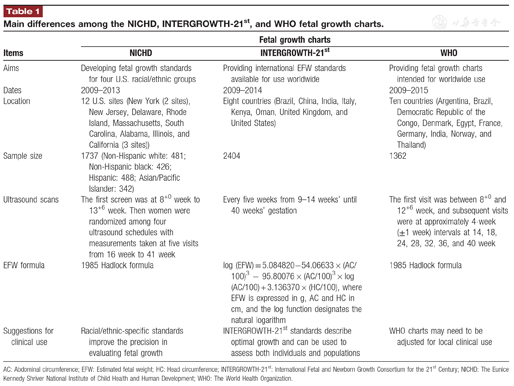
Main differences among the NICHD, INTERGROWTH-21st, and WHO fetal growth charts.
Main differences among the NICHD, INTERGROWTH-21st, and WHO fetal growth charts.
| Items | Fetal growth charts | ||
|---|---|---|---|
| NICHD | INTERGROWTH-21st | WHO | |
| Aims | Developing fetal growth standards for four U.S. racial/ethnic groups | Providing international EFW standards available for use worldwide | Providing fetal growth charts intended for worldwide use |
| Dates | 2009-2013 | 2009-2014 | 2009-2015 |
| Location | 12 U.S. sites (New York (2 sites), New Jersey, Delaware, Rhode Island, Massachusetts, South Carolina, Alabama, Illinois, and California (3 sites)) | Eight countries (Brazil, China, India, Italy, Kenya, Oman, United Kingdom, and United States) | Ten countries (Argentina, Brazil, Democratic Republic of the Congo, Denmark, Egypt, France, Germany, India, Norway, and Thailand) |
| Sample size | 1737 (Non-Hispanic white: 481; Non-Hispanic black: 426; Hispanic: 488; Asian/Pacific Islander: 342) | 2404 | 1362 |
| Ultrasound scans | The first screen was at 8+0 week to 13+6 week. Then women were randomized among four ultrasound schedules with measurements taken at five visits from 16 week to 41 week | Every five weeks from 9-14 weeks’ until 40 weeks’ gestation | The first visit was between 8+0 and 12+6 week, and subsequent visits were at approximately 4-week (±1 week) intervals at 14, 18, 24, 28, 32, 36, and 40 week |
| EFW formula | 1985 Hadlock formula | log (EFW) = 5.084820-54.06633 × (AC/100)3 - 95.80076 × (AC/100)3× log (AC/100) + 3.136370 × (HC/100), where EFW is expressed in g, AC and HC in cm, and the log function designates the natural logarithm | 1985 Hadlock formula |
| Suggestions for clinical use | Racial/ethnic-specific standards improve the precision in evaluating fetal growth | INTERGROWTH-21st standards describe optimal growth and can be used to assess both individuals and populations | WHO charts may need to be adjusted for local clinical use |
AC: Abdominal circumference; EFW: Estimated fetal weight; HC: Head circumference; INTERGROWTH-21st: International Fetal and Newborn Growth Consortium for the 21st Century; NICHD: The Eunice Kennedy Shriver National Institute of Child Health and Human Development; WHO: The World Health Organization.
Although INTERGROWTH-21st advocated a one-sizefits-all approach, there were doubts about its suitability for diverse populations. When applied to a Chinese population in Hong Kong(China), the INTERGROWTH-21st standard led to over-diagnosis of fetal smallness, particularly when using head circumference and femur length measures.23 On the contrary, when compared with the proportion identified as SGA in a Canadian population based on the Canadian reference, the proportion considered as SGA by INTERGROWTH-21st was lower.24 On the other hand, for LGA, the proportion was considerably higher for the Canadian population when adopting INTERGROWTH-21st standard.24 An Australian population-based study evaluated three international standards (Hadlock, INTERGROWTH-21st and WHO) and revealed significant differences in the SGA and LGA classifications, and poor performance of these standards in predicting adverse outcomes.25 Thus, the one-size-fits-all approach may result in misclassification of fetuses as SGA and LGA in local populations.
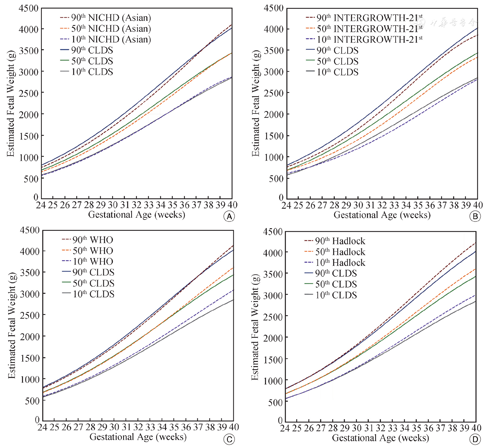
As well-controlled, prospectively measured fetal growth parameters in a representative sample of fetuses in China are still not available, it is challenging to ascertain if the growth of Chinese fetuses follows the global fetal growth curves. Therefore, we borrowed the adjustable global reference proposed by Zhang et al.26 to create a prototype of EFW standard for comparison and illustrative purposes. Specifically, Zhang et al. made a generic reference that could be easily adapted to local populations based on the fetal-weight reference developed by Hadlock et al. and the notion of proportionality proposed by Gardosi et al.9,26,27 Customization can be readily achieved by determining the mean birthweight and the standard deviation of birthweight at 40 weeks (40+0 to 40+6).26 Data from the China Labor and Delivery Survey (CLDS) was used in this customized curve. The CLDS was a multicenter, hospital-based cross-sectional survey conducted throughout China between March 1, 2015, and December 31, 2016. Hospitals with at least 1000 childbirths per year from 25 provinces and autonomous regions across the Chinese mainland were selected to describe the national labor and delivery situation.28,29 After excluding pregnancies with complications including but not limited to hypertensive disorders and diabetes, the mean birthweight of live-born singleton neonates with an Apgar score > 7 (n= 14,793) at 40 weeks in the CLDS was (3438 ± 493) g.30 The 10th, 50th, and 90th percentiles of the growth charts are presented in Figure 1 and Table 2,Table 3,Table 4. Upon comparing the prototype of Chinese fetal growth charts with the aforementioned commonly used standards, we could see the substantial differences in the EFW percentiles (Fig. 1). It should be noted that the differences may result from both the study population and the methodology to establish the charts. The customized curve based on the CLDS data is only an interim step towards better Chinese-specific growth charts. Additionally, the comparison among the curves was constrained by the lack of complete data from other studies. No formal statistical testing could be possible. Therefore, graphical presentation of weight percentiles for visual inspection was adopted in this review and the comparison between curves can only provide a preliminary observation and suggestion, rather than a definite justification.
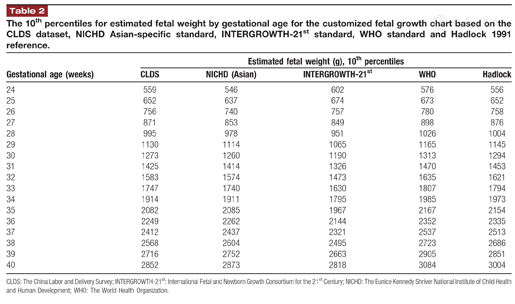
The 10th percentiles for estimated fetal weight by gestational age for the customized fetal growth chart based on the CLDS dataset, NICHD Asian-specific standard, INTERGROWTH-21st standard, WHO standard and Hadlock 1991 reference.
The 10th percentiles for estimated fetal weight by gestational age for the customized fetal growth chart based on the CLDS dataset, NICHD Asian-specific standard, INTERGROWTH-21st standard, WHO standard and Hadlock 1991 reference.
| Gestational age (weeks) | Estimated fetal weight (g), 10th percentiles | ||||
|---|---|---|---|---|---|
| CLDS | NICHD (Asian) | INTERGROWTH-21st | WHO | Hadlock | |
| 24 | 559 | 546 | 602 | 576 | 556 |
| 25 | 652 | 637 | 674 | 673 | 652 |
| 26 | 756 | 740 | 757 | 780 | 758 |
| 27 | 871 | 853 | 849 | 898 | 876 |
| 28 | 995 | 978 | 951 | 1026 | 1004 |
| 29 | 1130 | 1114 | 1065 | 1165 | 1145 |
| 30 | 1273 | 1260 | 1190 | 1313 | 1294 |
| 31 | 1425 | 1414 | 1326 | 1470 | 1453 |
| 32 | 1583 | 1574 | 1473 | 1635 | 1621 |
| 33 | 1747 | 1740 | 1630 | 1807 | 1794 |
| 34 | 1914 | 1911 | 1795 | 1985 | 1973 |
| 35 | 2082 | 2085 | 1967 | 2167 | 2154 |
| 36 | 2249 | 2262 | 2144 | 2352 | 2335 |
| 37 | 2412 | 2437 | 2321 | 2537 | 2513 |
| 38 | 2568 | 2604 | 2495 | 2723 | 2686 |
| 39 | 2716 | 2752 | 2663 | 2905 | 2851 |
| 40 | 2852 | 2873 | 2818 | 3084 | 3004 |
CLDS: The China Labor and Delivery Survey; INTERGROWTH-21st: International Fetal and Newborn Growth Consortium for the 21st Century; NICHD: The Eunice Kennedy Shriver National Institute of Child Health and Human Development; WHO: The World Health Organization.
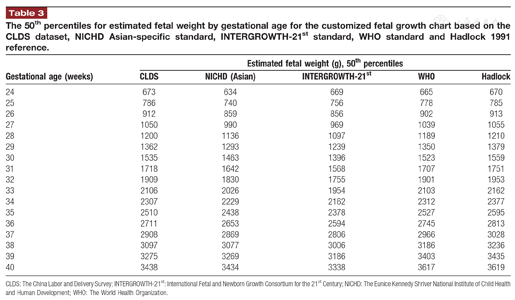
The 50th percentiles for estimated fetal weight by gestational age for the customized fetal growth chart based on the CLDS dataset, NICHD Asian-specific standard, INTERGROWTH-21st standard, WHO standard and Hadlock 1991 reference.
The 50th percentiles for estimated fetal weight by gestational age for the customized fetal growth chart based on the CLDS dataset, NICHD Asian-specific standard, INTERGROWTH-21st standard, WHO standard and Hadlock 1991 reference.
| Gestational age (weeks) | Estimated fetal weight (g), 50th percentiles | ||||
|---|---|---|---|---|---|
| CLDS | NICHD (Asian) | INTERGROWTH-21st | WHO | Hadlock | |
| 24 | 673 | 634 | 669 | 665 | 670 |
| 25 | 786 | 740 | 756 | 778 | 785 |
| 26 | 912 | 859 | 856 | 902 | 913 |
| 27 | 1050 | 990 | 969 | 1039 | 1055 |
| 28 | 1200 | 1136 | 1097 | 1189 | 1210 |
| 29 | 1362 | 1293 | 1239 | 1350 | 1379 |
| 30 | 1535 | 1463 | 1396 | 1523 | 1559 |
| 31 | 1718 | 1642 | 1568 | 1707 | 1751 |
| 32 | 1909 | 1830 | 1755 | 1901 | 1953 |
| 33 | 2106 | 2026 | 1954 | 2103 | 2162 |
| 34 | 2307 | 2229 | 2162 | 2312 | 2377 |
| 35 | 2510 | 2438 | 2378 | 2527 | 2595 |
| 36 | 2711 | 2653 | 2594 | 2745 | 2813 |
| 37 | 2908 | 2869 | 2806 | 2966 | 3028 |
| 38 | 3097 | 3077 | 3006 | 3186 | 3236 |
| 39 | 3275 | 3269 | 3186 | 3403 | 3435 |
| 40 | 3438 | 3434 | 3338 | 3617 | 3619 |
CLDS: The China Labor and Delivery Survey; INTERGROWTH-21st: International Fetal and Newborn Growth Consortium for the 21st Century; NICHD: The Eunice Kennedy Shriver National Institute of Child Health and Human Development; WHO: The World Health Organization.
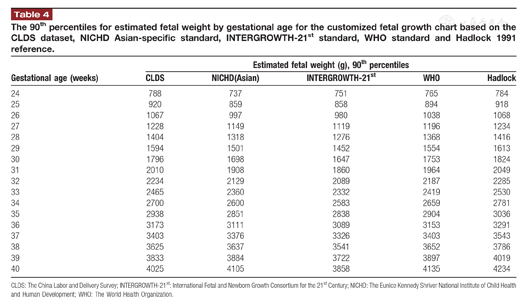
The 90th percentiles for estimated fetal weight by gestational age for the customized fetal growth chart based on the CLDS dataset, NICHD Asian-specific standard, INTERGROWTH-21st standard, WHO standard and Hadlock 1991 reference.
The 90th percentiles for estimated fetal weight by gestational age for the customized fetal growth chart based on the CLDS dataset, NICHD Asian-specific standard, INTERGROWTH-21st standard, WHO standard and Hadlock 1991 reference.
| Gestational age (weeks) | Estimated fetal weight (g), 90th percentiles | ||||
|---|---|---|---|---|---|
| CLDS | NICHD(Asian) | INTERGROWTH-21st | WHO | Hadlock | |
| 24 | 788 | 737 | 751 | 765 | 784 |
| 25 | 920 | 859 | 858 | 894 | 918 |
| 26 | 1067 | 997 | 980 | 1038 | 1068 |
| 27 | 1228 | 1149 | 1119 | 1196 | 1234 |
| 28 | 1404 | 1318 | 1276 | 1368 | 1416 |
| 29 | 1594 | 1501 | 1452 | 1554 | 1613 |
| 30 | 1796 | 1698 | 1647 | 1753 | 1824 |
| 31 | 2010 | 1908 | 1860 | 1964 | 2049 |
| 32 | 2234 | 2129 | 2089 | 2187 | 2285 |
| 33 | 2465 | 2360 | 2332 | 2419 | 2530 |
| 34 | 2700 | 2600 | 2583 | 2659 | 2781 |
| 35 | 2938 | 2851 | 2838 | 2904 | 3036 |
| 36 | 3173 | 3111 | 3089 | 3153 | 3291 |
| 37 | 3403 | 3376 | 3326 | 3403 | 3543 |
| 38 | 3625 | 3637 | 3541 | 3652 | 3786 |
| 39 | 3833 | 3884 | 3722 | 3897 | 4019 |
| 40 | 4025 | 4105 | 3858 | 4135 | 4234 |
CLDS: The China Labor and Delivery Survey; INTERGROWTH-21st: International Fetal and Newborn Growth Consortium for the 21st Century; NICHD: The Eunice Kennedy Shriver National Institute of Child Health and Human Development; WHO: The World Health Organization.
The NICHD Asian-specific standard performed closely at the 10th percentile to our Chinese curve but differed at the 50th and 90th percentiles (Fig. 1A). When compared with the INTERGROWTH-21st and WHO standards, neither international chart resembled our curve. The 10th, 50th, and 90th percentiles of the INTERGROWTH-21st standard were consistently lower than those in our local reference (Fig. 1B). In the third trimester, the 10th percentile of the WHO standard was much higher than that determined in our population (Fig. 1C). We also compared our curve with the Hadlock 1991 reference and found that our curve was consistently lower than the Hadlock curve, which was based on a White population in the U.S. (Fig. 1D).9
Collectively, it is imprecise to simply apply these existing standards or references to the Chinese population. Using country as a proxy for the local ethnic mix has been found to be much more important than other variables.26 Given these discrepancies between the study population in the universal standards and our own population, we suggest that a national fetal growth standard may be constructed for local use.
In the past two decades, several fetal growth charts have been developed for the Chinese population.31,32,33,34,35,36,37,38,39,40,41 Some of them were created especially for twins31,32 or for growth velocity trajectories,33 which are beyond the scope of our review. A comparison of eight other charts is presented in Table 5. Of these eight, two were based on a retrospective design,34,41 which may be limited by selection bias. Five studies collected data prospectively,35,36,38,39,40 but four of them used cross-sectional data that included only one ultrasound examination at a random gestational age,36,38,39,40 which can only indicate the size rather than the growth of a fetus. Only the prospective fetal growth standards created by Xu et al.35 used longitudinal measurements. They created both unconditional (cross-sectional) and conditional (longitudinal) standards for use in an ethnic Chinese population, but they did not assess their performance in detecting adverse birth outcomes.35 Furthermore, their curves were based on a population living in Singapore, where the environmental conditions are not the same as those in China. While three charts were developed from multi-center studies,37,38,40 two of them were derived from a local population in a specific region or province, which may be insufficient to represent the general Chinese population.37,38 The remaining one was conducted in 14 tertiary hospitals throughout the country.40 Nevertheless, the distribution of observations across the reference ranges was uneven in this study, which may impact the quality of data. As such, we suggest that a national fetal growth standard should be derived from a prospective, multi-center, and longitudinal study that takes geographic regions into account.
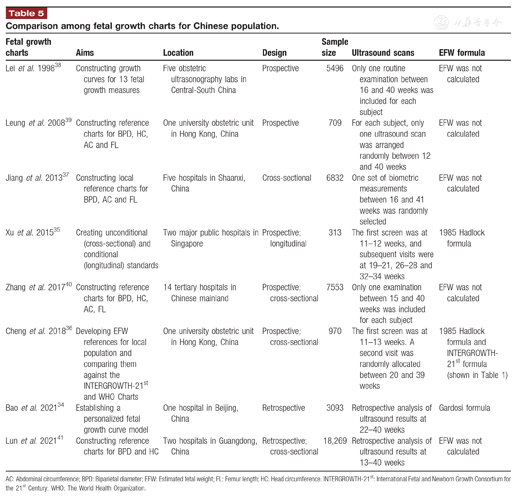
Comparison among fetal growth charts for Chinese population.
Comparison among fetal growth charts for Chinese population.
| Fetal growth charts | Aims | Location | Design | Sample size | Ultrasound scans | EFW formula |
|---|---|---|---|---|---|---|
| Lei et al. 199838 | Constructing growth curves for 13 fetal growth measures | Five obstetric ultrasonography labs in Central-South China | Prospective | 5496 | Only one routine examination between 16 and 40 weeks was included for each | EFW was not calculated |
| Leung et al. 200839 | Constructing reference charts for BPD, HC, AC and FL | One university obstetric unit in Hong Kong, China | Prospective | 709 | subject For each subject, only one ultrasound scan was arranged randomly between 12 and 40 weeks | EFW was not calculated |
| Jiang et al. 201337 | Constructing local reference charts for BPD, AC and FL | Five hospitals in Shaanxi, China | Cross-sectional | 6832 | One set of biometric measurements between 16 and 41 weeks was randomly selected | EFW was not calculated |
| Xu et al. 201535 | Creating unconditional (cross-sectional) and conditional (longitudinal) standards | Two major public hospitals in Singapore | Prospective; longitudinal | 313 | The first screen was at 11-12 weeks, and subsequent visits were at 19-21, 26-28 and 32-34 weeks | 1985 Hadlock formula |
| Zhang et al. 201740 | Constructing reference charts for BPD, HC, AC, FL | 14 tertiary hospitals in Chinese mainland | Prospective; cross-sectional | 7553 | Only one examination between 15 and 40 weeks was included | EFW was not calculated |
| Cheng et al. 201836 | Developing EFW references for local population and comparing them against the INTERGROWTH-21st and WHO Charts | One university obstetric unit in Hong Kong, China | Prospective; cross-sectional | 970 | for each subject The first screen was at 11-13 weeks. A second visit was randomly allocated between 20 and 39 weeks | 1985 Hadlock formula and INTERGROWTH- 21st formula (shown in Table 1) |
| Bao et al. 202134 | Establishing a personalized fetal growth curve model | One hospital in Beijing, China | Retrospective | 3093 | Retrospective analysis of ultrasound results at 22-40 weeks | Gardosi formula |
| Lun et al. 202141 | Constructing reference charts for BPD and HC | Two hospitals in Guangdong, China | Retrospective; cross-sectional | 18,269 | Retrospective analysis of ultrasound results at 13-40 weeks | EFW was not calculated |
AC: Abdominal circumference; BPD: Biparietal diameter; EFW: Estimated fetal weight; FL: Femur length; HC: Head circumference. INTERGROWTH-21st: International Fetal and Newborn Growth Consortium for the 21st Century; WHO: The World Health Organization.
Before discussing how to construct our own standard, it is critical to draw a distinction between fetal growth standards and fetal growth references. References are descriptive charts based on populations that include both low-and high-risk pregnancies with both normal and abnormal perinatal outcomes. On the other hand, standards are normative charts based on low-risk pregnancies with a normal outcome.3,21,42 A standard may have more clinical utility for a country than a reference, because it describes how fetuses should grow when nutritional and environmental conditions are optimal.42
On the basis of this definition, a crucial step in creating a national fetal growth standard is to select healthy pregnant women who are at low risk for adverse maternal and perinatal outcomes. The standard should be derived from a prospective, multi-center study that covers most areas of China. All centers should be under the supervision of an ultrasound quality-control center and a data management center. The sonographers participating in the study need to be trained and certified, and have their scans periodically assessed for quality control. Longitu-dinal data collection with repeated measurements is required to study true fetal growth. It is important to collect a validation dataset concurrently. Lastly, advanced statistical methodology is indispensable for appropriate data analysis.
Two main challenges are envisaged while constructing a Chinese fetal growth standard. First, the regional disparities in birthweight are substantial. According to the data from the CLDS, the mean birthweight at 40 weeks varied from 3276 g in Yunnan Province to 3538 g in Heilongjiang Province. In addition, differences were also observed between rural and urban areas and inland and coastal regions.43,44,45 Both environmental factors (such as maternal nutrition status and perinatal health care) and genetic backgrounds may have contributed to these regional disparities.43,44 Consequently, the national chart may need adjustment and refinement to increase their diagnostic and predictive performance. Although separate fetal growth standards for different regions might capture the growth patterns more precisely, the benefit must be balanced with the costs. The development and application of a set of weight charts will be laborious and expensive. With advanced computer programming, an adjustable standard such as the one proposed by Zhang et al.26 may be a reasonable solution.
Challenge can also be expected in terms of the accuracy of sonographic EFW, particularly in cases of suspected LGA in the third trimester.46 Inaccuracy of fetal weight estimation may be attributed to several causes, including systematic and random errors, combining two-dimensional (2D) measures to approximate three-dimensional (3D) fetal volume, and utilizing fetal volume to estimate fetal weight.42
Sonographic measurement errors and inter-and intraobserver variability account for the majority of systematic and random errors, which may be reduced by standardization, rigorous training and quality control.47 In addition to the inherent random errors, numerous maternal and fetal factors may affect the precision of sonographic EFW, including maternal body mass index, gestational age, parity, maternal diabetes, amniotic fluid volume, fetal presentation, and fetal sex.48,49 However, a study analyzed over 9000 sonographic fetal weight estimations and concluded that although some of these factors significantly affected EFW, their impact was of questionable clinical value since only up to 10% of the systematic errors could be attributed to these variables.48
The accuracy of fetal weight estimation equations is another concern. In 1984 and 1985 Hadlock et al. introduced an algorithm combining measurements of fetal head circumference (HC), biparietal diameter (BPD), femur length (FL) and abdominal circumference (AC) for weight estimation.50,51 Since then, various new estimation models have been developed. Nevertheless, the algorithm described by Hadlock et al. remains the most accurate prediction of fetal weight.52 For fetuses suspected to be SGA, Hadlock’s AC-BPD-FL function provided an accurate estimation for fetuses with asymmetric growth (HC/AC ratio > 95th percentile) before 34 weeks’ gestation.53 While for other subgroups with symmetric growth or beyond 34 weeks’ gestation, subgroup-specific models may enhance the accuracy.53 For instance, among fetuses with suspected SGA beyond 34 weeks’ gestation, the model proposed by Scott et al. performed better than others if the presence of a brain-sparing effect was identified.53,54 Likewise, Hadlock’s formula remained the top choice for LGA detection.52,55,56 It has been suggested that the accuracy of fetal weight estimation may have reached a maximum using traditional biometric parameters.57 Significant advances can probably only come from new ultrasonography technology. For example, several studies have demonstrated that soft tissue measurements and 3D ultrasonography were promising for weight assessment in macrosomia.58,59
Measurement of soft-tissue thickness (STT), involving adipose tissue plus lean mass, has shown an advantage over conventional biometric parameters in weight prediction.60,61,62 Most of the conventional measurements do not account for increased soft tissue mass, which may give rise to an underestimation of fetal weight.60 In addition, measurement of mid-thigh STT demonstrated its superiority over head measurements when the fetal head is in a low position in the pelvis.60 Moreover, rather than assessing circumferences, this approach measures linear parameters, which are more easily measured in obstetric practice.60 Scioscia et al. reported the linear measurement of mid-thigh STT and developed a new formula that had an absolute mean error of < 15% in 97% of cases.60 Abuelghar et al.61 validated Scioscia’s formula and proposed a modified one, both of which were considered equally efficient in calculating true fetal weight. For macrosomia or diabetic gestations, the utility of STT was valuable.62,63 Garabedian et al.63 showed that soft tissue in the upper arm had the best area under receiver operating characteristic (AUROC) value (0.855) along with good sensitivity and specificity (85.7% and 80.0%, respectively) for detecting macrosomia in pregnancies complicated by diabetes.
Fractional limb volume (FLV), measured by 3D ultrasound technology, can also reflect soft tissue development.64 In 2001, Lee et al. introduced the concept of FLV, which provided a new way of evaluating soft tissue for weight prediction.65 Since then, numerous studies have shown that a combination of 2D and 3D parameters can improve the precision of EFW.64,66,67,68 During the second and third trimesters of pregnancy, incorporation of 3D data, such as fractional arm volume (AVol) or fractional thigh volume (TVol), into estimation models reduced the random error to 6.6%.66 By comparison, the random errors of the original Hadlock model and a modified Hadlock model were 8.5% and 7.6%, respectively.66 A multicenter study indicated that the inclusion of automated FLV measurements improved the proportion of correctly classified birthweight ± 10% in >80% of cases than 73.8% for the INTERGROWTH-21st model.64 For Chinese fetuses in the third trimester, particularly newborns weighing <3500 g, the percentage of estimated error ≤5% using the automated limb volume estimation software (58.1% for AVol model and 64.5% for TVol model) was significantly higher than that of the traditional 2D model (19.4%).68
In summary, the recently published fetal growth standards and one-size-fits-all approach may not be applicable to Chinese fetuses. Developing Chinese-specific charts may better meet our clinical requirements. It is important to emphasize that strict quality control procedures for establishing standards are warranted. Meanwhile, efforts should be directed toward resolving the regional disparities in birthweight and obtaining satisfactory fetal weight estimation. A standardized ultrasound measurement protocol is essential and the introduction of novel weight assessment strategies are conducive to a more precise standard.
None.


