

版权归中华医学会所有。
未经授权,不得转载、摘编本刊文章,不得使用本刊的版式设计。
除非特别声明,本刊刊出的所有文章不代表中华医学会和本刊编委会的观点。
To the Editor: A 61-year-old diabetic male presented with a growing hyperplastic plaque measured 1.5 cm × 1.0 cm on the glans of his penis for 2 months [Figure 1a]. The plaque was pruritic burning. Polarized dermoscopy revealed multiple red papules with whitish areas of erosions [Figure 1b]. The patient was diagnosed as vascular neoplasm at other hospitals and he came to the Department of Dermatology, Peking University People’s Hospital for further consultation before an excision surgery.
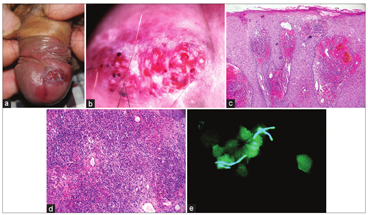
Histopathological examination showed epidermal pseudoepitheliomatous hyperplasia, dilation and proliferation of the vascular vessels with edematous vascular endothelium, erythrocytes extravasation and deposits of hemosiderin; dense mixed infiltration of plasma cells, neutrophils, and eosinophils were noted in the dermis [Figure 1c and Figure 1d]. Periodic acid-Schiff and Grocott’s methenamine silver staining were negative for fungus. The results of Treponema pallidum particle assay, rapid plasma reagin test, and antibodies to human immunodeficiency virus, hepatitis B virus, and hepatitis C virus were all negative. Smears and culture for fungus were positive for candida under fluorescence microscopy [Figure 1e].
After an empiric treatment of oral itraconazole 200 mg once daily for 2 weeks, the lesions flattened and shrunk dramatically. This was followed by complete resolution of the lesion with some hyperpigmentation of the skin after 5 weeks. The patient was finally diagnosed as candida balanitis with hyperplastic plaque.
Balanitis, inflammation of the glans penis, is a frequently presenting genital disorder. Infection, especially candida infection, is a common cause of balanitis. Candida balanitis and balanoposthitis are usually characterized by blotchy erythema with small papules which may be eroded or dry dull red areas with a glazed appearance.[1] As we have known so far, the lesions of hyperplastic angiomatoid plaque had not been reported in candida balanitis. Obviously, before making the diagnosis of candida balanitis with hyperplastic plaque, other causes of balanitis or neoplasms with hyperplastic plaques need to be excluded, including but not limited to lichen planus, syphilis, Zoon’s balanitis, psoriasis, circinate balanitis, erythroplasia of Queyrat, and squamous cell carcinoma.
The authors certify that they have obtained all appropriate patient consent form. In the form, the patient has given his consent for his images and other clinical information to be reported in the journal. The patient understands that his name and initials will not be published and due efforts will be made to conceal their identity, but anonymity cannot be guaranteed.
This work was supported by grants from the National Natural Science Foundation of China (No. 81773311 and No. 81402588).
There are no conflicts of interest.


