

Copyright © 2020 The Chinese Medical Association, produced by Wolters Kluwer, Inc. under the CC-BY-NC-ND license. This is an open access article distributed under the terms of the Creative Commons Attribution-Non Commercial-No Derivatives License 4.0 (CCBY-NC-ND), where it is permissible to download and share the work provided it is properly cited. The work cannot be changed in any way or used commercially without permission from the journal.
Pneumonia caused by a novel coronavirus known as 2019 novel coronavirus disease (COVID-19)[1] appeared in Wuhan, China in December 2019, and approximately 15% to 30% of patients developed acute respiratory distress syndrome within a short period of time.[2,3] To reduce respiratory symptoms and improve prognosis, respiratory support is the most important means of life support,[1] and non-invasive respiratory support systems,[2] including various conventional oxygen therapies, non-invasive positive pressure ventilation (NPPV), and high-flow nasal cannula (HFNC), are most commonly used. However, their efficacy and safety remain unclear, and whether they increase the risk of aerosol dispersion and disease transmission is particularly controversial.[4,5] Given that there are many similarities between COVID-19 pneumonia and severe acute respiratory syndrome (SARS) and Middle East respiratory syndrome (MERS),[6] this study primarily discusses clinical indications and provides details regarding the prevention of nosocomial infections during NPPV and HFNC treatment of COVID-19 pneumonia based on previous clinical data on the use of these two therapies for SARS and MERS and our experience with the treatment of COVID-19 pneumonia.
NPPV can reduce the rate of tracheal intubation; therefore, theoretically, it can significantly reduce the risk of infection of medical personnel during tracheal intubation and artificial airway management for COVID-19 pneumonia patients.[7] A recent retrospective epidemiological study of 99 COVID-19 pneumonia patients in China[2] revealed that NPPV is the most commonly used mechanical ventilation method for acute respiratory failure. The rates of using non-invasive and invasive mechanical ventilation are 13% and 4%, respectively; however, the efficacies of these ventilation methods need to be further investigated. There are little clinical data on NPPV for SARS,[4,5] of which most are small-sample, single-center retrospective studies from China, and the NPPV failure rate is approximately 20% to 40%. Cheung et al[8] in their study of 20 Hong Kong patients with SARS and acute respiratory failure (oxygen flow >6 L/min, pulse oxygen saturation [SpO2] 93-96%) revealed that NPPV could prevent tracheal intubation in 70% of patients and significantly reduce the time spent in the intensive care unit. Reports on NPPV for the treatment of MERS are also limited.[9] Because the degree of lung and extra-pulmonary injuries in patients with MERS is significantly higher than that in patients without MERS,[9] the failure rate of NPPV is relatively high (60-70%). In addition, current evidence and clinical guideline[10] do not recommend NPPV for treating acute hypoxic respiratory failure and pandemic viral illness. Therefore, we believe that NPPV should currently not be used as a first-line treatment to correct respiratory failure in patients with COVID-19 pneumonia. For strictly selected early-stage patients with mild-to-moderate (partial pressure of arterial oxygen [PaO2]/fraction of inspired oxygen [FiO2] >200 mmHg) hypoxic respiratory failure and especially for units with limited numbers of invasive ventilators, it is recommended that NPPV be attempted for short periods of time (1-2 h)[1,8,11] and intubation be performed immediately if no improvement is observed. In addition, early-stage identification of high-risk factors (shock, metabolic acidosis; multiple organ failure; PaO2/FiO2 ≤175 mmHg at 1 h after NPPV treatment; severe hypoxemia with PaO2/FiO2 ≤147 mmHg; Simplified Acute Physiology Score II >34; tidal volume >9.5 mL/kg; elevated partial pressure of arterial carbon dioxide (PaCO2); respiratory rate >30 breaths/min) for NPPV failure in the treatment of hypoxic respiratory failure can improve the safety of NPPV treatment.[11] NPPV should be avoided in patients with hemodynamic instability, multiple organ failure, disorders of consciousness, or mucus drainage disorders.[1]
Notably, NPPV can lead to aerosol transmission during use. In vitro simulation experiments have shown that NPPV can lead to the dispersion of exhaled aerosols within 1 m of patients. In addition, the dispersion range increases with increased air leakage and increased inspiratory pressure,[12,13] such that the World Health Organization considers NPPV to be an important form of aerosol transmission in patient wards. However, clinical studies on the use of NPPV for SARS did not clearly demonstrate that NPPV increases the risk of infection transmission between infected patients and medical staffs.[4,8] Conversely, NPPV masks may also reduce aerosol exhalation during coughing and talking.[4,5] Recent studies have shown that NPPV is a low-risk airborne route with good interface fitting.[1,14]
Therefore, it is still unclear whether NPPV increases the risk of aerosol diffusion and disease transmission, especially with respect to transmission to medical personnel.[4] The use of NPPV for COVID-19 pneumonia still requires strict control of the medical environment and vigilance and monitoring of the infection risk to medical personnel. Table 1 shows specific prevention and control measures for preventing aerosol production and disease transmission in patient wards during NPPV.[7,15]
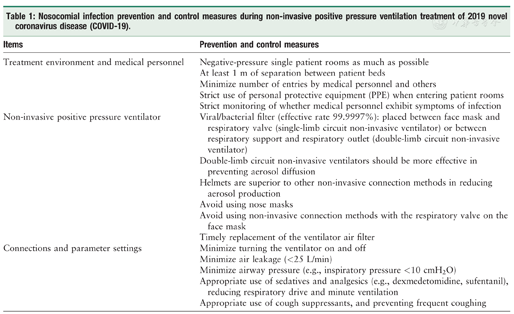
Nosocomial infection prevention and control measures during non-invasive positive pressure ventilation treatment of 2019 novel coronavirus disease (COVID-19).
Nosocomial infection prevention and control measures during non-invasive positive pressure ventilation treatment of 2019 novel coronavirus disease (COVID-19).
| ltems | Prevention and control measures |
|---|---|
| Treatment environment and medical personnel | Negative-pressure single patient rooms as much as possible |
| At least 1 m of separation between patient beds | |
| Minimize number of entries by medical personnel and others | |
| Strict use of personal protective equipment (PPE) when entering patient rooms | |
| Strict monitoring of whether medical personnel exhibit symptoms of infection | |
| Non-invasive positive pressure ventilator | Viral/bacterial filter (effective rate 99.9997%): placed between face mask and respiratory valve (single-limb circuit non-invasive ventilator) or between respiratory support and respiratory outlet (double-limb circuit non-invasive ventilator) |
| Double-limb circuit non-invasive ventilators should be more effective in preventing aerosol diffusion | |
| Helmets are superior to other non-invasive connection methods in reducing aerosol production | |
| Avoid using nose masks | |
| Avoid using non-invasive connection methods with the respiratory valve on the face mask | |
| Timely replacement of the ventilator air filter | |
| Connections and parameter settings | Minimize turning the ventilator on and off |
| Minimize air leakage (<25 L/min) | |
| Minimize airway pressure (e.g., inspiratory pressure <10 cmH2O) | |
| Appropriate use of sedatives and analgesics (e.g., dexmedetomidine, sufentanil), reducing respiratory drive and minute ventilation | |
| Appropriate use of cough suppressants, and preventing frequent coughing |
HFNC is a new form of non-invasive respiratory support[16] that can be adjusted to a maximum gas flow of 60 to 80 L/min and an FiO2 of 0.21 to 1.0. No clinical data exist regarding the use of HFNC for SARS, MERS, or COVID-19, and the clinical efficacy of HFNC needs to be further investigated. However, for patients with noninfectious mild-to-moderate hypoxic respiratory failure, compared with conventional oxygen therapy, HFNC can reduce the rate of tracheal intubation and mortality.[17] Therefore, HFNC treatment for COVID-19 pneumonia can be attempted when hypoxemia cannot be treated using conventional oxygen therapy devices, NPPV cannot be tolerated, or in the following situations[1] : mild-to-moderate hypoxemia (100 mmHg ≤ PaO2/FiO2 < 300 mmHg); no indications for emergency tracheal intubation; and relatively stable vital signs. HFNC should be avoided in patients with hemodynamic instability, multiple organ failure, or disorders of consciousness. The therapeutic response should be closely monitored (1-2 h) after HFNC treatment. The patient should be switched to non-invasive or invasive positive pressure ventilation if the following conditions persist: respiratory rate >30 breaths/min; SpO2 <88% to 90%; paradoxical breathing and/or continuous assisted respiratory muscle activity; pH <7.35; or PaCO2 >45 mmHg.[18]
To prevent and control the nosocomial infection during HFNC therapy, we provide the following suggestions based on our experience: (1) disposable, single-use highflow nasal plugs and tubing should be used during HFNC treatment; (2) patients should be instructed to breathe with the mouth closed as much as possible while wearing surgical masks or oxygen mask; (3) condensation in the circuit should be cleaned in a timely manner to avoid production of aerosols caused by high flow gas and condensed water entering the nasal cavity, stimulating coughing in patients; (4) recent evidence shows that the dispersion distance of exhaled gases during HFNC treatment is limited, and the risk of airborne transmission is low.[14,19] However, loose connections between HFNC and nasal plugs significantly increase the dispersion distance of exhaled gases (from 172 to 620 mm).[14,19] Therefore, attention should be paid to correct the positioning and wearing of high-flow nasal plugs.
None.


