

Copyright © 2020 The Chinese Medical Association, produced by Wolters Kluwer, Inc. under the CC-BY-NC-ND license. This is an open access article distributed under the terms of the Creative Commons Attribution-Non Commercial-No Derivatives License 4.0 (CCBY-NC-ND), where it is permissible to download and share the work provided it is properly cited. The work cannot be changed in any way or used commercially without permission from the journal.
Syphilis, caused by Treponema pallidum subsp pallidum (T. pallidum), is a chronic, systemic human disease transmitted through sexual contact. The incidence and prevalence of syphilis is still high in China.[1] To guide the prevention measures and management of this disease, we renew the guidelines on diagnosis and treatment of syphilis [Supplementary file, http://links.lww.com/CM9/A292]. Manifestations and diagnosis of all stages of syphilis are presented in Table 1, and management in Table 2.
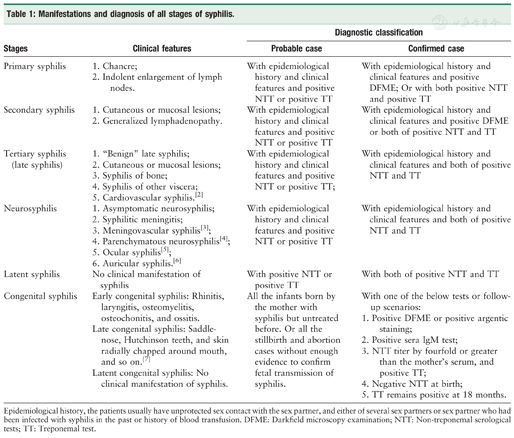
Manifestations and diagnosis of all stages of syphilis.
Manifestations and diagnosis of all stages of syphilis.
| Stages | Clinical features | Diagnostic classification | |
|---|---|---|---|
| Probable case | Confirmed case | ||
| Primary syphilis | 1. Chancre;2. Indolent enlargement of lymph nodes. | With epidemiological history and clinical features and positive NTT or positive TT | With epidemiological history and clinical features and positive DFME; Or with both positive NTT and positive TT |
| Secondary syphilis | 1. Cutaneous or mucosal lesions;2. Generalized lymphadenopathy. | With epidemiological history and clinical features and positive NTT or positive TT | With epidemiological history and clinical features and positive DFME or both of positive NTT and TT |
| Tertiary syphilis (late syphilis) | 1. "Benign" late syphilis;2. Cutaneous or mucosal lesions;3. Syphilis of bone;4. Syphilis of other viscera;5. Cardiovascular syphilis.[2] | With epidemiological history and clinical features and positive NTT or positive TT; | With epidemiological history and clinical features and both of positive NTT and TT |
| Neurosyphilis | 1. Asymptomatic neurosyphilis;2. Syphilitic meningitis;3. Meningovascular syphilis[3];4. Parenchymatous neurosyphilis[4];5. Ocular syphilis[5];6. Auricular syphilis.[6] | With epidemiological history and clinical features and positive NTT or positive TT | With epidemiological history and clinical features and both of positive NTT and TT |
| Latent syphilis | No clinical manifestation of syphilis | With positive NTT or positive TT | With both of positive NTT and TT |
| Congenital syphilis | Early congenital syphilis: Rhinitis, laryngitis, osteomyelitis, osteochonitis, and ossitis.Late congenital syphilis: Saddle-nose, Hutchinson teeth, and skin radially chapped around mouth, and so on.[7]Latent congenital syphilis: No clinical manifestation of syphilis. | All the infants born by the mother with syphilis but untreated before. Or all the stillbirth and abortion cases without enough evidence to confirm fetal transmission of syphilis. | With one of the below tests or follow-up scenarios:1. Positive DFME or positive argentic staining;2. Positive sera IgM test;3. NTT titer by fourfold or greater than the mother’s serum, and positive TT;4. Negative NTT at birth;5. TT remains positive at 18 months. |
Epidemiological history, the patients usually have unprotected sex contact with the sex partner, and either of several sex partners or sex partner who had been infected with syphilis in the past or history of blood transfusion. DFME: Darkfield microscopy examination; NTT: Non-treponemal serological tests; TT: Treponemal test.
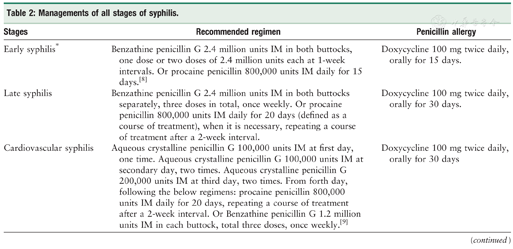
Managements of all stages of syphilis.
Managements of all stages of syphilis.
| Stages | Recommended regimen | Penicillin allergy |
|---|---|---|
| Early syphilis∗ | Benzathine penicillin G 2.4 million units IM in both buttocks, one dose or two doses of 2.4 million units each at 1-week intervals. Or procaine penicillin 800,000 units IM daily for 15 days.[8] | Doxycycline 100 mg twice daily, orally for 15 days. |
| Late syphilis | Benzathine penicillin G 2.4 million units IM in both buttocks separately, three doses in total, once weekly. Or procaine penicillin 800,000 units IM daily for 20 days (defined as a course of treatment), when it is necessary, repeating a course of treatment after a 2-week interval. | Doxycycline 100 mg twice daily, orally for 30 days. |
| Cardiovascular syphilis | Aqueous crystalline penicillin G 100,000 units IM at first day, one time. Aqueous crystalline penicillin G 100,000 units IM at secondary day, two times. Aqueous crystalline penicillin G 200,000 units IM at third day, two times. From forth day, following the below regimens: procaine penicillin 800,000 units IM daily for 20 days, repeating a course of treatment after a 2-week interval. Or Benzathine penicillin G 1.2 million units IM in each buttock, total three doses, once weekly.[9] | Doxycycline 100 mg twice daily, orally for 30 days |
| Neurosyphilis, ocular, and auricular syphilis | Aqueous crystalline penicillin G 18 to 24 million units daily IV for 10 to 14 days, if necessarily, following with Benzathine penicillin G 2.4 million units IM weekly, total three doses. Or Procaine penicillin 2.4 million units IM once daily and Probenecid 500 mg orally four times a day, for 10 to 14 days, if necessarily, following with Benzathine penicillin G 2.4 million units IM weekly, total three doses.[10] | Doxycycline 100 mg twice daily, orally for 30 days. |
| Congenital syphilis | Early congenital syphilis: Aqueous crystalline penicillin G 100,000-150,000 units/kg intravenously daily, administered as 50,000 units/kg per dose intravenously every 12 h during the first 7 days of life and every 8 h thereafter for 10 to 14 days. Or procaine penicillin G 50,000 units/kg IM in a single daily dose for 10 to 14 days.[11]Late congenital syphilis: Procaine penicillin 50,000 units/kg IM daily for 10 days defined as a course of treatment (the dose of penicillin should be less than that of adults in the same stage of syphilis). | No best alternative treatment so far, if without a history of ceftriaxone allergy, ceftriaxone (normal examination of cerebrospinal fluid 125 mg, abnormal examination of cerebrospinal fluid 250 mg) IM daily for 10 to 14 days, be aware of possible cross-allergic reactions with penicillin. |
Early syphilis*, alternative regimen is ceftriaxone 500 mg to 1 g, IM or intravenously daily for 10 days. Early congenital syphilis: <2 years of age; Late congenital syphilis: ≥2 years of age. IM: Intramuscularly.
In addition, after recommended treatment, regular follow-up should be performed, including clinical and serological evaluation. The assessment criteria of effective treatment include disappear of the skin lesion and clinical symptoms, and the titer of a non-treponemal serological test (NTT) should decline by more than or equal to four-fold within 3 to 6 months after treatment. If the NTT reverts from negative to positive or the titer is increased by four-fold, it is defined as serological reactivation. If clinical symptoms reappear (usually accompanied by increased NTT titer), it is defined as clinical reactivation. All patients with serological or clinical reactivation should receive treatment again. In a few syphilis patients, the titer of NTT may decline, but it usually does not return to negative, and remain positive within certain period (even through life), in which case, defined as serofast.
The Expert Group members:
Rui-Li Zhang1, Qian-Qiu Wang2, Yue-Ping Yin2, Quan-Zhong Liu3, Shu-Zhen Qi2, Dong-Mei Xu4, Yu-Ye Li5, Xiao-Fang Li2, Xiao-Hong Su2, Min-Zhi Wu6, Xian-Biao Zou7, Li-Gang Yang8, Xiang-Sheng Chen2, Ping-Yu Zhou9, Jin-Hua Xu10, Xiang-Dong Gong2, Guo-Jun Liang2, Juan Jiang2, Hao Cheng11, Feng-Qin Ge2
1 Department of Dermatology, The Second Affiliated Hospital of Nanjing Medical University, Nanjing, Jiangsu 210011, China
2 Institute of Dermatology, Chinese Academy of Medical Science & Peking Union Medical College, National Center for Sexually Transmitted Disease Control, China Centers for Disease Control and Prevention, Nanjing, Jiangsu 210042, China.
3 Department of Dermatology, General Hospital of Tianjin Medical University, Tianjin 300052, China
4 Department of Neurology, Beijing Ditan Hospital, Capital Medical University, Beijing 100015, China
5 Department of Dermatology, The First Affiliated Hospital of Kunming Medical University, Kunming, Yunnan 650032, China
6 Department of Dermatology, The 5th People’s Hospital of Suzhou, Suzhou, Jiangsu 215131, China
7 Department of Dermatology, The First Affiliated Hospital of General Hospital of People’s Liberation Army, Beijing 100037, China
8 Department of Dermatology, Dermatology Hospital of Southern Medical University, Guangzhou, Guangdong 510091, China
9 Department of Sexually Transmitted Disease Institute, Shanghai Skin Disease Hospital, Shanghai 200071, China
10 Department of Dermatology, Huashan Hospital of Fudan University, Shanghai 200040, China
11 Department of Dermatology, Sir Run Run Shaw Hospital of Zhejiang University School of Medicine, Hangzhou, Zhejiang 310016, China
None.


