

Copyright © 2021 The Chinese Medical Association, produced by Wolters Kluwer, Inc. under the CC-BY-NC-ND license. This is an open access article distributed under the terms of the Creative Commons Attribution-Non Commercial-No Derivatives License 4.0 (CCBY-NC-ND), where it is permissible to download and share the work provided it is properly cited. The work cannot be changed in any way or used commercially without permission from the journal.
Ductal carcinoma in situ (DCIS), also known as intraductal carcinoma, is an in situ carcinoma limited to the mammary ducts. The gold-standard screening, diagnostic, and treatment options have long been controversial. The Chinese Society of Breast Surgery (CSBrS) has re-evaluated the quality of the clinical study evidence on DCIS. In order to standardize the diagnosis and treatment of DCIS and provide a reference for Chinese breast surgeons, the CSBrS has used the Grading of Recommendations Assessment, Development, and Evaluation handbook while referring to its feasibility in the actual clinical practice of Chinese breast surgeons to develop the CSBrS Clinical Practice Guideline for the Diagnosis and Treatment of Ductal Carcinoma In Situ (2021).
There were 84 voting committee members for these guidelines: 70 from breast surgery departments (82.4%), four from medical oncology departments (4.7%), four from medical imaging departments (4.7%), two from a pathology department (2.4%), two from an obstetrics and gynecology department (2.4%), one from a radiotherapy department (2.4%), and two epidemiologists (2.4%).
Clinicians specializing in breast diseases in China.
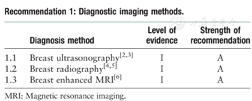
Recommendation 1: Diagnostic imaging methods.
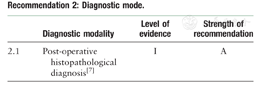
Recommendation 2: Diagnostic mode.
Recommendation 2: Diagnostic mode.
| Diagnostic modality | Level of evidence | Strength of recommendation | |
|---|---|---|---|
| 2.1 | Post-operative histopathological diagnosis[7] | I | A |
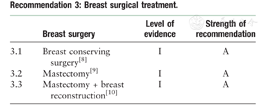
Recommendation 3: Breast surgical treatment.
This guideline was designed for the clinical treatment of DCIS, but not for assumed simple DCIS. The expert panel has agreed that the post-operative histopathological diagnosis is the only diagnostic modality for DCIS. In clinical practice, a diagnosis of DCIS from a pre-operative histopathological evaluation of a puncture biopsy specimen should be viewed inadequate because it could be an underestimation.
The expert panel recommends breast ultrasonography and radiography as the preferred imaging examinations for DCIS patients.[2,3,9] In China, breast ultrasonography is widely applied,[4,5,17] and breast enhanced MRI examination is recommended for patients as level I evidence.[6,18,19,20]
Studies have shown that mastectomy is a radical therapy for 98% of patients with DCIS.[9] In the opinion of the expert panel, mastectomy (or mastectomy + breast reconstruction) may be considered for DCIS patients who do not desire breast-conserving surgery.[10] Breast conserving surgery + adjuvant radiotherapy has a survival rate similar to total mastectomy.[8,9] Evidence-based medical studies have shown that a positive surgical margin of a resected DCIS specimen is closely related to local recurrence.[17,18,20] Therefore, the expert panel thinks that a negative surgical margin is the basic requirement for patients with DCIS who have undergone a breast conserving surgery. An extended resection should be performed for patients whose resected DCIS specimen has a positive surgical margin, and a total mastectomy (or mastectomy + breast reconstruction) is recommended if a negative surgical margin cannot be achieved. An intra-operative histopathological evaluation of a frozen section from a resected DCIS specimen has been helpful in reducing the rate of secondary surgeries performed for resected DCIS specimens confirmed to have positive surgical margins,[21] and an intra-operative histopathological evaluation is preferred for Chinese clinical practice. For DCIS specimens, a negative surgical margin should be ≥ a 2-mm distance from the tumor.[22] Considering its rare use in Chinese clinical work, ink-staining of the surgical margin is not recommended as a routine clinical practice in this guideline.
Since patients whose DCIS are initially diagnosed by coreneedle biopsy or vacuum-assisted biopsy may be found to show invasive carcinoma on post-operative histopathology examination,[7] a sentinel lymph node biopsy performed during a mastectomy for these patients is recommended in order to avoid the histopathological underestimation of the resected breast lesion. However, an axillary lymph node dissection is not recommended for patients with DCIS if there is no evidence of invasive breast carcinoma.
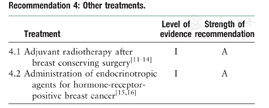
Some prospective randomized clinical trials have found that compared with no radiotherapy, post-operative adjuvant radiotherapy can lead to a 50% to 60% decreased risk of recurrence in DCIS patients.[11,12,13] A 10-year follow-up from a study of 3729 patients with DCIS who received adjuvant radiotherapy, found that it resulted in a decrease of up to 15.2% of the absolute risk of recurrence of homolateral breast carcinoma.[14] No strong evidence showing that DCIS patients with a low risk of recurrence can be waived from radiotherapy after breast conserving surgery exists.[23,24,25] Radiotherapy even for low-risk patients or patients receiving endocrine therapy can decrease the local recurrence rate of DCIS.[26] Based on the consistent opinion of expert panel, DCIS patients are all required to receive total breast radiotherapy after breast conserving surgery.
Combining the consensus of several domestic and foreign guidelines, the expert panel makes no recommendation on the use of chemotherapy and targeted therapy for patients with a definitive diagnosis of DCIS.[9,17,18,] The National Surgical Adjuvant Breast and Bowel Project-B24 study of 2061 patients with DCIS who underwent breast conserving surgery found that tamoxifen adjuvant therapy for patients led to a significant decrease in the 5-year cumulative risk of recurrence of breast cancer, compared with patients receiving a placebo (cumulative recurrence rate: 8.2% vs. 13.4%, respectively; relative ratio = 0.63, P = 0.0009); a median follow-up time of 13.6 years found that the absolute risks of recurrence of homolateral and contralateral breast carcinoma were decreased by 3.4% (hazard ratio = 0.30, 95% confidence interval [CI]: 0.21-0.42, P < 0.01) and 3.2% (hazard ratio = 0.68, 95% CI: 0.48-0.95, P = 0.023) respectively in the patients receiving tamoxifen.[16] The International Breast Cancer Intervention Study II (IBIS II) study, which was a large multicenter, randomized, double-blinded, placebo-controlled trial and involved 2980 hormone receptor (HR)-positive menopausal patients with DCIS from 236 centers in 14 countries found that after a mean follow-up period of 7.2 years, the risk differences of recurrence and death between patients receiving anastrozole vs. patients receiving tamoxifen were not significant.[15]
Referring to the domestic and foreign guidelines for preventive treatment and risk reduction of breast cancer, the expert panel proposes that premenopausal or menopausal patients with estrogen receptor-positive DCIS who undergo a reserved mastectomy + radiotherapy or total mastectomy should also receive 5 years of tamoxifen. Raloxifene or aromatase inhibitors (eg, exemestane and anastrozole) are recommended for menopausal patients with DCIS.[19]
List of compiling committee members (In alphabetical order by surname)
Zhong-Wei Cao, Bo Chen, De-Dian Chen, Yuan-Jia Cheng, Meng-Yao Cui, Xue-Ning Duan, Zhi-Min Fan, Pei-Fen Fu, Jian Huang, Jun Jiang, Hong-Chuan Jiang, Feng Jin, Zi-Ning Jin, Hua Kang, Rui Ling, Jin-Ping Liu, Ke Liu, Qian Liu, Yin-Hua Liu, Yun-Jiang Liu, Zhen-Zhen Liu, Yong-Hui Luo, Rong Ma, Da-Hua Mao, Jiang-Hua Ou, Xiang Qu, Guo-Sheng Ren, Ai-Lin Song, Er-Wei Song, Li-Li Tang, Xing-Song Tian, Chuan Wang, Fei Wang, Jian-Dong Wang, Shu Wang, Shui Wang, Xiang Wang, Jiong Wu, Ke-Jin Wu, Fei Xie, Ling Xin, Ying-Ying Xu, Fan Yao, Zhi-Gang Yu, Jian-Guo Zhang, Jin Zhang, Jing-Hua Zhang, Yi Zhao, Zuo-Wei Zhao, Wei Zhu, Ang Zheng, Qiang Zou.
The expert committee for these guidelines declares no conflict of interest. These guidelines are a reference for breast disease specialists in clinical practice. However, the guidelines are not to be used as the basis for medical evaluation, and do not play an arbitrating role in the handling of any medical disputes. The guidelines are not a reference for patients or non-breast specialists. The Chinese Society of Breast Surgery assumes no responsibility for results involving the inappropriate application of these guidelines, and reserves the right to interpret and revise the guidelines.


