综述
炎症性肠病经济负担的研究进展
中华炎性肠病杂志(中英文), 2023,07(3) : 286-291. DOI: 10.3760/cma.j.cn101480-20220824-00134
摘要

炎症性肠病(IBD)是一种病因不明、病情反复、迁延不愈的疾病,可累及多个器官及系统。当前,IBD发病呈年轻化趋势,因病情反复影响工作甚至导致失业,耗费大量的社会和医疗资源。生物制剂用于IBD的治疗已有20余年,其增加了治疗的选择性。但同时也有研究发现生物制剂的使用是增加IBD经济负担的主要因素之一。而生物类似物较生物制剂在优化成本-效益方面具有显著优势,应用前景良好。本文通过总结国内外IBD卫生经济学的研究现状,旨在为加强疾病管理和改善患者生存质量提供经济学依据。


引用本文: 李章琴, 黄奇, 李茂涓, 等.  炎症性肠病经济负担的研究进展 [J] . 中华炎性肠病杂志(中英文), 2023, 07(3) : 286-291. DOI: 10.3760/cma.j.cn101480-20220824-00134.
参考文献导出:   Endnote    NoteExpress    RefWorks    NoteFirst    医学文献王
扫  描  看  全  文

正文
作者信息
基金 0  关键词  0
English Abstract
评论
阅读 0  评论  0
相关资源
引用 | 论文 | 视频

版权归中华医学会所有。

未经授权,不得转载、摘编本刊文章,不得使用本刊的版式设计。

除非特别声明,本刊刊出的所有文章不代表中华医学会和本刊编委会的观点。

炎症性肠病(inflammatory bowel disease,IBD)是一种由多基因及环境因素共同引起并加速免疫-肠道-微生态轴紊乱的遗传相关性疾病,主要包括溃疡性结肠炎(ulcerative colitis,UC)、克罗恩病(Crohn′s disease,CD)和未分类IBD(IBD unclassified,IBDU)[1]。进入21世纪之后,亚洲IBD发病率呈逐年上升趋势[2]。中国UC发病率为11.6/10万,CD为1.4/10万[3]。疾病反复发作导致较高的病残率和病死率,再加上难就业、高失业率,给患者和社会造成巨大的经济负担。近年来出现的生物制剂可提高IBD无激素缓解率、内镜缓解率,降低手术率、住院率,当前指南多建议使用生物制剂治疗IBD[4,5]。但有研究表明,使用生物制剂会增加IBD的经济成本,高达4 ~ 5倍[6]

本综述通过总结国内外IBD卫生经济学研究进展,以期为提高患者生存质量、降低疾病的社会负担提供经济学证据。

一、IBD的经济负担

IBD的经济负担包括在医保系统之外的直接经济负担、间接经济负担和无形经济负担。直接经济负担主要包括药物费用、门诊费用、住院费用和手术费用等,受到疾病类型、疾病严重程度、医疗保险计划等因素影响[7]。间接经济负担被称为"生产力损失",包括政府提供的残疾养恤金及因病休假等所致的经济损失。此外,无形经济负担还包括因病辍学、失业等造成的经济损失。

(一)直接经济负担
1.疾病类型:

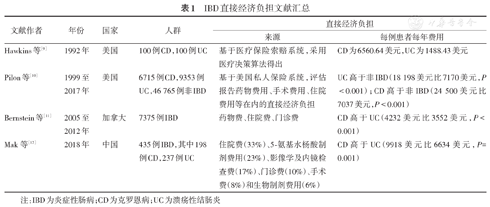
疾病经济负担与IBD疾病类型密切相关。2020年我国CD患者个人支付的年平均医疗费用30 279元/人,接近当年全国年平均可支配收入(32 189元/人),远超过2016年中国2型糖尿病患者的年平均医疗费用(8245元/人)[8]。国内外研究大多提示CD患者直接经济负担高于UC,见表1[9,10,11,12]

点击查看表格
表1

IBD直接经济负担文献汇总

表1

IBD直接经济负担文献汇总

文献作者年份国家人群直接经济负担
来源每例患者每年费用
Hawkins等[9]1992年美国100例CD,100例UC基于医疗保险索赔系统,采用医疗决策算法得出CD为6560.64美元,UC为1488.43美元
Pilon等[10]1999至2017年美国6715例CD,9353例UC,46 765例非IBD基于美国私人保险系统,评估报告药物费用、手术费用、住院费用等在内的直接经济负担UC高于非IBD(18 198美元比7170美元,P<0.001);CD高于非IBD(24 500美元比7037美元,P<0.001)
Bernstein等[11]2005至2012年加拿大7375例IBD药物费、住院费、门诊费CD高于UC(4232美元比3552美元,P<0.001)
Mak等[12]2018年中国435例IBD,其中198例CD,237例UC住院费(33%)、5-氨基水杨酸制剂费用(23%)、影像学及内镜检查费(17%)、门诊费(10%)、手术费(8%)和生物制剂费用(6%)CD高于UC(9918美元比6634美元,P=0.001)

注:IBD为炎症性肠病;CD为克罗恩病;UC为溃疡性结肠炎

2.疾病严重程度:

2004年英国一项单中心回顾性研究显示,IBD疾病复发较缓解期住院费用增加20倍[13]。2016年美国一项纳入67例儿童IBD患者的研究显示,轻度CD患儿直接经济总负担为(26 917 ± 16 994)美元,中度为(37 906 ± 16 095)美元,重度为(71 176 ± 43 817)美元;轻度UC患儿为(23 804 ± 10 452)美元,中度为(34 958 ± 15 381)美元,重度为(134 178 ± 40 920)美元[14]。英国一项纳入307例UC和172例CD患者的单中心回顾性研究发现,复发IBD患者的疾病治疗费用与住院次数、疾病严重程度、疾病范围呈正相关(均P<0.001)[13]。因此,降低疾病活动性、减少疾病复发有利于减轻患者经济负担。

3.医疗保险计划:

在中国,社会健康保险计划由3部分组成,分别为2003年启动的农村新合作医疗计划、2007年启动的城市居民基本医疗保险计划和1998年启动的城市员工基本医疗保险计划[15]

质量调整生命年(quality-adjusted life year,QALY)是指一种调整的期望寿命,用生命质量来调整期望寿命或生存年数而得到的一个指标,是一个综合反映人群生命质量和生存年数的指标。数值越高提示患者的健康状况越好。2019年我国学者构建决策分析模型,通过单向敏感性和概率敏感性分析发现,使用英夫利西单克隆抗体(infliximab,IFX)维持治疗并购买中国公共医疗保险的中重度CD患者,获得1个QALY的费用为2018年中国人均国内生产总值(9732美元)的86.4%[16]。2021年一项涉及中国14个IBD中心共3000例IBD患者的研究显示,26.6%(799/3000)的IBD患者每年需要接受3次及以上的生物制剂治疗,但54.3%(1399/2576)使用生物制剂的患者因IBD无法购买商业保险,只能自费购买生物制剂,没有任何经济补偿[17]

(二)间接经济负担

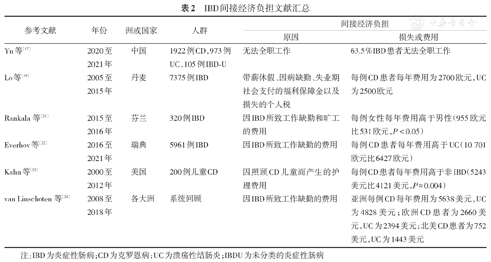
IBD患者常因疾病复发住院造成工作效率低下甚至无法工作。Blomqvist和Ekbom[18]的研究显示,IBD患者因病所致的间接经济负担占总费用的68%,其中因病休假所致的损失和因病提前退休造成的损失分别占间接经济负担的47%、53%。丹麦一项2005至2015年的前瞻性研究显示,IBD患者间接费用(病假、失业救济金和税收损失)占总费用的比例较高,其中62%患者因IBD至少休假1次[19]。里约热内卢2010至2018年的一项前瞻性研究结果显示,CD病残率为16.7%,永久性残疾在40 ~ 49岁的人群中发生率最高,占46.7%(193/413)[20]。女性因IBD所致工作缺勤和旷工的成本高于男性[21],而CD高于UC[22]。国内外IBD间接经济负担研究见表2[17,19,21,22,23,24]

点击查看表格
表2

IBD间接经济负担文献汇总

表2

IBD间接经济负担文献汇总

参考文献年份洲或国家人群间接经济负担
原因损失或费用
Yu等[17]2020至2021年中国1922例CD,973例UC,105例IBD-U无法全职工作63.5%IBD患者无法全职工作
Lo等[19]2005至2015年丹麦7375例IBD带薪休假、因病缺勤、失业期社会支付的福利保障金以及损失的个人税每例CD患者每年费用为2700欧元,UC为2500欧元
Rankala等[21]2015至2016年芬兰320例IBD因IBD所致工作缺勤和旷工的费用每例女性每年费用高于男性(955欧元比531欧元,P<0.05)
Everhov等[22]2016至2021年瑞典5961例IBD因IBD所致工作缺勤的费用每例CD患者每年费用高于UC(10 701欧元比6427欧元)
Kahn等[23]2000至2012年美国200例儿童CD因照顾CD儿童而产生的护理费用每例CD患者每年费用高于非IBD(5243美元比4121美元,P = 0.004)
van Linschoten等[24]2008至2018年各大洲系统回顾因IBD所致工作缺勤的费用亚洲每例CD每年费用为5638美元,UC为4828美元;欧洲CD患者为2660美元,UC为2394美元;北美CD患者为752美元,UC为1443美元

注:IBD为炎症性肠病;CD为克罗恩病;UC为溃疡性结肠炎;IBDU为未分类的炎症性肠病

二、经济负担的主要影响因素

根据2020年Crohn′s & Colitis基金会(Crohn′s & Colitis Foundation,CCF)的倡议,影响IBD经济负担的主要因素包括药物疗法、贫血或精神疾病等并发症及伴发症、再手术率及住院率等[25]

(一)药物疗法
1.传统药物:

传统药物时代,直接经济负担中药物占比低,手术占比高。1994年瑞典一项研究显示,传统药物费用占直接经济负担的24%[18]。1993年美国一项Meta分析研究结果显示,UC缓解期患者采用美沙拉嗪灌肠费用约39美元/(人·月),而口服美沙拉嗪的经济成本为49.5美元/(人·月)[26]。2000年加拿大一项关于CD医疗资源使用与相关成本分析的研究表明,27%的住院患者需接受全肠外营养,占总药物费用的63%[27]

2.生物制剂:

生物制剂时代,IBD手术率、病残率较前下降。2004年法国一项研究表明,中重度活动期CD患者中,IFX较传统疗法有更高的QALY(30.38年比29.62年)[28]。IFX可减少疾病复发,降低住院率、手术率,减少结肠镜检查次数,从而减少住院费用[29]。2019年西班牙学者通过构建Markov预测模型比较3种生物制剂的增值成本效应比(incremental cost-effectiveness ratio,ICER),ICER即成本差值/效果差值,效果差值用QALY表示,是评价医药卫生经济学的指标之一,数值越小提示目标药物经济效益越大;在接受生物疗法的中重度UC患者中,IFX与戈利木单克隆抗体的ICER为43 928.07欧元/QALY,IFX与阿达木单克隆抗体(adalimumab,ADA)的ICER为122 890.19欧元/QALY,ADA与戈利木单克隆抗体的ICER为31 340.69欧元/QALY,因此,ADA具有更高的经济效益[30]。2019年德国一项真实世界研究结果显示,IBD患者使用维得利珠单克隆抗体(vedolizumab,VDZ)的直接经济负担低于抗肿瘤坏死因子-α制剂(32 112欧元比34 136欧元,P = 0.011)[31]

当前多项研究结果提示,生物制剂是IBD治疗早期的主要成本驱动因素。2010年意大利一项前瞻性研究结果显示,每例患者每年生物制剂费用支出在第5年较第1年明显增加(1347欧元比416欧元,P<0.001)[32]。瑞士一项2006至2016年的队列研究结果显示,10年间因生物制剂导致UC患者药物支出每年增加7%,CD患者增加10%[33]。由于经济负担重,患者常因自行停药导致疾病复发,生物制剂治疗停药2年内,75%的患者需要再次使用生物制剂进行挽救治疗,90%的患者至少出现1次不良结局(肠瘘、穿孔、狭窄等),进而增加患者的经济负担[34,35]

3.生物类似物:

生物类似物与原研药物在疗效、安全性、免疫原性方面相似,其成本仅为原研药物的30%,在降低治疗成本方面有很大优势[36]。2017年ECCO指南指出,原研药物向生物类似物转换是可行且安全的[37]。2019年挪威一项大型Ⅳ期临床试验纳入127例(33%)CD、80例(21%)UC、67例(18%)脊柱关节炎、55例(15%)类风湿关节炎、20例(5%)银屑病关节炎和31例(8%)慢性斑块银屑病患者,随访52周,IFX类似物CT-P13较IFX有更低的疾病复发率(11.6%比16.6%)[38]。挪威2010至2016年一项纳入5283例CD患者和9362例UC患者的大型研究结果显示,CT-P13较IFX降低了药物成本[39]。2019年加拿大一项前瞻性研究显示,通过强制性的非医疗转换政策可以显著提高生物类似物的使用,并在全国范围内每年节省1.8亿加元的成本[40]。生物类似物在中国应用的卫生经济学数据尚未见报道。结合已发表文献可以看出,生物类似物在节省成本方面有较大潜力。

(二)并发症及伴发症

贫血是IBD常见的系统性并发症,与较差的疾病结局和较高的医疗保健费用有关[41,42]。与无贫血的IBD患者比较,IBD贫血患者每月平均住院次数更高(1.2次比0.16次,P<0.0001)、每月急诊就诊次数更多(1.9次比0.8次,P<0.0001),总成本更高(25 623.77美元比17 627.32美元,P<0.0001),而接受输血治疗的贫血患者总成本高于未接受输血治疗者(23 422.47美元比17 627.32美元,P<0.0001)[43]。因IBD患者伴有贫血使其疾病复杂,需要更多的护理,从而导致更高的医疗成本[44]。文献报道,贫血的IBD较无贫血患者医疗成本增加8%[25]

IBD患者伴焦虑、抑郁、双相情感障碍、精神分裂症等精神疾病较无精神疾病者,护理费用增加2倍[45]。2019年美国一项研究显示,抑郁症患者占IBD总人数的16%,伴抑郁症的每例IBD患者每年直接经济负担高于无抑郁症患者(17 706美元比9079美元,P<0.001)[46]。美国2021年一项研究也显示,合并精神心理疾病的IBD患者的急诊费用(970美元比754美元,P<0.001)、住院费用(39 205美元比29 550美元,P<0.001)、年度手术总费用(55 693美元比40 486美元,P<0.001)均高于无精神疾病的IBD患者[47]

(三)再手术率及住院率

随着生物制剂的广泛使用,IBD的经济负担正在发生变化,但住院和手术仍然是影响IBD成本驱动的重要因素。美国1998到2015年的一项回顾性研究显示,药物费用增加7%,成为最大的成本驱动因素(占总支出的44%),IBD患者的住院费用下降了40%[48]。葡萄牙2000至2015年的一项回顾性研究显示,5%的IBD患者住院与再手术有关。其中,UC患者16年内人均住院总费用从96 010欧元增加到123 965欧元,再手术率从0.1/10万提高到0.4/10万;CD患者16年内人均住院总费用从154 994欧元增加到208 075欧元,再手术率从0.4/10万上升到1.3/10万[49]。生物制剂时代(2005至2011年)较前生物制剂时代(1998至2004年),UC患者结肠切除率下降(36.08‰比29.99‰,P = 0.004)[50]。1996至2016年美国IBD患者经济负担增加,每例IBD患者因疾病本身增加的年支出也有不成比例的增加,从5714美元增至14 033美元,住院费用和急诊费用占总支出的56%[51]。患者病情进展或自行停药等因素导致多次住院,甚至因病情严重需手术治疗,导致经济成本增加,从而加重患者经济负担。

三、总结与对策

药物的选择、住院、手术、并发症或伴发症的出现是影响IBD疾病经济负担的主要因素。CD较UC有更高的经济负担[35,37]。原因推测如下:(1)诊断上的困难导致疾病治疗延迟,而随着时间的推移,疾病经济负担逐渐增加[52]。(2)CD因病变累及范围广,且药物缓解率较低,绝大多数患者需要外科手术,治疗复杂。故制定IBD规范化诊治流程,提高疾病早诊早治、降低经济负担至关重要。

目前,全球IBD疾病经济总支出呈现上升趋势,存在地域差异,北美洲最高,亚洲最低(每例患者每年费用:31 059美元比6023美元)[24]。一方面,这一差异受到流行率、经济发展水平、国家卫生保健系统、社会力量支持程度的影响。另一方面,当前关于IBD卫生经济学的研究,多基于患者临床表现,以疾病结局作为衡量经济学的重要指标,受到疾病类型、经济水平、诊疗技术等因素影响。中国IBD患病率高[3],而不少患者存在就医难、经济负担大的问题。较低的经济收入、较高的交通成本、异地就医住宿费用、自行停药与IBD患者急诊就医的次数显著相关。因此,实施远程医疗,定期开展健康教育活动,制定并实施IBD相关医疗卫生政策是提高我国IBD患者生存质量的有效措施。

生物制剂的使用转变了IBD的治疗目标[53],而较少的证据支持良好的远期成本效益。生物类似物较原研药物在优化成本效益方面更具前景,但由于IBD患者缺乏对药物有效性及安全性的了解,当开始或转向生物类似物时,可能出现反安慰剂效应(由患者期望引起的、与生理作用无关的治疗的负面影响),影响生存质量,导致治疗依从性及疗效大幅降低,从而阻碍生物类似物的成本节约[54,55]。故须从提高卫生保健提供者(医生、药剂师、心理学家、IBD护士等)及患者对生物类似物和非安慰剂效果的认知水平做起[56],减少反安慰剂效应,推广生物类似物的使用。

利益冲突
利益冲突

所有作者均声明不存在利益冲突

参考文献
[1]
GrahamDBXavierRJ. Pathway paradigms revealed from the genetics of inflammatory bowel disease[J]. Nature20205787796):527-539. DOI:10.1038/s41586-020-2025-2.
[2]
ParkJCheonJH. Incidence and prevalence of inflammatory bowel disease across Asia[J]. Yonsei Med J2021622):99-108. DOI:10.3349/ymj.2021.62.2.99.
[3]
KaplanGGNgSC. Understanding and preventing the global increase of inflammatory bowel disease[J]. Gastroenterology20171522):313-321.e2. DOI:10.1053/j.gastro.2016.10.020.
[4]
FrolkisADLiptonDSFiestKMet al. Cumulative incidence of second intestinal resection in Crohn′s disease:a systematic review and meta-analysis of population-based studies[J]. Am J Gastroenterol201410911):1739-1748. DOI:10.1038/ajg.2014.297.
[5]
FrolkisADDykemanJNegrónMEet al. Risk of surgery for inflammatory bowel diseases has decreased over time:a systematic review and meta-analysis of population-based studies[J]. Gastroenterology20131455):996-1006. DOI:10.1053/j.gastro.2013.07.041.
[6]
TargownikLEBenchimolEIWittJet al. The effect of initiation of anti-TNF therapy on the subsequent direct health care costs of inflammatory bowel disease[J]. Inflamm Bowel Dis20192510):1718-1728. DOI:10.1093/ibd/izz063.
[7]
StarkRKönigHHLeidlR. Costs of inflammatory bowel disease in Germany[J]. Pharmacoeconomics2006248):797-814. DOI:10.2165/00019053-200624080-00006.
[8]
ZhouWPMuNJianWYet al. Economic burden and factors associated with Crohn′s disease[J]. Beijing Da Xue Xue Bao Yi Xue Ban2021533):555-559. DOI:10.19723/j.issn.1671-167X.2021.03.019.
[9]
HawkinsATWisePEChanTet al. Diverticulitis:an update from the age old paradigm[J]. Curr Probl Surg20205710):100862. DOI:10.1016/j.cpsurg.2020.100862.
[10]
PilonDDingZMuserEet al. Long-term direct and indirect costs of ulcerative colitis in a privately-insured United States population[J]. Curr Med Res Opin2020368):1285-1294. DOI:10.1080/03007995.2020.1771293.
[11]
BernsteinCNLongobardiTFinlaysonGet al. Direct medical cost of managing IBD patients:a Canadian population-based study[J]. Inflamm Bowel Dis2012188):1498-1508. DOI:10.1002/ibd.21878.
[12]
MakLYNgSCWongIet al. Direct health-care cost utilization in Hong Kong inflammatory bowel disease patients in the initial 2 years following diagnosis[J]. J Gastroenterol Hepatol2018331):141-149. DOI:10.1111/jgh.13817.
[13]
BassiADoddSWilliamsonPet al. Cost of illness of inflammatory bowel disease in the UK:a single centre retrospective study[J]. Gut20045310):1471-1478. DOI:10.1136/gut.2004.041616.
[14]
FondellAWMoshaMHFrankCRet al. Health care cost for children newly diagnosed with inflammatory bowel disease[J]. Inflamm Bowel Dis2020264):635-640. DOI:10.1093/ibd/izz183.
[15]
MengQFangHLiuXet al. Consolidating the social health insurance schemes in China:towards an equitable and efficient health system[J]. Lancet201538610002):1484-1492. DOI:10.1016/S0140-6736(15)00342-6.
[16]
ShiJHLuoLChenXLet al. Real-world cost-effectiveness associated with infliximab maintenance therapy for moderate to severe Crohn′s disease in China[J]. World J Gastroenterol20202641):6455-6474. DOI:10.3748/wjg.v26.i41.6455.
[17]
YuQZhuCFengSet al. Economic burden and health care access for patients with inflammatory bowel diseases in China:web-based survey study[J]. J Med Internet Res2021231):e20629. DOI:10.2196/20629.
[18]
BlomqvistPEkbomA. Inflammatory bowel diseases:health care and costs in Sweden in 1994[J]. Scand J Gastroenterol19973211):1134-1139. DOI:10.3109/00365529709002993.
[19]
LoBVindIVester-AndersenMKet al. Direct and indirect costs of inflammatory bowel disease:ten years of follow-up in a Danish population-based inception cohort[J]. J Crohns Colitis2020141):53-63. DOI:10.1093/ecco-jcc/jjz096.
[20]
de Sá Brito FróesRda Luz MoreiraACarneiroAet al. Prevalence,indirect costs,and risk factors for work disability in patients with Crohn′s disease at a tertiary care center in Rio de Janeiro[J]. Dig Dis Sci2021669):2925-2934. DOI:10.1007/s10620-020-06646-z.
[21]
RankalaRMattilaKVoutilainenMet al. Inflammatory bowel disease-related economic costs due to presenteeism and absenteeism[J]. Scand J Gastroenterol2021566):687-692. DOI:10.1080/00365521.2021.1908416.
[22]
EverhovÅHBruzeGSöderlingJet al. Women′s earnings are more affected by inflammatory bowel disease than men′s:a register-based Swedish cohort study[J]. J Crohns Colitis2021156):980-987. DOI:10.1093/ecco-jcc/jjaa238.
[23]
KahnSALinCWOzbayBet al. Indirect costs and family burden of pediatric Crohn′s disease in the United States[J]. Inflamm Bowel Dis20172312):2089-2096. DOI:10.1097/MIB.0000000000001268.
[24]
van LinschotenRVisserENiehotCDet al. Systematic review:societal cost of illness of inflammatory bowel disease is increasing due to biologics and varies between continents[J]. Aliment Pharmacol Ther2021543):234-248. DOI:10.1111/apt.16445.
[25]
ParkKTEhrlichOGAllenJIet al. The cost of inflammatory bowel disease:an initiative from the Crohn′s & Colitis Foundation[J]. Inflamm Bowel Dis2020261):1-10. DOI:10.1093/ibd/izz104.
[26]
TralloriGMessoriAScuffiCet al. 5-Aminosalicylic acid enemas to maintain remission in left-sided ulcerative colitis:a meta- and economic analysis[J]. J Clin Gastroenterol1995203):257-259. DOI:10.1097/00004836-199504000-00022.
[27]
CohenRDLarsonLRRothJMet al. The cost of hospitalization in Crohn′s disease[J]. Am J Gastroenterol2000952):524-530. DOI:10.1111/j.1572-0241.2000.01779.x.
[28]
Jaisson-HotIFlouriéBDescosLet al. Management for severe Crohn′s disease:a lifetime cost-utility analysis[J]. Int J Technol Assess Health Care2004203):274-279. DOI:10.1017/s0266462304001084.
[29]
LoomesDETeshimaCJacobsPet al. Health care resource use and costs in Crohn′s disease before and after infliximab therapy[J]. Can J Gastroenterol2011259):497-502. DOI:10.1155/2011/157604.
[30]
Trigo-VicenteCGimeno-BallesterVLópez-Del ValA. Cost-effectiveness analysis of infliximab,adalimumab,golimumab,vedolizumab and tofacitinib for moderate to severe ulcerative colitis in Spain[J]. Eur J Hosp Pharm2020276):355-360. DOI:10.1136/ejhpharm-2018-001833.
[31]
BrandesAGrothAGottschalkFet al. Real-world biologic treatment and associated cost in patients with inflammatory bowel disease[J]. Z Gastroenterol2019577):843-851. DOI:10.1055/a-0903-2938.
[32]
LeeKJaniTChengRet al. Prescribed drug spending in Canada,2019:a focus on public drug programs[J]. Healthc Q2020231):10-12. DOI:10.12927/hcq.2020.26145.
[33]
PillaiNDusheikoMMaillardMHet al. The evolution of health care utilisation and costs for inflammatory bowel disease over ten years[J]. J Crohns Colitis2019136):744-754. DOI:10.1093/ecco-jcc/jjz003.
[34]
ShivajiUNBazarovaACritchlowTet al. Clinical outcomes,predictors of prognosis and health economics consequences in IBD patients after discontinuation of the first biological therapy[J]. Therap Adv Gastroenterol2020131756284820981216. DOI:10.1177/1756284820981216.
[35]
NgSCTangWChingJYet al. Incidence and phenotype of inflammatory bowel disease based on results from the Asia-pacific Crohn′s and colitis epidemiology study[J]. Gastroenterology20131451):158-165.e2. DOI:10.1053/j.gastro.2013.04.007.
[36]
DaneseSBonovasSPeyrin-BirouletL. Biosimilars in IBD:from theory to practice[J]. Nat Rev Gastroenterol Hepatol2017141):22-31. DOI:10.1038/nrgastro.2016.155.
[37]
DaneseSFiorinoGRaineTet al. ECCO position statement on the use of biosimilars for inflammatory bowel disease-an update[J]. J Crohns Colitis2017111):26-34. DOI:10.1093/ecco-jcc/jjw198.
[38]
GollGLJørgensenKKSextonJet al. Long-term efficacy and safety of biosimilar infliximab(CT-P13)after switching from originator infliximab:open-label extension of the NOR-SWITCH trial[J]. J Intern Med20192856):653-669. DOI:10.1111/joim.12880.
[39]
AnisdahlKSvatun LirhusSMedhusAWet al. First-line biologic treatment of inflammatory bowel disease during the first 12 months after diagnosis from 2010 to 2016:a Norwegian nationwide registry study[J]. Scand J Gastroenterol20215610):1163-1168. DOI:10.1080/00365521.2021.1955147.
[40]
CrosbyMTadrousMGomesT. Potential cost implications of mandatory non-medical switching policies for biologics for rheumatic conditions and inflammatory bowel disease in Canada[J]. Clin Pharmacol Ther20211093):739-745. DOI:10.1002/cpt.2042.
[41]
PatelDTrivediCKhanN. Management of anemia in patients with inflammatory bowel disease(IBD)[J]. Curr Treat Options Gastroenterol2018161):112-128. DOI:10.1007/s11938-018-0174-2.
[42]
魏舒纯吴晓涵陈梅林.炎症性肠病合并缺铁性贫血与肠道菌群相关性的研究进展[J].临床内科杂志20223912):857-859. DOI:10.3969/j.issn.1001-9057.2022.12.022.
WeiSCWuXHChenMLet al. Research progress on the correlation between inflammatory bowel disease complicated with iron deficiency anemia and intestinal flora[J]. J Clin Intern Med20223912):857-859. DOI:10.3969/j.issn.1001-9057.2022.12.022.
[43]
BlaneyHVuPMathewAet al. Anemia severity associated with increased healthcare utilization and costs in inflammatory bowel disease[J]. Dig Dis Sci2021668):2555-2563. DOI:10.1007/s10620-020-06590-y.
[44]
ClickBRamos RiversCKoutroubakisIEet al. Demographic and clinical predictors of high healthcare use in patients with inflammatory bowel disease[J]. Inflamm Bowel Dis2016226):1442-1449. DOI:10.1097/MIB.0000000000000763.
[45]
DubinskyMCDotanIRubinDTet al. Burden of comorbid anxiety and depression in patients with inflammatory bowel disease:a systematic literature review[J]. Expert Rev Gastroenterol Hepatol2021159):985-997. DOI:10.1080/17474124.2021.1911644.
[46]
WongJJSceatsLDehghanMet al. Depression and health care use in patients with inflammatory bowel disease[J]. J Crohns Colitis2019131):19-26. DOI:10.1093/ecco-jcc/jjy145.
[47]
SzigethyEMurphySMEhrlichOGet al. Mental health costs of inflammatory bowel diseases[J]. Inflamm Bowel Dis2021271):40-48. DOI:10.1093/ibd/izaa030.
[48]
ClickBLopezRArrigainSet al. Shifting cost-drivers of health care expenditures in inflammatory bowel disease[J]. Inflamm Bowel Dis2020268):1268-1275. DOI:10.1093/ibd/izz256.
[49]
SantiagoMMagroFCorreiaLet al. Inflammatory bowel disease reoperation rate has decreased over time if corrected by prevalence[J]. Clin Transl Gastroenterol2020119):e00227. DOI:10.14309/ctg.0000000000000227.
[50]
Abou KhalilMBoutrosMNedjarHet al. Incidence rates and predictors of colectomy for ulcerative colitis in the era of biologics:results from a provincial database[J]. J Gastrointest Surg2018221):124-132. DOI:10.1007/s11605-017-3530-y.
[51]
SinghSQianASNguyenNHet al. Trends in U.S. health care spending on inflammatory bowel diseases,1996-2016[J]. Inflamm Bowel Dis2022283):364-372. DOI:10.1093/ibd/izab074.
[52]
VadstrupKAlulisSBorsiAet al. Cost burden of Crohn′s disease and ulcerative colitis in the 10-year period before diagnosis-a Danish register-based study from 2003-2015[J]. Inflamm Bowel Dis2020269):1377-1382. DOI:10.1093/ibd/izz265.
[53]
TurnerDRicciutoALewisAet al. STRIDE-II:an update on the Selecting Therapeutic Targets in Inflammatory Bowel Disease (STRIDE)Initiative of the International Organization for the Study of IBD(IOIBD):determining therapeutic goals for treat-to-target strategies in IBD[J]. Gastroenterology20211605):1570-1583. DOI:10.1053/j.gastro.2020.12.031.
[54]
PouillonLSochaMDemoreBet al. The nocebo effect:a clinical challenge in the era of biosimilars[J]. Expert Rev Clin Immunol2018149):739-749. DOI:10.1080/1744666X.2018.1512406.
[55]
PouillonLDaneseSHartAet al. Consensus report:clinical recommendations for the prevention and management of the nocebo effect in biosimilar-treated IBD patients[J]. Aliment Pharmacol Ther2019499):1181-1187. DOI:10.1111/apt.15223.
[56]
D′AmicoFPouillonLArgolloMet al. Multidisciplinary management of the nocebo effect in biosimilar-treated IBD patients:results of a workshop from the NOCE-BIO consensus group[J]. Dig Liver Dis2020522):138-142. DOI:10.1016/j.dld.2019.11.004.
 
 
展开/关闭提纲
查看图表详情
回到顶部
放大字体
缩小字体
标签
关键词