参考文献[132]
JiL, ZhangP, ZhuD, et al. Observational Registry of Basal Insulin Treatment (ORBIT) in patients with type 2 diabetes uncontrolled with oral antihyperglycaemic drugs: Real-life use of basal insulin in China[J]. Diabetes Obes Metab, 2017, 19(6):822-830. .
[133]
ZhangY, TingRZ, YangW, et al. Depression in Chinese patients with type 2 diabetes: associations with hyperglycemia, hypoglycemia, and poor treatment adherence[J]. J Diabetes, 2015, 7(6):800-808. .
[134]
谷伟军,陆菊明,纪立农,等. 2013年全国2型糖尿病患者人胰岛素治疗状况调查[J].中华糖尿病杂志,2015,(4):213-217. .
[135]
ZhengW, ZhangYJ, BuXT, et al. LDL-cholesterol goal attainment under persistent lipid-lowering therapy in northeast China: Subgroup analysis of the dyslipidemia international study of China (DYSIS-China)[J]. Medicine (Baltimore), 2017, 96(46):e8555. .
[136]
GuoH, WangX, MaoT, et al. How psychosocial outcomes impact on the self-reported health status in type 2 diabetes patients: findings from the Diabetes Attitudes, Wishes and Needs (DAWN) study in eastern China[J]. PLoS One, 2018, 13(1):e0190484. .
[137]
YangW, GaoY, LiuG, et al. Biphasic insulin aspart 30 as insulin initiation or replacement therapy: the China cohort of the IMPROVE study[J]. Curr Med Res Opin, 2010, 26(1):101-107. .
[138]
YangW, ZhuangX, LiY, et al. Improvements in quality of life associated with biphasic insulin aspart 30 in type 2 diabetes patients in China: results from the A1chieve® observational study[J]. Health Qual Life Outcomes, 2014, 12:137. .
[139]
潘长玉,纪立农,陆菊明,等.口服降糖药治疗失效的2型糖尿病患者使用地特胰岛素的安全性和有效性SOLVETM国际临床观察研究中国结果报道[J].中华内科杂志,2013,52(1):11-15. .
[140]
BuS, ZhangX, ZhuH, et al. Which patients will benefit from a switch in therapy from premixed insulin to insulin glargine plus oral antidiabetic drugs? further analysis of the Lantus Registry Study[J]. Diabetes Ther, 2017, 8(4):887-898. .
[141]
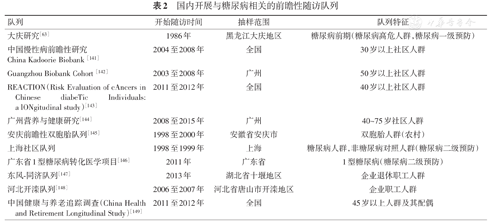
GanW, WaltersRG, HolmesMV, et al. Evaluation of type 2 diabetes genetic risk variants in Chinese adults: findings from 93, 000 individuals from the China Kadoorie Biobank[J]. Diabetologia, 2016, 59(7):1446-1457. .
[142]
JiangC, ThomasGN, LamTH, et al. Cohort profile: The Guangzhou Biobank Cohort Study, a Guangzhou-Hong Kong-Birmingham collaboration[J]. Int J Epidemiol, 2006, 35(4):844-852. .
[143]
NingG. Risk Evaluation of cAncers in Chinese diabeTic Individuals: a lONgitudinal (REACTION) study[J]. J Diabetes, 2012, 4(2):172-173. .
[144]
ZhengJS, LinJS, DongHL, et al. Association of erythrocyte n-3 polyunsaturated fatty acids with incident type 2 diabetes in a Chinese population[J]. Clin Nutr, 2018, .
[145]
WangG, RadovickS, XuX, et al. Strategy for early identification of prediabetes in lean populations: new insight from a prospective Chinese twin cohort of children and young adults[J]. Diabetes Res Clin Pract, 2018, 146:101-110. .
[146]
YangD, DengH, LuoG, et al. Demographic and clinical characteristics of patients with type 1 diabetes mellitus: a multicenter registry study in Guangdong, China[J]. J Diabetes, 2016, 8(6):847-853. .
[147]
何美安,张策,朱江,等.东风-同济队列研究:研究方法及调查对象基线和第一次随访特征[J].中华流行病学杂志,2016,37(4):480-485. .
[148]
WangA, ChenG, SuZ, et al. Risk scores for predicting incidence of type 2 diabetes in the Chinese population: the Kailuan prospective study[J]. Sci Rep, 2016, 6:26548. .
[149]
ZhaoY, HuY, SmithJP, et al. Cohort profile: the China Health and Retirement Longitudinal Study (CHARLS)[J]. Int J Epidemiol, 2014, 43(1):61-68. .
[150]
WuL, LuY, JiaoY, et al. Paternal psychological stress reprograms hepatic gluconeogenesis in offspring[J]. Cell Metab, 2016, 23(4):735-743. .
[151]
ZhangCS, HawleySA, ZongY, et al. Fructose-1, 6-bisphosphate and aldolase mediate glucose sensing by AMPK[J]. Nature, 2017, 548(7665):112-116. .
[152]
DengD, YanN. Crystallization and structural determination of the human glucose transporters GLUT1 and GLUT3[J]. Methods Mol Biol, 2018, 1713:15-29. .
[153]
DengD, XuC, SunP, et al. Crystal structure of the human glucose transporter GLUT1[J]. Nature, 2014, 510(7503):121-125. .
[154]
DengD, SunP, YanC, et al. Molecular basis of ligand recognition and transport by glucose transporters[J]. Nature, 2015, 526(7573):391-396. .
[155]
YangD, de GraafC, YangL, et al. Structural determinants of binding the seven-transmembrane domain of the glucagon-like peptide-1 receptor (GLP-1R)[J]. J Biol Chem, 2016, 291(25):12991-13004. .
[156]
DengD, SunP, YanC, et al. Molecular basis of ligand recognition and transport by glucose transporters[J]. Nature, 2015, 526(7573):391-396. .
[157]
QiuWL, ZhangYW, FengY, et al. Deciphering pancreatic islet β cell and α cell maturation pathways and characteristic features at the single-cell level[J].Cell Metab, 2018, 27(3):702. .
[158]
SunJ, NiQ, XieJ, et al. β-Cell dedifferentiation in patients with T2D with adequate glucose control and nondiabetic chronic pancreatitis[J].J Clin Endocrinol Metab, 2019, 104(1):83-94. .
[159]
NingG, BiY, WangT, et al. Relationship of urinary bisphenol A concentration to risk for prevalent type 2 diabetes in Chinese adults: a cross-sectional analysis[J]. Ann Intern Med, 2011, 155(6):368-374. .
[160]
HaoM, DingL, XuanL, et al. Urinary bisphenol A concentration and the risk of central obesity in Chinese adults: a prospective study[J]. J Diabetes, 2018, 10(6):442-448. .
[161]
WangN, ChenY, NingZ, et al. Exposure to famine in early life and nonalcoholic fatty liver disease in adulthood[J]. J Clin Endocrinol Metab, 2016, 101(5):2218-2225. .
[162]
SunY, ZhangL, DuanW, et al. Association between famine exposure in early life and type 2 diabetes mellitus and hyperglycemia in adulthood: Results from the China Health And Retirement Longitudinal Study (CHARLS)[J]. J Diabetes, 2018, 10(9):724-733. .
[163]
ZhangX, ShenD, FangZ, et al. Human gut microbiota changes reveal the progression of glucose intolerance[J]. PLoS One, 2013, 8(8):e71108. .
[164]
LiuR, HongJ, XuX, et al. Gut microbiome and serum metabolome alterations in obesity and after weight-loss intervention[J]. Nat Med, 2017, 23(7):859-868. .
[165]
刘海霞,李晶,刘奔,等.阿卡波糖对2型糖尿病患者粪便中双歧杆菌数量的影响[J].中华内分泌代谢杂志,2011,27(11):928-931. .
[166]
ZhangX, FangZ, ZhangC, et al. Effects of acarbose on the gut microbiota of prediabetic patients: a randomized, double-blind, controlled crossover trial[J]. Diabetes Ther, 2017, 8(2):293-307. .
[167]
GuY, WangX, LiJ, et al. Analyses of gut microbiota and plasma bile acids enable stratification of patients for antidiabetic treatment[J]. Nat Commun, 2017, 8(1):1785. .
[168]
WangS, DengY, XieX, et al. Plasma bile acid changes in type 2 diabetes correlated with insulin secretion in two-step hyperglycemic clamp[J]. J Diabetes, 2018, 10(11):874-885. .
[169]
LinSC, HardieDG. AMPK: sensing glucose as well as cellular energy status[J]. Cell Metab, 2018, 27(2):299-313. .
[170]
LiuDM, MosialouI, LiuJM. Bone: another potential target to treat, prevent and predict diabetes[J]. Diabetes Obes Metab, 2018, 20(8):1817-1828. .
[171]
DengH, DaiY, LuH, et al. Analysis of the correlation between non-alcoholic fatty liver disease and bone metabolism indicators in healthy middle-aged men[J]. Eur Rev Med Pharmacol Sci, 2018, 22(5):1457-1462. .
[172]
LiuB, JiangS, LiM, et al. Proteome-wide analysis of USP14 substrates revealed its role in hepatosteatosis via stabilization of FASN[J]. Nat Commun, 2018, 9(1):4770. .
[173]
ZhaoXY, XiongX, LiuT, et al. Long noncoding RNA licensing of obesity-linked hepatic lipogenesis and NAFLD pathogenesis[J]. Nat Commun, 2018, 9(1):2986. .
[174]
FengWH, BiY, LiP, et al. Effects of liraglutide, metformin and gliclazide on body composition in patients with both type 2 diabetes and non-alcoholic fatty liver disease: A randomized trial[J]. J Diabetes Investig, 2018, .
[175]
JuJ, LiJ, LinQ, et al. Efficacy and safety of berberine for dyslipidaemias: a systematic review and meta-analysis of randomized clinical trials[J]. Phytomedicine, 2018, 50:25-34. .
[176]
LiangY, XuX, YinM, et al. Effects of berberine on blood glucose in patients with type 2 diabetes mellitus: a systematic literature review and a meta-analysis[J]. Endocr J, 2019, 66(1):51-63. .
[177]
WangY, ShouJW, LiXY, et al. Berberine-induced bioactive metabolites of the gut microbiota improve energy metabolism[J]. Metabolism, 2017, 70:72-84. .
[178]
XuJ, LianF, ZhaoL, et al. Structural modulation of gut microbiota during alleviation of type 2 diabetes with a Chinese herbal formula[J]. ISME J, 2015, 9(3):552-562. .
[179]
ZhangY, WangW, NingG. Study on the efficacy and safety of Jinlida in patients with inadequately controlled type-2 diabetes and dyslipidemia under life style intervention (ENJOY LIFE Study)[J]. J Diabetes, 2015, 7(2):268-269. .
[180]
MitchellSJ, BernierM, MattisonJA, et al. Daily fasting improves health and survival in male mice independent of diet composition and calories[J]. Cell Metab, 2018, 29(1): 221-228.e3.
[181]
LiL, GuW, ZhuD. Novel therapy for type 1 diabetes: autologous hematopoietic stem cell transplantation[J]. J Diabetes, 2012, 4(4):332-337. .
[182]
中华医学会糖尿病分会.中华医学会糖尿病学分会关于干细胞移植治疗糖尿病下肢动脉病变的立场声明[J].中华糖尿病杂志,2010,2(6):404-409. .
[183]
中华医学会糖尿病学分会.中华医学会糖尿病学分会关于干细胞移植治疗糖尿病的立场声明[J].中华糖尿病杂志,2010,2(6):401-403. .