

探讨肝型和脑型肝豆状核变性(Wilson disease,WD)患者头颅MRI影像学表现、眼底检查及其实验室检查的差异性。
回顾性收集陆军军医大学第一附属医院2009年至2019年度经实验室基因检测确诊的89例WD患者(脑型44例,肝型45例)的铜蓝蛋白、血清铜、眼底检查及头颅MRI检查的结果并进行分析,对MRI异常信号进行量化评定标准评分,并对不同临床类型的WD患者临床指标和影像结果进行比较。
脑型和肝型WD患者KF环的阳性率无统计学差异(P=0.946>0.05);脑型WD患者血清铜及铜蓝蛋白的含量明显低于肝型WD患者(P<0.001),WD患者中脑型比肝型发病年龄更早、且发病时长更长(P=0.043,0.013<0.05),脑型WD患者脑部MRI除苍白球、丘脑、小脑外其余各部位出现异常信号比率均高于肝型患者(P<0.05)。两型患者在苍白球、丘脑的信号异常范围评分差异并无统计学意义(P>0.05),而累积程度评分脑型患者明显高于肝型患者(P<0.05);两型患者在小脑区域信号异常范围和累积程度分数差异无统计学意义(P=0.779>0.05)。脑型WD患者脑部MRI的T2序列范围及程度总分与发病时长呈正相关(r=0.315,P=0.038);而肝型WD患者无相关性。
WD患者颅脑影像同时累及基底节区和脑干是肝型和脑型WD患者特征性影像表现。脑型患者颅内异常信号发生率、发病时长、以及颅内病变范围和程度均高于肝型患者。通过MRI检查T2序列的量化性评价可以在一定程度上反映和评估WD患者脑部的病理学阶段和程度。



本刊刊出的所有论文不代表本刊编委会的观点,除非特别声明
肝豆状核变性又称Wilson病(Wilson disease,WD),是Wilson于1912年首次报道的一种常染色体隐性遗传,铜元素代谢障碍性疾病,其致病基因是ATPase-Cu2+转运β多肽基因(ATP7B),最常见的致病变异位点是Arg778Leu[1]。ATP7B基因突变导致铜离子代谢紊乱,引起合成铜蓝蛋白数量的减少,并导致铜在肝、脑、角膜等器官内病理性沉积[2]。其常见的临床表现包括进行性肝损害、神经精神障碍与角膜色素环(Kayer-Fleischer环, K-F环)等[3]。WD患者根据首发临床症状不同可分四种类型[4]:(1)脑型;(2)肝型;(3)其他类型(肾脏功能损害、骨肌损伤、溶血性贫血等);(4)混合型。笔者通过对89例脑型和肝型WD患者的颅脑MRI图像的影像学特点、血清铜及铜蓝蛋白含量、眼底检查结果进行回顾性总结分析,探讨本病的脑部影像学表现、血清铜及铜蓝蛋白含量、K-F环的阳性率与临床分型的关系。
回顾性分析2009年至2019年陆军军医大学第一附属医院经基因检测确诊为WD的89例患者,其中男47例,女42例,平均年龄(24.5±11.7)岁,发病年龄最大的57岁,最小的7岁。本研究经过本单位医学伦理委员会批准(批件号:KY2020081),免除受试者知情同意。纳入标准:(1)基因检测及实验室血清学指标诊断明确;(2)符合“肝豆状核变性的诊断与治疗指南”临床分型的标准[4]。排除标准:(1)患有其他颅脑病变患者或患有其他金属代谢性疾病患者;(2)其他类型WD患者;(3)混合型WD患者;(4)临床资料不完整或检查不全。89例患者按照临床类型分为肝型45例,脑型44例。不同临床类型的纳入标准分别为:(1)肝型WD患者临床表现:Ⅰ血清转氨酶持续性地升高;Ⅱ急性或慢性肝炎;Ⅲ肝硬化;Ⅳ暴发性肝功能衰竭。(2)脑型WD患者临床表现:Ⅰ帕金森症;Ⅱ锥体外系运动障碍,表现为扭转痉挛、舞蹈症状、四肢徐动、步态异常、共济失调等。
收集WD患者血清铜蓝蛋白、血清铜离子浓度、眼底筛查及头颅MRI检查的结果。通过原子吸收分光光度计火焰法测定血清铜、铜蓝蛋白浓度。通过裂隙灯检查眼底。全部MRI检查均在Siemens Magnetom Spectra 3.0 T磁共振上完成,患者仰卧位,采用8通道头颅线圈。扫描序列为快速自选回波序列,扫描范围:颅底至颅顶。扫描参数:T1WI TR 37 ms,TE 5 ms;T2WI TR 6000 ms,TE 89 ms,层厚5 mm,层间距1 mm。根据SINHA等对MRI异常信号的量化评定标准[5],在T2加权成像上,将WD的异常信号分为高、低、混杂信号三种,采用双盲法,由2名影像科医生分别对苍白球、壳核、尾状核、丘脑、中脑、桥脑、延髓、小脑的病变范围及程度,选取病变最严重的层面进行评分,如意见不一由另一名高年资神经影像专家评估决定。各部位得分0分为阴性,1~3分为阳性。评分标准见表1、图1, 2, 3, 4, 5, 6, 7, 8。

Wilson病患者脑部MRI的T2序列评分标准
T2 sequence scoring criteria for brain MRI in WD patients
Wilson病患者脑部MRI的T2序列评分标准
T2 sequence scoring criteria for brain MRI in WD patients
| 病变 | 0分 | 1分 | 2分 | 3分 |
|---|---|---|---|---|
| 范围 | 无异常 | 病灶范围<1/3 | 病灶范围<2/3且>1/3 | 病灶范围>2/3 |
| 程度 | 无异常 | 大致等于或低于皮质 | 高于皮质信号,低于水信号 | 大致等同于脑室内水信号 |

两型WD患者的年龄、血清学指标、发病年龄、发病时长、MRI评分采用t检验比较。性别、K-F环阳性率、异常信号出现比率比较用卡方检验。颅脑异常信号量化指标和临床指标的相关性采用皮尔逊相关性分析。各项数据均应用软件SPSS 25.0分析完成。
两型WD患者K-F环的阳性率无统计学差异(P>0.05);脑型WD患者血清铜及铜蓝蛋白的含量明显低于肝型WD患者(P<0.001),本组WD患者中脑型比肝型发病年龄更早、且发病时长更长(P<0.05)。其他指标差异均无统计学意义(表2)。
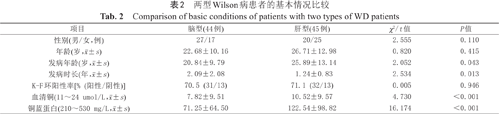
两型Wilson病患者的基本情况比较
Comparison of basic conditions of patients with two types of WD patients
两型Wilson病患者的基本情况比较
Comparison of basic conditions of patients with two types of WD patients
| 项目 | 脑型(44例) | 肝型(45例) | χ2/t值 | P值 |
|---|---|---|---|---|
| 性别(男/女,例) | 27/17 | 20/25 | 2.555 | 0.110 |
| 年龄(岁,±s) | 22.68±10.16 | 26.71±12.98 | 0.820 | 0.415 |
| 发病年龄(岁,±s) | 20.84±9.79 | 25.89±13.14 | 2.052 | 0.043 |
| 发病时长(年,±s) | 2.09±2.08 | 1.24±0.83 | 2.534 | 0.013 |
| K-F环阳性率[% (阳性/阴性)] | 70.5 (31/13) | 71.1 (32/13) | 0.005 | 0.946 |
| 血清铜(11~24 umol/L,±s) | 7.82±9.51 | 10.52±9.57 | 4.730 | <0.001 |
| 铜蓝蛋白(210~530 mg/L,±s) | 71.25±64.50 | 122.54±98.82 | 16.174 | <0.001 |
脑型WD患者脑部MRI除苍白球、丘脑、小脑外其余各部位出现异常信号比率均高于肝型患者,差异有统计学意义(P<0.05) (表3)。评分比较结果显示两型患者在苍白球、丘脑的信号异常范围评分差异并无统计学意义(P>0.05) (表4),而累积程度评分脑型患者明显高于肝型患者(P<0.05);小脑区域两型在信号异常范围和累积程度分数差异无统计学意义(P>0.05) (表4)。
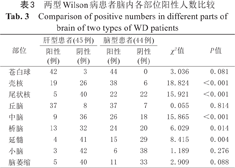
两型Wilson病患者脑内各部位阳性人数比较
Comparison of positive numbers in different parts of brain of two types of WD patients
两型Wilson病患者脑内各部位阳性人数比较
Comparison of positive numbers in different parts of brain of two types of WD patients
| 部位 | 肝型患者(45例) | 脑型患者(44例) | χ2值 | P值 | ||
|---|---|---|---|---|---|---|
| 阳性(例) | 阴性(例) | 阳性(例) | 阴性(例) | |||
| 苍白球 | 42 | 3 | 44 | 0 | 3.036 | 0.081 |
| 壳核 | 19 | 26 | 38 | 6 | 18.824 | <0.001 |
| 尾状核 | 5 | 40 | 22 | 22 | 15.921 | <0.001 |
| 丘脑 | 37 | 8 | 37 | 7 | 0.055 | 0.814 |
| 中脑 | 9 | 36 | 26 | 18 | 15.865 | <0.001 |
| 桥脑 | 13 | 32 | 24 | 20 | 6.029 | 0.014 |
| 延髓 | 4 | 41 | 15 | 29 | 8.415 | 0.004 |
| 小脑 | 3 | 42 | 6 | 38 | 1.189 | 0.276 |
| 脑萎缩 | 5 | 40 | 11 | 33 | 2.909 | 0.088 |
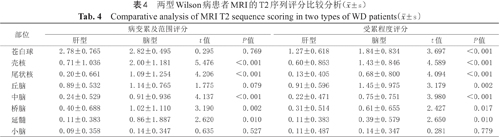
两型Wilson病患者MRI的T2序列评分比较分析(±s)
Comparative analysis of MRI T2 sequence scoring in two types of WD patients(±s)
两型Wilson病患者MRI的T2序列评分比较分析(±s)
Comparative analysis of MRI T2 sequence scoring in two types of WD patients(±s)
| 部位 | 病变累及范围评分 | 受累程度评分 | ||||||
|---|---|---|---|---|---|---|---|---|
| 肝型 | 脑型 | t值 | P值 | 肝型 | 脑型 | t值 | P值 | |
| 苍白球 | 2.78±0.765 | 2.82±0.495 | 0.295 | 0.769 | 1.27±0.618 | 1.84±0.834 | 3.697 | <0.001 |
| 壳核 | 0.71±1.036 | 2.00±1.181 | 5.476 | <0.001 | 0.60±0.863 | 1.43±0.846 | 4.589 | <0.001 |
| 尾状核 | 0.20±0.661 | 1.09±1.254 | 4.206 | <0.001 | 0.13±0.405 | 0.68±0.800 | 4.094 | <0.001 |
| 丘脑 | 0.89±0.532 | 1.14±0.765 | 1.775 | 0.079 | 0.91±0.596 | 1.45±0.975 | 3.179 | 0.002 |
| 中脑 | 0.24±0.529 | 0.91±0.936 | 4.137 | <0.001 | 0.22±0.471 | 0.75±0.751 | 3.980 | <0.001 |
| 桥脑 | 0.40±0.688 | 1.02±1.110 | 3.190 | 0.002 | 0.31±0.514 | 0.61±0.655 | 2.427 | 0.017 |
| 延髓 | 0.11±0.383 | 0.86±1.887 | 2.620 | 0.010 | 0.11±0.383 | 0.39±0.579 | 2.650 | 0.010 |
| 小脑 | 0.09±0.358 | 0.14±0.347 | 0.635 | 0.527 | 0.11±0.487 | 0.14±0.347 | 0.281 | 0.779 |
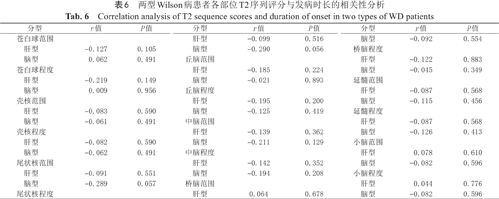
不同临床类型WD患者临床指标和MRI指标的相关性结果显示如表5:脑型WD患者发病时长与脑部MRI的T2序列评分呈正相关。肝型WD患者发病时长与脑部MRI的T2序列评分无相关性。两型发病年龄及确诊年龄与脑部MRI的T2序列评分无相关性。肝型、脑型WD患者颅脑各部位T2序列评分与发病时长无相关性(表6)。
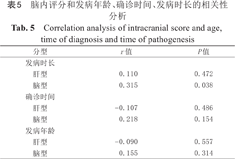
脑内评分和发病年龄、确诊时间、发病时长的相关性分析
Correlation analysis of intracranial score and age, time of diagnosis and time of pathogenesis
脑内评分和发病年龄、确诊时间、发病时长的相关性分析
Correlation analysis of intracranial score and age, time of diagnosis and time of pathogenesis
| 分型 | r值 | P值 |
|---|---|---|
| 发病时长 | ||
| 肝型 | 0.110 | 0.472 |
| 脑型 | 0.315 | 0.038 |
| 确诊时间 | ||
| 肝型 | -0.107 | 0.486 |
| 脑型 | 0.218 | 0.154 |
| 发病年龄 | ||
| 肝型 | -0.090 | 0.557 |
| 脑型 | 0.155 | 0.314 |
两型Wilson病患者各部位T2序列评分与发病时长的相关性分析
Correlation analysis of T2 sequence scores and duration of onset in two types of WD patients
两型Wilson病患者各部位T2序列评分与发病时长的相关性分析
Correlation analysis of T2 sequence scores and duration of onset in two types of WD patients
| 分型 | r值 | P值 | 分型 | r值 | P值 | 分型 | r值 | P值 | ||
| 苍白球范围 | 肝型 | -0.099 | 0.516 | 脑型 | -0.092 | 0.554 | ||||
| 肝型 | -0.127 | 0.105 | 脑型 | -0.290 | 0.056 | 桥脑程度 | ||||
| 脑型 | 0.062 | 0.491 | 丘脑范围 | 肝型 | -0.122 | 0.883 | ||||
| 苍白球程度 | 肝型 | -0.185 | 0.224 | 脑型 | -0.045 | 0.349 | ||||
| 肝型 | -0.219 | 0.149 | 脑型 | -0.021 | 0.893 | 延髓范围 | ||||
| 脑型 | 0.009 | 0.956 | 丘脑程度 | 肝型 | -0.087 | 0.568 | ||||
| 壳核范围 | 肝型 | -0.195 | 0.200 | 脑型 | -0.115 | 0.456 | ||||
| 肝型 | -0.083 | 0.590 | 脑型 | -0.125 | 0.419 | 延髓程度 | ||||
| 脑型 | -0.061 | 0.491 | 中脑范围 | 肝型 | -0.087 | 0.568 | ||||
| 壳核程度 | 肝型 | -0.139 | 0.362 | 脑型 | -0.126 | 0.413 | ||||
| 肝型 | -0.082 | 0.590 | 脑型 | -0.211 | 0.129 | 小脑范围 | ||||
| 脑型 | -0.062 | 0.491 | 中脑程度 | 肝型 | 0.078 | 0.610 | ||||
| 尾状核范围 | 肝型 | -0.142 | 0.352 | 脑型 | -0.082 | 0.596 | ||||
| 肝型 | -0.091 | 0.551 | 脑型 | -0.194 | 0.208 | 小脑程度 | ||||
| 脑型 | -0.289 | 0.057 | 桥脑范围 | 肝型 | 0.044 | 0.776 | ||||
| 尾状核程度 | 肝型 | 0.064 | 0.678 | 脑型 | -0.082 | 0.596 |
WD患者发病年龄大多位于5~35岁[6]。有研究提出[7]以肝功能损害为首发症状的患者(多小于20岁)发病年龄低于以运动功能障碍症状起病的患者(30~40岁)。更多研究表明[8, 9]脑型WD患者发病年龄要早于肝型患者。本组病例中WD脑型患者的平均发病年龄(20.84±9.786)低于肝型平均发病年龄(25.89±13.141),儿童患者均为脑型,30岁以上患者中76.4%(13例)为肝型,与既往研究结果一致。这可能是因为运动障碍症状及异常精神障碍、睡眠障碍和自主神经紊乱等[10]的临床症状相对肝脏损伤的临床症状更易被发现,而晚发型WD患者(>30岁)脑中主要以铜离子沉积为主,对细胞造成的损伤轻微,因此神经和精神症状表现轻[11]。
WD的发病机制是由于ATP7B基因突变造成编码蛋白错误的折叠,使得铜离子在肝脏、脑、角膜缘等组织器官中渐进性沉积[12, 13, 14]。本组研究中发现脑型WD患者的血铜、铜蓝蛋白平均含量(7.82±9.51,71.25±64.50)要明显低于肝型患者(10.52±9.57,122.54±98.82),笔者猜测这可能是因为脑型WD患者血脑屏障破坏后,铜离子在脑部沉积导致血铜、铜蓝蛋白含量进一步下降所致。有学者证实[15]合并肝细胞衰竭的患者脑代谢物(NAA、NAA/Cr和NAA/Cho比值)相对无此表现的患者显著降低,提示肝功能衰竭先于并参与神经系统损伤,脑型WD患者的脑内代谢物与肝型WD患者相比明显下降,从而证实了笔者观点。
铜沉积于角膜边缘后,眼底检查时可在角膜缘观测棕黄色的K-F环,这是诊断WD的主要临床证据之一。有学者[16]发现绝大部分脑型患者可检测出K-F环的存在,而以肝脏功能性损害为初始症状的肝型患者仅50%~60%检出K-F环。本组研究中脑型、肝型患者K-F环的阳性率并无统计学差异。这可能是因为本组病例中患者发病时间短,可疑患者统计为阴性所致。
少数学者认为铜在颅内广泛均匀沉积分布[17],但更多的研究[18]认为,铜在颅内并非均匀分布,而呈对称性分布,本研究结果也佐证了此观点。有研究证实WD患者颅内病变MRI序列中T2序列的敏感度最高,为89.7%,T1和FLAIR序列的敏感度相对稍低,均为76.5%[19],本研究以T2序列作为两型比较主要序列。由于铜最容易沉积在苍白球和黑质中,在T2序列大都显示为对称性低信号;其次为壳核、丘脑,以混杂性的信号为主,这是由于铜离子不均匀沉积造成的顺磁性作用和组织水肿、胶质细胞增生共同作用的结果;尾状核、脑干及小脑相对受累较轻,以组织水肿和胶质细胞增生为主,一般表现为高信号。
本研究中发现脑型WD患者除了苍白球、丘脑以外脑部各部位发病率均高于肝型患者;而两型患者在苍白球、丘脑的发病率、累积范围相近,并无显著差异,其原因在于苍白球和丘脑是脑内最易受累的部位,因此两型患者均可受累,但包括苍白球和丘脑在内的各部位严重程度脑型患者均要高于肝型患者。两型患者小脑的发病率、程度和范围并无显著差异,笔者猜测这主要是因为小脑相对其他部位不易受累,统计样本量不足所致。本研究中同样发现脑型WD患者发病时长与脑部MRI的T2序列范围及程度总分有相关性;肝型WD患者发病时长与脑部MRI的T2序列范围及程度总分无相关性;肝型、脑型WD患者颅脑各部位范围及程度评分与发病时长无相关性。这就提示颅内病变严重程度有可能与血脑屏障的破坏程度、铜的沉积时间、细胞损伤的严重程度有关,但基于个体差异性,颅内病变的严重程度与临床症状并非完全一致。
WD的颅脑MRI表现通常典型,但应与先天遗传代谢性疾病造成的脑部病变、营养不良性脑病、多发性硬化和肝性脑病等[20]进行鉴别。有学者表示在颅脑MRI表现中,“八字征”、“啄木鸟征”、“蝴蝶征”、中脑“大熊猫脸”征、“脑桥中央髓鞘溶解”等并不能作为WD的特异性表现,只有基底节、丘脑和脑干同时出现信号异常才是WD的特异性表现,有助于和上述疾病相鉴别[21]。本研究结果显示5例脑型患者表现为T1对称性高信号,这可能与锰及铁等金属沉积引起的顺磁性相关[22]。
综上所述,WD脑型患者发病年龄低于肝型患者,血清中铜蓝蛋白及铜离子浓度均低于肝型患者,两者K-F环的发生率并无显著性差异。同时累及基底节区和脑干是WD患者特征性影像表现。而脑型患者,其颅内异常信号比率、发病时长、以及颅内病变范围和程度均高于肝型患者。以磁共振为基础的量化分析可以在一定程度上[23]反映和评估WD患者脑部的病理阶段、范围和程度,解释临床症状的发生,对临床工作起到一定的指导和帮助。
全体作者均声明无利益冲突。


