调查研究
阿尔茨海默病默认网络和海马功能连接研究:一项基于SDM的Meta分析
磁共振成像, 2022,13(3) : 54-60. DOI: 10.12015/issn.1674-8034.2022.03.011
摘要
目的

以往研究表明海马和默认网络(default-mode network,DMN)易受阿尔茨海默病(Alzheimer′s disease,AD)的影响,而这两个系统的静息态功能连接(resting-state functional connectivity,rsFC)随AD进程表现出不同的变化模式。本文采用Meta分析方法研究AD及其早期轻度认知障碍(mild cognitive impairment,MCI)基于DMN和海马为种子点的rsFC变化特征。

材料与方法

基于Meta分析标准化程序对PubMed和 Web of Science数据库进行全面检索,采用标记差异映射分析(signed differential mapping,SDM)对纳入12篇基于种子点的全脑体素rsFC研究进行分析。

结果

以海马为种子点,AD患者内侧前额叶(medial prefrontal cortex,MPFC) rsFC较健康对照组(healthy controls,HC)显著下降。以DMN脑区为种子点,AD患者MPFC、中央沟盖、海马和海马旁回等区域rsFC下降;MCI患者右侧后扣带回(posterior cingulate cortex,PCC) rsFC下降,而右侧中央前回rsFC增强。

结论

海马和DMN前部MPFC之间rsFC下降是AD的重要影像学特征,而MCI主要损伤DMN后部PCC,同时在中央前回(感觉运动区)表现出代偿性增强。该结果明确了DMN和海马在AD和MCI的不同变化模式,可为AD的识别和干预效果评估提供影像学参考。


引用本文: 陆冠琴, 张守字, 李锐. 阿尔茨海默病默认网络和海马功能连接研究:一项基于SDM的Meta分析 [J] . 磁共振成像, 2022, 13(3) : 54-60. DOI: 10.12015/issn.1674-8034.2022.03.011.
参考文献导出:   Endnote    NoteExpress    RefWorks    NoteFirst    医学文献王
扫  描  看  全  文

正文
作者信息
基金 0  关键词  0
English Abstract
评论
阅读 0  评论  0
相关资源
引用 | 论文 | 视频

本刊刊出的所有论文不代表本刊编委会的观点,除非特别声明

阿尔茨海默病(Alzheimer′s disease,AD)是老年群体中常见的一种神经退行性疾病,其神经病理学改变主要体现为神经纤维缠结和淀粉样蛋白沉积[1]。随着影像学技术的发展,正电子发射计算机断层扫描(positron emission computed tomography,PET)、磁共振成像(magnetic resonance imaging,MRI)、功能磁共振成像(functional magnetic resonance imaging,fMRI) [尤其是静息态功能磁共振成像(resting-state functional magnetic resonance imaging,rs-fMRI)]等成像技术被广泛应用于AD脑成像研究。影像学研究认为AD是一种“失连接综合病”[2,3],表现为脑网络静息态功能连接(resting-state functional connectivity,rsFC)的异常[4],尤其是高级认知网络[5,6]

默认网络(default-mode network,DMN)是AD病理特征的核心网络[7],该网络主要包括后扣带回(posterior cingulate cortex,PCC)、内侧前额叶(medial prefrontal cortex,MPFC)、楔前叶和顶下小叶等区域,并与海马、海马旁回等内侧颞叶系统存在连接。Greicius等[8]基于独立成分分析(independent component analysis,ICA),首次发现AD患者DMN rsFC存在异常,表现为PCC和海马之间的rsFC下降,提示DMN异常的脑活动变化是早期识别AD的生物学标志。随后近二十年神经影像学研究围绕AD开展了大量研究,这些研究为AD患者基于DMN和海马为种子点的rsFC异常提供了丰富的证据[9, 10, 11, 12, 13]。许多研究表明在正常衰老和AD的过渡阶段-轻度认知障碍(mild cognitive impairment,MCI)中DMN rsFC已发生异常,主要表现为rsFC下降[14, 15, 16],然而也有研究证实了他们还存在不同的rsFC模式。例如Qi等[17]基于ICA发现MCI患者的双侧楔前叶、PCC、右侧顶下小叶rsFC下降,而MPFC、顶下小叶、颞中回rsFC增加。Gardini等[18]发现MCI患者PCC与MPFC之间rsFC增加。通过对DMN脑区的进一步划分,有研究表明AD患者DMN脑区也存在不同的rsFC模式。例如Damoiseaux等[19]基于ICA发现AD患者DMN后部rsFC下降,而DMN前部rsFC增加。Chiesa等[20]对携带AD遗传风险的个体研究结果也表明DMN后部rsFC下降,而DMN前部和外部的rsFC增加。

海马是连接大脑内侧颞叶系统前颞区域(anterior-temporal,AT)和后内侧区域(posterior-medial,PM)的重要脑区[21, 22]。AT主要包括外侧颞叶皮层、外侧眶额皮层和杏仁核;PM包含DMN部分区域、丘脑和枕叶[23, 24]。大多数的研究表明,MCI和AD患者海马和PM网络中的DMN区域(如PCC)之间rsFC下降[25, 26]。但Gardini等[18]探讨MCI患者语义记忆障碍与脑网络rsFC之间关系的研究表明,PCC与海马之间的rsFC增加。Miller等[27]基于认知任务,发现MCI患者海马的激活程度先增加后下降,并认为该模式的拐点可作为认知行为异常的标志。这些研究结果的不一致性反映了AD发生发展过程中,全脑rsFC基于DMN及海马为种子点发生变化的复杂性,因此对其rsFC的变化模式仍需进一步明确。

DMN及海马受损与AD患者认知损害的严重程度有关,MPFC、PCC及海马等脑区在情景记忆的编码和提取等认知过程中起关键作用[7,28]。DMN连接异常与AD病程之间有较强的相关性[29]。PCC、楔前叶及海马为功能易损区,其rsFC下降及内侧颞叶、眶额结构的萎缩可识别转归为AD的MCI患者[30],Ibrahim等[31]基于机器学习方法发现DMN的节点可区分AD和MCI患者。此外,AD最早的临床阶段表现为主观认知下降,该阶段患者双侧海马尾部的灰质体积显著减少,且伴随着rsFC下降[32],rsFC改变可能是认知下降的早期迹象[33, 34, 35],Xu等[36]采用机器学习方法发现DMN和双侧海马间异常的连接模式可有效识别患者主观认知下降。因此,研究DMN及海马对于理解AD的早期识别标志具有重要意义。

MCI和AD患者的DMN和海马的连接模式复杂而多变。虽然目前尚未发现DMN连接指标可以作为MCI或AD患者确切的生物标志物[37],但rsFC仍有望用于AD的早期诊断[38]。AD患者DMN和海马区域异常的连接模式是目前研究普遍的共识,但异常模式具体表现为rsFC降低和增加同时存在。其次,目前还没有大量的研究表明这些改变是如何随着疾病的发展而变化[39],同时也缺乏在大尺度脑网络水平上总体描述MCI和AD影响脑网络连接的研究[38]。因此,DMN和海马区域与AD病程相关的连接模式仍需进一步探究。以往关于AD、MCI患者研究结果的不一致性可能是受到单个研究的被试数量较少、特定实验操作等原因的影响。基于此,本研究采用标记差异映射分析(signed differential mapping,SDM)进行Meta分析,在增加研究被试数量的同时对以往的研究结果进行二次系统地分析,以此来发现AD和MCI患者rsFC的变化特征,增加以往研究结果的可信性,并为AD的早期识别或早期干预提供影像学依据。

1 方法
1.1 文献选取

系统检索了PubMed、Web of Science数据库,文献发表时间为2000年1月至2020年9月。检索关键词包括“mild cognitive impairment”“MCI”“Alzheimer”“Alzheimer′s”“AD”“older”“elderly”“aging”and“functional magnetic resonance imaging”“functional MRI”“fMRI”and“rest”“resting”and“connectivity”。纳入标准:(1)基于种子点分析全脑rsFC的研究;(2)报告AD、MCI患者与健康对照组(healthy controls,HC)之间存在显著的rsFC差异;(3)报告组间比较具有统计意义的空间坐标[使用蒙特利尔神经病学研究所(Montreal Neurological Institute,MNI)或Talarach空间坐标系]。排除标准:(1)使用基于rs-fMRI以外的神经成像方法,如任务态、PET;(2)基于种子点分析全脑rsFC以外的方法;(3)缺乏年龄相匹配的HC;(4)缺乏基线数据比较的纵向研究;(5)仅报告组内比较结果的研究;(6)未提供组间比较具有统计意义的空间坐标。

1.2 数据分析

采用SDM软件对纳入的文献进行Meta分析,即提取研究中AD、MCI患者相对于HC组rsFC有显著性差异的脑区坐标和t值,如纳入的研究结果为z值或P值,需要将其转换为t值(使用www.sdmproject.com/utilities/?show=Statistics)。本研究采用无阈值簇群增强(threshold free cluster enhancement,TFCE)对rsFC有显著差异的区域进行校正。

2 结果
2.1 纳入分析的文献

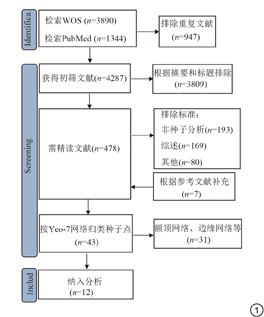
运用以上关键词进行主题检索,共检索到5234篇文献。排除重复文献947篇,根据标题、摘要排除被试非AD、MCI患者、非rsFC等3809篇,通过全文精读排除442篇(其中综述169篇,非种子点分析193篇,无对照组、无统计学意义的空间坐标等80篇)。根据以上步骤排除后剩36篇文献,通过参考文献补充了7篇文献。

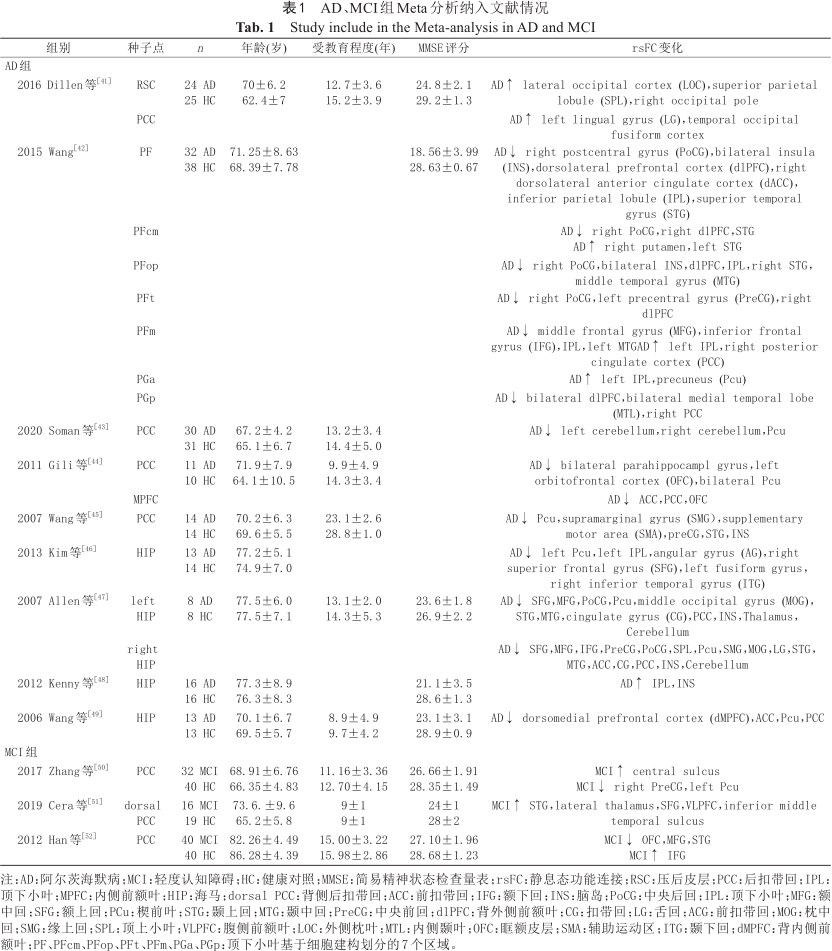
由于有文献未报告种子点所在的脑网络,我们将其按照Yeo的7个脑功能网络模板[40]进行归类。关于AD文献25篇,MCI文献共有18篇。其中,研究AD DMN文献有5篇、边缘网络6篇(海马4篇、杏仁核2篇)、额顶网络3篇,突显网络2篇,背侧注意网络2篇,腹侧注意网络2篇,其他5篇;研究MCI DMN 3篇、边缘网络4篇(海马1篇、梭状回2篇、丘脑1篇)、额顶网络4篇、突显网络3篇、背侧注意网络2篇,腹侧注意网络2篇。基于DMN、海马与AD关系密切,我们将其作为种子点探讨其在AD和MCI中rsFC的变化情况。最终纳入Meta分析文献12篇,其中研究AD 9篇(以DMN脑区为种子点5篇,以海马为种子点4篇),MCI 3篇(均以DMN脑区为种子点),见表1图1。纳入研究均通过同行评议。

点击查看表格
表1

AD、MCI组Meta分析纳入文献情况

Tab. 1

Study include in the Meta-analysis in AD and MCI

表1

AD、MCI组Meta分析纳入文献情况

Tab. 1

Study include in the Meta-analysis in AD and MCI

组别种子点n年龄(岁)受教育程度(年)MMSE评分rsFC变化
AD组

2016 Dillen等41

RSC

24 AD

25 HC

70±6.2

62.4±7

12.7±3.6

15.2±3.9

24.8±2.1

29.2±1.3

AD↑ lateral occipital cortex (LOC),superior parietal lobule (SPL),right occipital pole
PCCAD↑ left lingual gyrus (LG),temporal occipital fusiform cortex

2015 Wang42

PF

32 AD

38 HC

71.25±8.63

68.39±7.78

18.56±3.99

28.63±0.67

AD↓ right postcentral gyrus (PoCG),bilateral insula (INS),dorsolateral prefrontal cortex (dlPFC),right dorsolateral anterior cingulate cortex (dACC),inferior parietal lobule (IPL),superior temporal gyrus (STG)
PFcm

AD↓ right PoCG,right dlPFC,STG

AD↑ right putamen,left STG

PFopAD↓ right PoCG,bilateral INS,dlPFC,IPL,right STG,middle temporal gyrus (MTG)
PFtAD↓ right PoCG,left precentral gyrus (PreCG),right dlPFC
PFmAD↓ middle frontal gyrus (MFG),inferior frontal gyrus (IFG),IPL,left MTGAD↑ left IPL,right posterior cingulate cortex (PCC)
PGaAD↑ left IPL,precuneus (Pcu)
PGpAD↓ bilateral dlPFC,bilateral medial temporal lobe (MTL),right PCC

2020 Soman等43

PCC

30 AD

31 HC

67.2±4.2

65.1±6.7

13.2±3.4

14.4±5.0

AD↓ left cerebellum,right cerebellum,Pcu

2011 Gili等44

PCC

11 AD

10 HC

71.9±7.9

64.1±10.5

9.9±4.9

14.3±3.4

AD↓ bilateral parahippocampl gyrus,left orbitofrontal cortex (OFC),bilateral Pcu
MPFCAD↓ ACC,PCC,OFC

2007 Wang等45

PCC

14 AD

14 HC

70.2±6.3

69.6±5.5

23.1±2.6

28.8±1.0

AD↓ Pcu,supramarginal gyrus (SMG),supplementary motor area (SMA),preCG,STG,INS

2013 Kim等46

HIP

13 AD

14 HC

77.2±5.1

74.9±7.0

AD↓ left Pcu,left IPL,angular gyrus (AG),right superior frontal gyrus (SFG),left fusiform gyrus,right inferior temporal gyrus (ITG)

2007 Allen等47

left HIP

8 AD

8 HC

77.5±6.0

77.5±7.1

13.1±2.0

14.3±5.3

23.6±1.8

26.9±2.2

AD↓ SFG,MFG,PoCG,Pcu,middle occipital gyrus (MOG),STG,MTG,cingulate gyrus (CG),PCC,INS,Thalamus,Cerebellum
right HIPAD↓ SFG,MFG,IFG,PreCG,PoCG,SPL,Pcu,SMG,MOG,LG,STG,MTG,ACC,CG,PCC,INS,Cerebellum

2012 Kenny等48

HIP

16 AD

16 HC

77.3±8.9

76.3±8.3

21.1±3.5

28.6±1.3

AD↑ IPL,INS

2006 Wang等49

HIP

13 AD

13 HC

70.1±6.7

69.5±5.7

8.9±4.9

9.7±4.2

23.1±3.1

28.9±0.9

AD↓ dorsomedial prefrontal cortex (dMPFC),ACC,Pcu,PCC
MCI组

2017 Zhang等50

PCC

32 MCI

40 HC

68.91±6.76

66.35±4.83

11.16±3.36

12.70±4.15

26.66±1.91

28.35±1.49

MCI↑ central sulcus

MCI↓ right PreCG,left Pcu

2019 Cera等51

dorsal PCC

16 MCI

19 HC

73.6.±9.6

65.2±5.8

9±1

9±1

24±1

28±2

MCI↑ STG,lateral thalamus,SFG,VLPFC,inferior middle temporal sulcus

2012 Han等52

PCC

40 MCI

40 HC

82.26±4.49

86.28±4.39

15.00±3.22

15.98±2.86

27.10±1.96

28.68±1.23

MCI↓ OFC,MFG,STG

MCI↑ IFG

注:AD:阿尔茨海默病;MCI:轻度认知障碍;HC:健康对照;MMSE:简易精神状态检查量表;rsFC:静息态功能连接;RSC:压后皮层;PCC:后扣带回;IPL:顶下小叶;MPFC:内侧前额叶;HIP:海马;dorsal PCC:背侧后扣带回;ACC:前扣带回;IFG:额下回;INS:脑岛;PoCG:中央后回;IPL:顶下小叶;MFG:额中回;SFG:额上回;PCu:楔前叶;STG:颞上回;MTG:颞中回;PreCG:中央前回;dlPFC:背外侧前额叶;CG:扣带回;LG:舌回;ACG:前扣带回;MOG:枕中回;SMG:缘上回;SPL:顶上小叶;VLPFC:腹侧前额叶;LOC:外侧枕叶;MTL:内侧颞叶;OFC:眶额皮层;SMA:辅助运动区;ITG:颞下回;dMPFC:背内侧前额叶;PF、PFcm、PFop、PFt、PFm、PGa、PGp:顶下小叶基于细胞建构划分的7个区域。

点击查看大图
图1
研究筛选过程。
Fig. 1
Study selection process.
点击查看大图
图1
研究筛选过程。
Fig. 1
Study selection process.
2.2 Meta分析结果

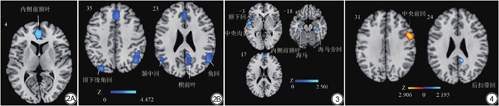
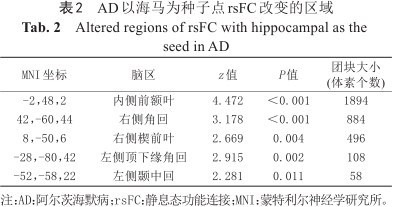
以海马为种子点,AD较HC组MPFC rsFC显著下降(P<0.05,TFCE校正;图2A)。在未校正水平(P<0.05)下,AD右侧角回和楔前叶等DMN脑区的rsFC也出现下降(表2图2B)。

点击查看大图
图2
阿尔茨海默病组以海马为种子点静息态功能连接降低的脑区。2A:P<0.05,无阈值簇群增强(TFCE)校正;2B:P<0.05,未校正。
图3
阿尔茨海默病组以默认网络为种子点静息态功能连接降低的脑区(P<0.05,未校正)。
图4
轻度认知障碍组以默认网络为种子点静息态功能连接改变的脑区降低(蓝色),静息态功能连接增加(红色) (P<0.05,未校正)。
Fig. 2
Brain regions of Alzheimer's disease show decreased rsFC with hippocampal as the seed. 2A: P<0.05, corrected with threshold free cluster enhancement (TFCE); 2B: P<0.05, uncorrected.
Fig. 3
Brain regions of Alzheimer's disease show decreased rsFC with default-mode network as the seed (P<0.05,uncorrected).
Fig. 4
Brain regions of mild cognitive impairment show decreased rsFC (blue) and increased rsFC (red) with default-mode network as the seed (P<0.05,uncorrected).
点击查看大图
图2
阿尔茨海默病组以海马为种子点静息态功能连接降低的脑区。2A:P<0.05,无阈值簇群增强(TFCE)校正;2B:P<0.05,未校正。
图3
阿尔茨海默病组以默认网络为种子点静息态功能连接降低的脑区(P<0.05,未校正)。
图4
轻度认知障碍组以默认网络为种子点静息态功能连接改变的脑区降低(蓝色),静息态功能连接增加(红色) (P<0.05,未校正)。
Fig. 2
Brain regions of Alzheimer's disease show decreased rsFC with hippocampal as the seed. 2A: P<0.05, corrected with threshold free cluster enhancement (TFCE); 2B: P<0.05, uncorrected.
Fig. 3
Brain regions of Alzheimer's disease show decreased rsFC with default-mode network as the seed (P<0.05,uncorrected).
Fig. 4
Brain regions of mild cognitive impairment show decreased rsFC (blue) and increased rsFC (red) with default-mode network as the seed (P<0.05,uncorrected).
点击查看表格
表2

AD以海马为种子点rsFC改变的区域

Tab. 2

Altered regions of rsFC with hippocampal as the seed in AD

表2

AD以海马为种子点rsFC改变的区域

Tab. 2

Altered regions of rsFC with hippocampal as the seed in AD

MNI坐标脑区zP团块大小(体素个数)
-2,48,2内侧前额叶4.472<0.0011894
42,-60,44右侧角回3.178<0.001884
8,-50,6右侧楔前叶2.6690.004496
-28,-80,42左侧顶下缘角回2.9150.002108
-52,-58,22左侧颞中回2.2810.01158

注:AD:阿尔茨海默病;rsFC:静息态功能连接;MNI:蒙特利尔神经学研究所。

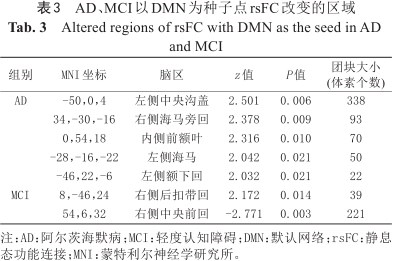
以DMN脑区为种子点,在TFCE校正水平下未发现显著结果。在未校正水平(P<0.05)下,AD患者左侧中央沟盖、右侧海马旁回等脑区的rsFC较HC组下降;MCI患者较HC组的右侧PCC rsFC下降,而右侧中央前回rsFC增加(P<0.05;表3图34)。

点击查看表格
表3

AD、MCI以DMN为种子点rsFC改变的区域

Tab. 3

Altered regions of rsFC with DMN as the seed in AD and MCI

表3

AD、MCI以DMN为种子点rsFC改变的区域

Tab. 3

Altered regions of rsFC with DMN as the seed in AD and MCI

组别MNI坐标脑区zP团块大小(体素个数)
AD-50,0,4左侧中央沟盖2.5010.006338
34,-30,-16右侧海马旁回2.3780.00993
0,54,18内侧前额叶2.3160.01070
-28,-16,-22左侧海马2.0420.02150
-46,22,-6左侧额下回2.0320.02122
MCI8,-46,24右侧后扣带回2.1720.01439
54,6,32右侧中央前回-2.7710.003221

注:AD:阿尔茨海默病;MCI:轻度认知障碍;DMN:默认网络;rsFC:静息态功能连接;MNI:蒙特利尔神经学研究所。

3 讨论

基于DMN和海马脑区在AD病理生理机制中起关键作用,我们将其作为种子点,对MCI、AD患者的rsFC变化进行了Meta分析。以海马为种子点,AD患者DMN前部区域MPFC rsFC显著下降;角回、楔前叶等DMN后部区域rsFC下降。以DMN脑区为种子点,AD患者MPFC、中央沟盖、海马和海马旁回等区域rsFC下降;MCI患者PCC rsFC下降,而右侧中央前回rsFC增强。本研究结果明确了DMN和海马在AD和MCI的不同变化模式,可为AD的识别和干预效果评估提供影像学参考。

3.1 AD患者脑网络rsFC变化

海马与MPFC之间rsFC显著下降是AD患者的重要特征。MPFC与认知加工密切相关,其rsFC异常先于其他脑区的结构性病理改变[53],这为研究者将MPFC的异常变化作为潜在的生物标志提供了依据。如Josef Golubic等[54]基于脑磁图识别AD患者的研究表明,MPFC的激活异常有望成为诊断AD的生物学标志。此外,海马和MPFC在处理信息中分别扮演“驱动”和“聚集”枢纽的角色。海马是影响脑功能活动的重要驱动力,而MPFC是汇聚信息的重要整合力[55],两者之间的通路对记忆、学习等高级认知功能起关键作用[56, 57]。我们的结果发现AD患者海马和MPFC之间rsFC显著下降,表明该rsFC异常是AD患者认知受损的重要特征。

AD患者海马与角回、楔前叶等DMN后部区域之间的rsFC下降,这一发现与Li等[58]先前的Meta分析结果一致。本研究结果支持了先前认为其易受病理学影响的研究[59]。AD的病理学研究表明,神经纤维缠结最早发现于内侧颞叶结构,海马是首先受到影响的大脑区域之一[60],其rsFC强度与内侧顶叶的tau蛋白积累相关[61]。DMN也容易受到tau蛋白的影响,该脑区与tau病理聚集的脑区相重叠[62]。PET研究也表明AD患者早期的DMN rsFC就已受到脑病理改变的影响,其rsFC下降与淀粉样蛋白沉淀有关[63, 64]。随着淀粉样蛋白的累积,DMN rsFC先增加后降低[65],而Jones等[66]通过研究AD不同阶段(前临床期、前驱期及临床期) DMN的子系统表明,DMN后部rsFC下降先于淀粉样蛋白沉淀,提示DMN后部rsFC异常可能是AD潜在的生物学标志。此外,Zhao等[67]分析DMN与认知之间关系的研究表明,与HC组相比,AD患者楔前叶rsFC降低,且与简易精神状态检查量表(MMSE)评分显著正相关。Wang等[68]基于多种rs-fMRI的研究表明,角回rsFC变化在ROC曲线分析中表现最佳,能有效预测AD患者。

DMN与海马旁回、中央沟盖间rsFC下降,这一发现支持了海马旁易受病理学影响的研究。Ge等[69]基于PET的研究表明,与淀粉样蛋白阴性组相比,AD患者海马旁回tau蛋白沉淀显著增加。Park等[70]研究也发现AD患者中央沟盖rsFC降低。

3.2 MCI患者脑网络rsFC变化

MCI和AD患者的连接模式不一致,具体表现为MCI患者PCC rsFC下降而中央前回增加。PCC是AD早期最脆弱的脑区之一[71],其rsFC异常为更好地理解MCI患者的大脑机制提供一个新思路[51],如PCC可能是监测AD进展的影像学标志[72]。Ibrahim等[31]基于机器学习分析MCI患者DMN连接模式的研究表明,PCC与前扣带回之间的rsFC下降。Sörensen等[73]基于PET的研究也表明,PCC的脑糖代谢模式有望预测转归为AD的MCI患者。

MCI患者DMN与中央前回之间rsFC增加可能是代偿脑机制起作用的结果。中央前回与感觉运动、注意等认知过程有关。Min等[74]基于脑功能局部一致性(regional homogeneity,ReHo)分析,发现遗忘型MCI患者中央前回、额下回等区域的ReHo增强。Behfar等[75]基于脑区体积变化及图论分析表明,MCI患者中央前回、额中回等脑区虽然局部萎缩,但其与认知相关的脑区rsFC增加,提示该现象可能是代偿机制作用的结果。Lenzi等[76]通过注意任务发现MCI患者中央前回的激活高于HC组,且该脑区的激活程度与神经心理学评分强相关,提示中央前回激活增加可能与代偿机制相关。Wang等[77]通过个体代谢连接组学表明,中央前回、楔前叶及额下回等脑区的代谢异常可有效识别转归为AD的MCI患者。我们基于Meta分析的结果进一步明确中央前回可能是参与MCI代偿机制的重要区域。这些代偿机制通过调用其他脑区参与认知活动来减缓与脑损伤相关的认知缺陷,但随着病情的加重,发挥代偿的脑区最终也会受损,甚至无法发挥作用。因此,某些脑区表现出rsFC异常增加的现象在AD后期阶段可能会消失。

3.3 局限性

本研究存在一定的局限性。首先,本研究采用了较为严格的排除标准,导致最终纳入分析的文献数量较少,削弱了rsFC的变化发现。MCI患者以海马为种子点文献数量只有1篇,故未将其纳入Meta分析。由于文献数量较少,未能实现按照Yeo的7个脑功能网络作为种子点分析全脑的rsFC。MCI和AD患者通常伴随着认知能力的下降,而认知能力与注意网络、突显网络、额顶网络关系密切,后续的研究可以进一步扩大脑网络将其作为对象进行探讨,为确定AD不同阶段特有的rsFC变化模式提供影像学依据。其次,本研究纳入的研究全部集中在rsFC上,而多参数MRI的结合可以提高诊断MCI和AD的准确性。近年来,动态功能连接在区分健康人群和AD患者研究方面取得了重要进展[78]。结构磁共振成像和功能磁共振成像的结合可以提供大脑结构和功能变化的信息,进一步分析脑影像变化与认知表现之间的相关关系等,这些方法均有助于疾病的识别和预测。

本研究基于Meta方法对MCI和AD患者以DMN和海马为种子点的rsFC改变进行了系统量化分析。结果表明,海马与MPFC之间rsFC显著下降是AD患者重要的脑影像特征。MCI患者DMN脑区与右侧中央前回间的rsFC增加,提示该现象可能是代偿机制作用的结果。

志      谢
ACKNOWLEDGMENTS

National Natural Science Foundation of China (No. 61673374, 62177004).

利益冲突
作者利益冲突声明:

全体作者均声明无利益冲突。

参考文献References
[1]
DeTureMA, DicksonDW. The neuropathological diagnosis of Alzheimer's disease[J]. Mol Neurodegener, 2019, 14(1): 32. DOI:10.1186/s13024-019-0333-5.
[2]
RaseroJ, Alonso-MontesC, DiezI, et al. Group-level progressive alterations in brain connectivity patterns revealed by diffusion-tensor brain networks across severity stages in Alzheimer's disease[J]. Front Aging Neurosci, 2017, 9: 215. DOI:10.3389/fnagi.2017.00215.
[3]
TeipelS, GrotheMJ, ZhouJ, et al. Measuring cortical connectivity in Alzheimer's disease as a brain neural network pathology: toward clinical applications[J]. J Int Neuropsychol Soc, 2016, 22(2): 138-163. DOI:10.1017/S1355617715000995.
[4]
JalilianhasanpourR, BeheshtianE, SherbafG, et al. Functional connectivity in neurodegenerative disorders: Alzheimer's disease and frontotemporal dementia[J]. Top Magn Reson Imaging, 2019, 28(6): 317-324. DOI:10.1097/RMR.0000000000000223.
[5]
WatanabeH, BagarinaoE, YokoiT, et al. Tau accumulation and network breakdown in Alzheimer's disease[J]. Adv Exp Med Biol, 2019, 1184: 231-240. DOI:10.1007/978-981-32-9358-8_19.
[6]
LiR, YuJ, ZhangSZ, et al. Bayesian network analysis reveals alterations to default mode network connectivity in individuals at risk for Alzheimer's disease[J]. PLoS One, 2013, 8(12): e82104. DOI:10.1371/journal.pone.0082104.
[7]
ZhongYF, HuangLY, CaiSP, et al. Altered effective connectivity patterns of the default mode network in Alzheimer's disease: an fMRI study[J]. Neurosci Lett, 2014, 578: 171-175. DOI:10.1016/j.neulet.2014.06.043.
[8]
GreiciusMD, SrivastavaG, ReissAL, et al. Default-mode network activity distinguishes Alzheimer's disease from healthy aging: evidence from functional MRI[J]. Proc Natl Acad Sci USA, 2004, 101(13): 4637-4642. DOI:10.1073/pnas.0308627101.
[9]
SohnWS, YooK, NaDL, et al. Progressive changes in hippocampal resting-state connectivity across cognitive impairment: a cross-sectional study from normal to Alzheimer disease[J]. Alzheimer Dis Assoc Disord, 2014, 28(3): 239-246. DOI:10.1097/WAD.0000000000000027.
[10]
XueJY, GuoH, GaoY, et al. Altered directed functional connectivity of the Hippocampus in mild cognitive impairment and Alzheimer's disease: a resting-state fMRI study[J]. Front Aging Neurosci, 2019, 11: 326. DOI:10.3389/fnagi.2019.00326.
[11]
SullivanMD, AndersonJAE, TurnerGR, et al. Intrinsic neurocognitive network connectivity differences between normal aging and mild cognitive impairment are associated with cognitive status and age[J]. Neurobiol Aging, 2019, 73: 219-228. DOI:10.1016/j.neurobiolaging.2018.10.001.
[12]
TherriaultJ, WangS, MathotaarachchiS, et al. Rostral-caudal hippocampal functional convergence is reduced across the Alzheimer's disease spectrum[J]. Mol Neurobiol, 2019, 56(12): 8336-8344. DOI:10.1007/s12035-019-01671-0.
[13]
QiHH, LiuH, HuHM, et al. Primary disruption of the memory-related subsystems of the default mode network in Alzheimer's disease: resting-state functional connectivity MRI study[J]. Front Aging Neurosci, 2018, 10: 344. DOI:10.3389/fnagi.2018.00344.
[14]
CaiSP, ChongT, PengYL, et al. Altered functional brain networks in amnestic mild cognitive impairment: a resting-state fMRI study[J]. Brain Imaging Behav, 2017, 11(3): 619-631. DOI:10.1007/s11682-016-9539-0.
[15]
TahmasianM, PasquiniL, ScherrM, et al. The lower hippocampus global connectivity, the higher its local metabolism in Alzheimer disease[J]. Neurology, 2015, 84(19): 1956-1963. DOI:10.1212/WNL.0000000000001575.
[16]
DasSR, PlutaJ, MancusoL, et al. Anterior and posterior MTL networks in aging and MCI[J]. Neurobiol Aging, 2015, 36Suppl 1(0 1): S141-S150, S150.e1. DOI:10.1016/j.neurobiolaging.2014.03.041.
[17]
QiZG, WuX, WangZQ, et al. Impairment and compensation coexist in amnestic MCI default mode network[J]. Neuroimage, 2010, 50(1): 48-55. DOI:10.1016/j.neuroimage.2009.12.025.
[18]
GardiniS, VenneriA, SambataroF, et al. Increased functional connectivity in the default mode network in mild cognitive impairment: a maladaptive compensatory mechanism associated with poor semantic memory performance[J]. J Alzheimers Dis, 2015, 45(2): 457-470. DOI:10.3233/JAD-142547.
[19]
DamoiseauxJS, PraterKE, MillerBL, et al. Functional connectivity tracks clinical deterioration in Alzheimer's disease[J]. Neurobiol Aging, 2012, 33(4): 828.e19-828.e30. DOI:10.1016/j.neurobiolaging.2011.06.024.
[20]
ChiesaPA, CavedoE, ListaS, et al. Revolution of resting-state functional neuroimaging genetics in Alzheimer's disease[J]. Trends Neurosci, 2017, 40(8): 469-480. DOI:10.1016/j.tins.2017.06.002.
[21]
RanganathC, RitcheyM. Two cortical systems for memory-guided behaviour[J]. Nat Rev Neurosci, 2012, 13(10): 713-726. DOI:10.1038/nrn3338.
[22]
ZhuoJJ, FanLZ, LiuY, et al. Connectivity profiles reveal a transition subarea in the parahippocampal region that integrates the anterior temporal-posterior medial systems[J]. J Neurosci, 2016, 36(9): 2782-2795. DOI:10.1523/JNEUROSCI.1975-15.2016.
[23]
HughesRE, NikolicK, RamsayRR. One for all? hitting multiple Alzheimer's disease targets with one drug[J]. Front Neurosci, 2016, 10: 177. DOI:10.3389/fnins.2016.00177.
[24]
MatthewsPM, HampshireA. Clinical concepts emerging from fMRI functional connectomics[J]. Neuron, 2016, 91(3): 511-528. DOI:10.1016/j.neuron.2016.07.031.
[25]
TamA, DansereauC, BadhwarA, et al. Common effects of amnestic mild cognitive impairment on resting-state connectivity across four independent studies[J]. Front Aging Neurosci, 2015, 7: 242. DOI:10.3389/fnagi.2015.00242.
[26]
BellecP, BenhajaliY, CarbonellF, et al. Impact of the resolution of brain parcels on connectome-wide association studies in fMRI[J]. Neuroimage, 2015, 123: 212-228. DOI:10.1016/j.neuroimage.2015.07.071.
[27]
MillerSL, FenstermacherE, BatesJ, et al. Hippocampal activation in adults with mild cognitive impairment predicts subsequent cognitive decline[J]. J Neurol Neurosurg Psychiatry, 2008, 79(6): 630-635. DOI:10.1136/jnnp.2007.124149.
[28]
XuP, ChenA, LiY, et al. Medial prefrontal cortex in neurological diseases[J]. Physiol Genomics, 2019, 51(9): 432-442. DOI:10.1152/physiolgenomics.00006.2019.
[29]
HafkemeijerA, van der GrondJ, RomboutsSA. Imaging the default mode network in aging and dementia[J]. Biochim Biophys Acta, 2012, 1822(3): 431-441. DOI:10.1016/j.bbadis.2011.07.008.
[30]
SerraL, CercignaniM, MastropasquaC, et al. Longitudinal changes in functional brain connectivity predicts conversion to Alzheimer's disease[J]. J Alzheimers Dis, 2016, 51(2): 377-389. DOI:10.3233/JAD-150961.
[31]
IbrahimB, SuppiahS, IbrahimN, et al. Diagnostic power of resting-state fMRI for detection of network connectivity in Alzheimer's disease and mild cognitive impairment: a systematic review[J]. Hum Brain Mapp, 2021, 42(9): 2941-2968. DOI:10.1002/hbm.25369.
[32]
LiangLY, ZhaoLH, WeiYC, et al. Structural and functional hippocampal changes in subjective cognitive decline from the community[J]. Front Aging Neurosci, 2020, 12: 64. DOI:10.3389/fnagi.2020.00064.
[33]
WangY, RisacherSL, WestJD, et al. Altered default mode network connectivity in older adults with cognitive complaints and amnestic mild cognitive impairment[J]. J Alzheimers Dis, 2013, 35(4): 751-760. DOI:10.3233/JAD-130080.
[34]
王晓妮, 盛灿, 韩璎. 主观认知下降生物标记物研究进展[J]. 医学研究生学报, 2015, 28(4): 423-426. DOI:10.16571/j.cnki.1008-8199.2015.04.023.
WangXN, ShengC, HanY. Progress of biomarkers for subjective cognitive decline[J]. J Med Postgrad, 2015, 28(4): 423-426. DOI:10.16571/j.cnki.1008-8199.2015.04.023.
[35]
SiT, XingGQ, HanY. Subjective cognitive decline and related cognitive deficits[J]. Front Neurol, 2020, 11: 247. DOI:10.3389/fneur.2020.00247.
[36]
XuXW, LiWK, TaoML, et al. Effective and accurate diagnosis of subjective cognitive decline based on functional connection and graph theory view[J]. Front Neurosci, 2020, 14: 577887. DOI:10.3389/fnins.2020.577887.
[37]
EylerLT, ElmanJA, HattonSN, et al. Resting state abnormalities of the default mode network in mild cognitive impairment: a systematic review and meta-analysis[J]. J Alzheimers Dis, 2019, 70(1): 107-120. DOI:10.3233/JAD-180847.
[38]
BadhwarA, TamA, DansereauC, et al. Resting-state network dysfunction in Alzheimer's disease: a systematic review and meta-analysis[J]. Alzheimers Dement (Amst), 2017, 8: 73-85. DOI:10.1016/j.dadm.2017.03.007.
[39]
HohenfeldC, WernerCJ, ReetzK. Resting-state connectivity in neurodegenerative disorders: is there potential for an imaging biomarker?[J]. Neuroimage Clin, 2018, 18: 849-870. DOI:10.1016/j.nicl.2018.03.013.
[40]
YeoBT, KrienenFM, SepulcreJ, et al. The organization of the human cerebral cortex estimated by intrinsic functional connectivity[J]. J Neurophysiol, 2011, 106(3): 1125-1165. DOI:10.1152/jn.00338.2011.
[41]
DillenKNH, JacobsHIL, KukoljaJ, et al. Aberrant functional connectivity differentiates retrosplenial cortex from posterior cingulate cortex in prodromal Alzheimer's disease[J]. Neurobiol Aging, 2016, 44: 114-126. DOI:10.1016/j.neurobiolaging.2016.04.010.
[42]
WangZQ, XiaMR, DaiZJ, et al. Differentially disrupted functional connectivity of the subregions of the inferior parietal lobule in Alzheimer's disease[J]. Brain Struct Funct, 2015, 220(2): 745-762. DOI:10.1007/s00429-013-0681-9.
[43]
SomanSM, RaghavanS, RajeshPG, et al. Does resting state functional connectivity differ between mild cognitive impairment and early Alzheimer's dementia?[J]. J Neurol Sci, 2020, 418: 117093. DOI:10.1016/j.jns.2020.117093.
[44]
GiliT, CercignaniM, SerraL, et al. Regional brain atrophy and functional disconnection across Alzheimer's disease evolution[J]. J Neurol Neurosurg Psychiatry, 2011, 82(1): 58-66. DOI:10.1136/jnnp.2009.199935.
[45]
WangK, LiangM, WangL, et al. Altered functional connectivity in early Alzheimer's disease: a resting-state fMRI study[J]. Hum Brain Mapp, 2007, 28(10): 967-978. DOI:10.1002/hbm.20324.
[46]
KimJ, KimYH, LeeJH. Hippocampus-precuneus functional connectivity as an early sign of Alzheimer's disease: a preliminary study using structural and functional magnetic resonance imaging data[J]. Brain Res, 2013, 1495: 18-29. DOI:10.1016/j.brainres.2012.12.011.
[47]
AllenG, BarnardH, McCollR, et al. Reduced hippocampal functional connectivity in Alzheimer disease[J]. Arch Neurol, 2007, 64(10): 1482-1487. DOI:10.1001/archneur.64.10.1482.
[48]
KennyER, BlamireAM, FirbankMJ, et al. Functional connectivity in cortical regions in dementia with Lewy bodies and Alzheimer's disease[J]. Brain, 2012, 135(Pt 2): 569-581. DOI:10.1093/brain/awr327.
[49]
WangL, ZangYF, HeY, et al. Changes in hippocampal connectivity in the early stages of Alzheimer's disease: evidence from resting state fMRI[J]. Neuroimage, 2006, 31(2): 496-504. DOI:10.1016/j.neuroimage.2005.12.033.
[50]
ZhangYW, ZhaoZL, QiZG, et al. Local-to-remote cortical connectivity in amnestic mild cognitive impairment[J]. Neurobiol Aging, 2017, 56: 138-149. DOI:10.1016/j.neurobiolaging.2017.04.016.
[51]
CeraN, EspositoR, CieriF, et al. Altered cingulate cortex functional connectivity in normal aging and mild cognitive impairment[J]. Front Neurosci, 2019, 13: 857. DOI:10.3389/fnins.2019.00857.
[52]
HanSD, ArfanakisK, FleischmanDA, et al. Functional connectivity variations in mild cognitive impairment: associations with cognitive function[J]. J Int Neuropsychol Soc, 2012, 18(1): 39-48. DOI:10.1017/S1355617711001299.
[53]
JobsonDD, HaseY, ClarksonAN, et al. The role of the medial prefrontal cortex in cognition, ageing and dementia[J]. Brain Commun, 2021, 3(3): fcab125. DOI:10.1093/braincomms/fcab125.
[54]
Josef GolubicS, AineCJ, StephenJM, et al. MEG biomarker of Alzheimer's disease: absence of a prefrontal generator during auditory sensory gating[J]. Hum Brain Mapp, 2017, 38(10): 5180-5194. DOI:10.1002/hbm.23724.
[55]
LiR, ZhangJ, WuX, et al. Brain-wide resting-state connectivity regulation by the hippocampus and medial prefrontal cortex is associated with fluid intelligence[J]. Brain Struct Funct, 2020, 225(5): 1587-1600. DOI:10.1007/s00429-020-02077-8.
[56]
PrestonAR, EichenbaumH. Interplay of hippocampus and prefrontal cortex in memory[J]. Curr Biol, 2013, 23(17): R764-R773. DOI:10.1016/j.cub.2013.05.041.
[57]
MitraA, SnyderAZ, HackerCD, et al. Human cortical-hippocampal dialogue in wake and slow-wave sleep[J]. Proc Natl Acad Sci USA, 2016, 113(44): E6868-E6876. DOI:10.1073/pnas.1607289113.
[58]
LiWK, XuXW, WangZX, et al. Multiple connection pattern combination from single-mode data for mild cognitive impairment identification[J]. Front Cell Dev Biol, 2021, 9: 782727. DOI:10.3389/fcell.2021.782727.
[59]
YıldırımE, Soncu BüyükişcanE. Default mode network connectivity in alzheimers disease[J]. Turk Psikiyatri Derg, 2019, 30(4): 279-286.
[60]
BraakH, BraakE. Neuropathological stageing of alzheimer-related changes[J]. Acta Neuropathol, 1991, 82(4): 239-259. DOI:10.1007/BF00308809.
[61]
ZiontzJ, AdamsJN, HarrisonTM, et al. Hippocampal connectivity with retrosplenial cortex is linked to neocortical tau accumulation and memory function[J]. J Neurosci, 2021, 41(42): 8839-8847. DOI:10.1523/JNEUROSCI.0990-21.2021.
[62]
HoenigMC, BischofGN, SeemillerJ, et al. Networks of tau distribution in Alzheimer's disease[J]. Brain, 2018, 141(2): 568-581. DOI:10.1093/brain/awx353.
[63]
LiXZ, LiTQ, AndreasenN, et al. Ratio of Aβ42/P-tau181p in CSF is associated with aberrant default mode network in AD[J]. Sci Rep, 2013, 3: 1339. DOI:10.1038/srep01339.
[64]
WangL, BrierMR, SnyderAZ, et al. Cerebrospinal fluid Aβ42, phosphorylated Tau181, and resting-state functional connectivity[J]. JAMA Neurol, 2013, 70(10): 1242-1248. DOI:10.1001/jamaneurol.2013.3253.
[65]
SchultzAP, ChhatwalJP, HeddenT, et al. Phases of hyperconnectivity and hypoconnectivity in the default mode and salience networks track with amyloid and tau in clinically normal individuals[J]. J Neurosci, 2017, 37(16): 4323-4331. DOI:10.1523/JNEUROSCI.3263-16.2017.
[66]
JonesDT, Graff-RadfordJ, LoweVJ, et al. Tau, amyloid, and cascading network failure across the Alzheimer's disease spectrum[J]. Cortex, 2017, 97: 143-159. DOI:10.1016/j.cortex.2017.09.018.
[67]
ZhaoT, QuanMN, JiaJP. Functional connectivity of default mode network subsystems in the presymptomatic stage of autosomal dominant Alzheimer's disease[J]. J Alzheimers Dis, 2020, 73(4): 1435-1444. DOI:10.3233/JAD-191065.
[68]
WangSM, KimNY, KangDW, et al. A comparative study on the predictive value of different resting-state functional magnetic resonance imaging parameters in preclinical Alzheimer's disease[J]. Front Psychiatry, 2021, 12: 626332. DOI:10.3389/fpsyt.2021.626332.
[69]
GeXT, ZhangD, QiaoYC, et al. Association of tau pathology with clinical symptoms in the subfields of hippocampal formation[J]. Front Aging Neurosci, 2021, 13: 672077. DOI:10.3389/fnagi.2021.672077.
[70]
ParkKH, NohY, ChoiEJ, et al. Functional connectivity of the Hippocampus in early- and vs. late-onset Alzheimer's disease[J]. J Clin Neurol, 2017, 13(4): 387-393. DOI:10.3988/jcn.2017.13.4.387.
[71]
LeePL, ChouKH, ChungCP, et al. Posterior cingulate cortex network predicts Alzheimer's disease progression[J]. Front Aging Neurosci, 2020, 12: 608667. DOI:10.3389/fnagi.2020.608667.
[72]
YuEY, LiaoZL, MaoDW, et al. Directed functional connectivity of posterior cingulate cortex and whole brain in Alzheimer's disease and mild cognitive impairment[J]. Curr Alzheimer Res, 2017, 14(6): 628-635. DOI:10.2174/1567205013666161201201000.
[73]
SörensenA, BlazhenetsG, RückerG, et al. Prognosis of conversion of mild cognitive impairment to Alzheimer's dementia by voxel-wise Cox regression based on FDG PET data[J]. Neuroimage Clin, 2019, 21: 101637. DOI:10.1016/j.nicl.2018.101637.
[74]
MinJ, ZhouXX, ZhouF, et al. A study on changes of the resting-state brain function network in patients with amnestic mild cognitive impairment[J]. Braz J Med Biol Res, 2019, 52(5): e8244. DOI:10.1590/1414-431X20198244.
[75]
BehfarQ, BehfarSK, von ReuternB, et al. Graph theory analysis reveals resting-state compensatory mechanisms in healthy aging and prodromal Alzheimer's disease[J]. Front Aging Neurosci, 2020, 12: 576627. DOI:10.3389/fnagi.2020.576627.
[76]
LenziD, SerraL, PerriR, et al. Single domain amnestic MCI: a multiple cognitive domains fMRI investigation[J]. Neurobiol Aging, 2011, 32(9): 1542-1557. DOI:10.1016/j.neurobiolaging.2009.09.006.
[77]
WangM, YanZZ, XiaoSY, et al. A novel metabolic connectome method to predict progression to mild cognitive impairment[J]. Behav Neurol, 2020, 2020: 2825037. DOI:10.1155/2020/2825037.
[78]
SendiMSE, ZendehrouhE, FuZN, et al. Disrupted dynamic functional network connectivity among cognitive control networks in the progression of Alzheimer's disease[J]. Brain Connect, 2021, Online ahead of print. DOI:10.1089/brain.2020.0847.
 
 
展开/关闭提纲
查看图表详情
回到顶部
放大字体
缩小字体
标签
关键词