临床研究
基于ADC诊断局部晚期直肠癌新辅助治疗后完全缓解准确性的Meta分析
磁共振成像, 2022,13(8) : 36-42,54. DOI: 10.12015/issn.1674-8034.2022.08.007
摘要
目的

采用Meta分析的方法评价表观扩散系数(apparent diffusion coefficient, ADC)诊断局部晚期直肠癌新辅助治疗后完全缓解的准确性。

材料与方法

计算机检索PubMed、Embase、The Cochrane Library、中国知网(CNKI)、万方数据库(Wanfang Data)、中国生物医学文献数据库(CBM)和维普数据库(www.cqvip.com),收集ADC评价局部晚期直肠癌新辅助治疗疗效的研究。根据预先设定的纳入排除标准筛选文献后提取资料,并使用诊断准确性研究的质量评价工具修订版(Quality Assessment of Diagnostic Accuracy Studies 2, QUADAS-2)对纳入的研究进行方法质量学评价。排除阈值效应后计算合并的敏感度(sensitivity, SEN)、特异度(specificity, SPE)、阳性似然比(positive likelihood ratio, PLR)、阴性似然比(negative likelihood ratio, NLR)、诊断比值比(diagnostic odds ratio, DOR)等诊断性能指标,绘制森林图、分层综合受试者工作特征(hierarchical summary receiver-operating characteristic curves, HSROC)曲线,计算HSROC曲线下面积(area under the curve, AUC)及上述指标的95%可信区间(confidence intervals, CI)。

结果

最终共纳入34个诊断性试验,包含1914例直肠癌患者,纳入研究的ADC指标包括治疗前ADC、治疗后ADC以及治疗前后ADC值的变化率,治疗前ADC的合并SEN、SPE分别是0.76(95% CI:0.62~0.86)、0.68(95% CI:0.60~0.75),治疗后ADC的合并SEN、SPE分别是0.82(95% CI:0.72~0.88)、0.77(95% CI:0.71~0.82),ADC变化率的合并SEN、SPE分别是0.83(95% CI:0.77~0.87)、0.75(95% CI:0.67~0.81)。

结论

在不同ADC指标中,治疗后ADC以及ADC变化率诊断完全缓解的准确性较高,而治疗前ADC可用于预测肿瘤治疗反应。

引用本文: 李戟玭, 张文凯, 庄乐怡, 等.  基于ADC诊断局部晚期直肠癌新辅助治疗后完全缓解准确性的Meta分析 [J] . 磁共振成像, 2022, 13(8) : 36-42,54. DOI: 10.12015/issn.1674-8034.2022.08.007.
参考文献导出:   Endnote    NoteExpress    RefWorks    NoteFirst    医学文献王
扫  描  看  全  文

正文
作者信息
基金 0  关键词  0
English Abstract
评论
阅读 0  评论  0
相关资源
引用 | 论文 | 视频

本刊刊出的所有论文不代表本刊编委会的观点,除非特别声明

局部晚期直肠癌(locally advanced rectal cancer, LARC)被定义为T3或T4、伴或不伴淋巴结转移、但无远处转移的肿瘤(T3~T4和/或N+,M0)[1, 2]。目前LARC的主要治疗方式是新辅助放化疗(neoadjuvant chemoradiotherapy, nCRT)联合全直肠系膜切除术(total mesorectal excision, TME)[1, 2, 3, 4],新辅助治疗有助于LARC患者实现肿瘤降期、提高保肛率、降低局部复发率,从而提高其生存率[5, 6]。新辅助治疗后直肠癌患者可出现不同治疗反应,部分患者可出现疾病缓解,而小部分患者可能出现疾病进展[7]。LARC患者在接受nCRT后5~12周行手术治疗,然后经组织病理检查提示肿瘤完全消退被定义为病理完全缓解[8, 9, 10]。约有10%~30%直肠癌患者在接受新辅助治疗后可实现完全缓解,新辅助治疗后完全缓解组的患者与非完全缓解组的患者相比,局部复发率降低,生存率及预后有所改善[11, 12]。有研究表明新辅助治疗后达到完全缓解的患者不进行根治性手术治疗,而采用严格的随访和观察策略(watch-and-wait)是可行的,其局部无复发率、无病生存率及总体生存率与手术组相比无明显差异[11,13, 14, 15, 16]。由此可见,在新辅助治疗后手术治疗前,准确评估LARC的肿瘤反应,尤其是准确识别完全缓解有助于为患者制订侵入性较小的个性化治疗方案;并且提前预测治疗效果有助于及早调整和优化治疗[11]

盆腔MRI能清楚地显示直肠壁各层组织及直肠周围脂肪间隙,并且通过三维重建能将各个断面的成像整合为一体[17]。高场强MRI的优点是采集图像速度快,空间分辨率和信噪比高,因此使用高场强MRI能够改善直肠壁的可见性[18]。基于对直肠成像的优势,MRI被推荐为评估直肠癌新辅助治疗疗效的首选检查方法[16, 19, 20]

扩散加权成像(diffusion-weighted imaging, DWI)作为一种功能MRI,以水分子在细胞内外的自由扩散为基础,能够反映组织内部的微环境[21]。表观扩散系数(apparent diffusion coefficient, ADC)是评估水分子在组织内扩散的定量参数,即DWI的定量参数,其与组织细胞密度呈负相关[22]。目前大部分研究通过测量治疗前ADC值(pretreatment ADC, pre-ADC)、治疗后ADC值(posttreatment ADC, post-ADC)及治疗前后ADC变化率[ΔADC=(post-ADC-pre-ADC)/pre-ADC]评估直肠癌新辅助治疗后的肿瘤反应,然而ADC值在评估直肠癌新辅助治疗后完全缓解的诊断价值存在争议[23]。本文通过系统评价的方法,全面检索已发表的文献,评价基于ADC诊断LARC新辅助治疗后完全缓解的临床价值。

1 材料与方法
1.1 纳入与排除标准

本研究的纳入标准:(1)研究类型:国内外公开发表的关于ADC评估LARC新辅助治疗疗效的诊断性研究;(2)研究对象:明确诊断为非黏液型直肠癌的患者,患者年龄、种族不限;(3)诊断标准:ADC为待评价试验,术后组织病理检查为金标准;(4)测量的结局指标:合并的敏感度(sensitivity, SEN)、特异度(specificity, SPE)、阳性似然比(positive likelihood ratio, PLR)、阴性似然比(negative likelihood ratio, NLR)、诊断比值比(diagnosis odds ratios, DOR)、分层综合受试者工作特征(hierarchical summary receiver-operating characteristic curve, HSROC)曲线下面积(area under the curve, AUC)。排除标准:(1)未报告完全缓解的研究;(2)参照诊断方法不是术后组织病理检查结果;(3)研究数据不完整不能提取诊断数据信息:真阳性(true positive, TP)、假阳性(false positive, FP)、假阴性(false negative, FN)、真阴性(true negative, TN);(4)研究计划书、社论等文献类型;(5)重复的研究;(6)无法获取全文的研究。

1.2 文献检索策略

计算机全面检索数据库,包括中国知网(CNKI)、万方数据库(Wanfang Database)、中国生物医学文献数据库(CBM)、维普数据库、PubMed、Embase、The Cochrane Library,收集DWI诊断直肠癌新辅助治疗后完全缓解的相关文献,检索时间均由建库至2022年1月。采用自由词检索与主题词检索相结合的方法,所有检索式均通过预检后确定。英文检索词包括:“rectal cancer”“diffusion magnetic resonance imaging”“apparent diffusion coefficient”“sensitivity”和“specificity”,中文检索词包括:“直肠癌”“直肠肿瘤”“扩散磁共振成像”“敏感度”和“特异度”。同时对纳入文章的参考文献进行手动检索。

1.3 文献筛选

将检索的文献导入Endnote X8,首先查找并剔除重复文献,然后由2名研究者根据纳入及排除标准独立筛选文献,阅读文献题目及摘要进行初筛,再阅读全文筛选最终纳入的文献。如遇分歧,则讨论解决。对于缺乏资料的文献,尽量与原作者取得联系予以补充。

1.4 资料提取

采用Office Excel 2019设计资料提取表,资料提取的主要内容包括:(1)纳入研究信息:第一作者、国家、发表年份、研究类型(前瞻性/回顾性研究);(2)病例特征:研究对象的年龄、数量、性别、MRI与新辅助治疗的时间间隔、MRI与手术治疗时间间隔;(3)诊断方法特征:ADC类型、磁场强度、是否对病理结果盲法;(4)诊断数据信息:TP、FP、FN、TN。

1.5 纳入文献的质量学评价

由2名研究者采用诊断准确性研究的质量评价工具修订版(Quality Assessment of Diagnostic Accuracy Studies-2, QUADAS-2)对纳入研究进行偏倚风险评价[24],并交叉核对,意见不一致时通过讨论解决,讨论未果则由第3名研究人员协助判断。主要评价内容包括4个领域:病例的选择、待评价试验、金标准、病例流程和时间。所有组成部分在偏倚风险方面都会被评估,前3部分也会在临床适用性方面被评估。每一条标准以“是”(低度偏倚或适用性好)、“否”(高度偏倚或适用性差)和“不清楚”(缺乏相关信息或偏倚情况不确定)评价。

1.6 统计学分析

首先对纳入研究进行阈值效应检验,采用Spearman相关系数判断阈值效应,若P<0.05存在阈值效应,若P>0.05则不存在阈值效应。排除阈值效应后进行Cochran-Q检验并且计算I2值,若Cochran-Q检验的P<0.05或I2>50%,表明研究间的异质性由非阈值效应所致的可能性较大,分析异质性来源,按照可能产生异质性的因素进行Meta回归分析。使用Stata 15.0软件合并效应量,本研究采用双变量混合效应模型,基于“midas”命令计算合并的SEN、SPE、PLR、NLR、DOR,并绘制HSROC曲线,计算AUC。根据AUC值评价诊断方法的价值,当AUC为0.7~0.9时表示诊断方法准确性中等,当AUC>0.9时表示其诊断准确性较高。最后使用Stata 15.0绘制Deek's漏斗图(Deek's funnel plot asymmetry test)检测是否存在发表偏倚。

2 结果
2.1 文献筛选流程及结果

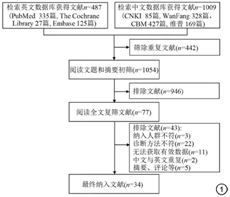
计算机检索共获得文献1496篇,导入Endnote X8软件筛除重复文献442篇,通过阅读剩余1054篇文献的题目和摘要后获得可能相关文献77篇,进一步阅读全文最终纳入34个诊断试验[22,25, 26, 27, 28, 29, 30, 31, 32, 33, 34, 35, 36, 37, 38, 39, 40, 41, 42, 43, 44, 45, 46, 47, 48, 49, 50, 51, 52, 53, 54, 55, 56, 57]。文献筛选流程及结果见图1

点击查看大图
图1
文献筛选流程图。
Fig. 1
Flow diagram of the literature selection for the meta-analysis.
点击查看大图
图1
文献筛选流程图。
Fig. 1
Flow diagram of the literature selection for the meta-analysis.
2.2 纳入文献基本特征和质量学评价结果
2.2.1 纳入文献基本特征

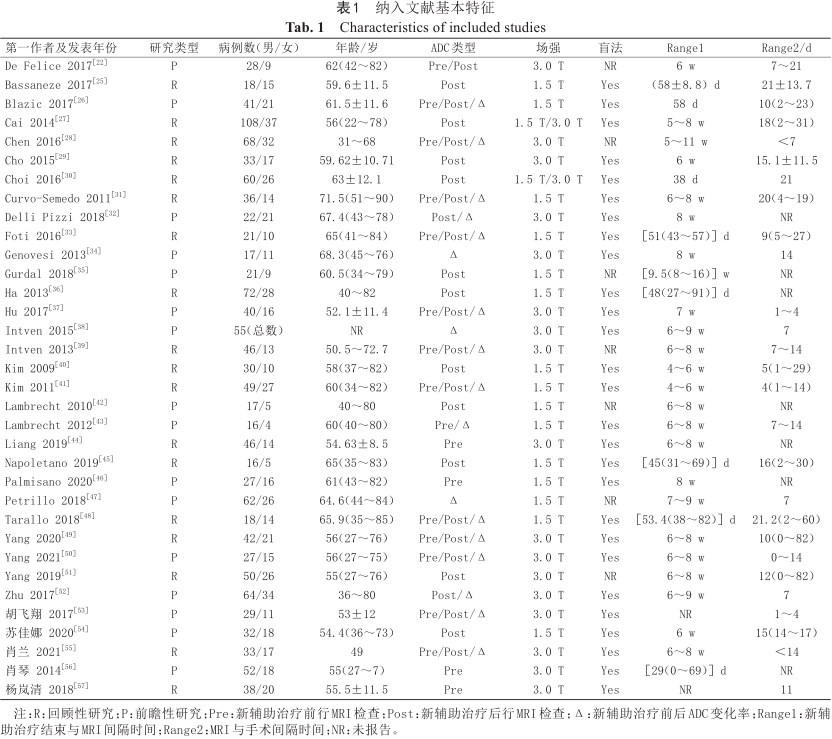
纳入文献基本特征见表1,共纳入34篇文献,共纳入LARC患者1914例,其中达到完全缓解的患者有758例。纳入文献中有5篇中文文献,29篇英文文献;18篇回顾性研究,16篇前瞻性研究。纳入文献的ADC类型主要包括pre-ADC、post-ADC及ΔADC。纳入文献中有7篇文献未提及对病理结果是否进行盲法,但所有纳入研究均以术后组织病理结果为金标准。2篇研究未报告新辅助治疗后的MRI与治疗结束间隔时间,7篇研究未报告治疗后的MRI与外科手术具体间隔时间。
点击查看表格
表1

纳入文献基本特征

Tab. 1

Characteristics of included studies

表1

纳入文献基本特征

Tab. 1

Characteristics of included studies

第一作者及发表年份研究类型病例数(男/女)年龄/岁ADC类型场强盲法Range1Range2/d
De Felice 201722P28/962(42~82)Pre/Post3.0 TNR6 w7~21
Bassaneze 201725R18/1559.6±11.5Post1.5 TYes(58±8.8)d21±13.7
Blazic 201726P41/2161.5±11.6Pre/Post/Δ1.5 TYes58 d10(2~23)
Cai 201427R108/3756(22~78)Post1.5 T/3.0 TYes5~8 w18(2~31)
Chen 201628R68/3231~68Pre/Post/Δ3.0 TNR5~11 w<7
Cho 201529R33/1759.62±10.71Post3.0 TYes6 w15.1±11.5
Choi 201630R60/2663±12.1Post1.5 T/3.0 TYes38 d21
Curvo-Semedo 201131R36/1471.5(51~90)Pre/Post/Δ1.5 TYes6~8 w20(4~19)
Delli Pizzi 201832P22/2167.4(43~78)Post/Δ3.0 TYes8 wNR
Foti 201633R21/1065(41~84)Pre/Post/Δ1.5 TYes[51(43~57)]d9(5~27)
Genovesi 201334P17/1168.3(45~76)Δ3.0 TYes8 w14
Gurdal 201835P21/960.5(34~79)Post1.5 TNR[9.5(8~16)]wNR
Ha 201336R72/2840~82Post1.5 TYes[48(27~91)]dNR
Hu 201737P40/1652.1±11.4Pre/Post/Δ3.0 TYes7 w1~4
Intven 201538P55(总数)NRΔ3.0 TYes6~9 w7
Intven 201339R46/1350.5~72.7Pre/Post/Δ3.0 TNR6~8 w7~14
Kim 200940R30/1058(37~82)Post1.5 TYes4~6 w5(1~29)
Kim 201141R49/2760(34~82)Pre/Post/Δ1.5 TYes4~6 w4(1~14)
Lambrecht 201042P17/540~80Post1.5 TNR6~8 wNR
Lambrecht 201243P16/460(40~80)Pre/Δ1.5 TYes6~8 w7~14
Liang 201944R46/1454.63±8.5Pre3.0 TYes6~8 wNR
Napoletano 201945R16/565(35~83)Post1.5 TYes[45(31~69)]d16(2~30)
Palmisano 202046P27/1661(43~82)Pre1.5 TYes8 wNR
Petrillo 201847P62/2664.6(44~84)Δ1.5 TNR7~9 w7
Tarallo 201848R18/1465.9(35~85)Pre/Post/Δ1.5 TYes[53.4(38~82)]d21.2(2~60)
Yang 202049R42/2156(27~76)Pre/Post/Δ3.0 TYes6~8 w10(0~82)
Yang 202150P27/1556(27~75)Pre/Post/Δ3.0 TYes6~8 w0~14
Yang 201951R50/2655(27~76)Post3.0 TNR6~8 w12(0~82)
Zhu 201752P64/3436~80Post/Δ3.0 TYes6~9 w7
胡飞翔 201753P29/1153±12Pre/Post/Δ3.0 TYesNR1~4
苏佳娜 202054P32/1854.4(36~73)Post1.5 TYes6 w15(14~17)
肖兰 202155R33/1749Pre/Post/Δ3.0 TYes6~8 w<14
肖琴 201456P52/1855(27~7)Pre3.0 TYes[29(0~69)]dNR
杨岚清 201857R38/2055.5±11.5Pre3.0 TYesNR11

注:R:回顾性研究;P:前瞻性研究;Pre:新辅助治疗前行MRI检查;Post:新辅助治疗后行MRI检查;Δ:新辅助治疗前后ADC变化率;Range1:新辅助治疗结束与MRI间隔时间;Range2:MRI与手术间隔时间;NR:未报告。

2.2.2 纳入文献质量学评价

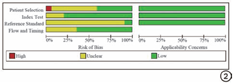
纳入文献质量学评价结果见图2。偏倚风险评价方面,纳入文献中共有2篇被评价为高偏倚风险,其余为低风险或不清楚风险。临床适用性方面,所有研究在病例选择、待评价诊断试验及金标准领域均不存在临床不适用性。
点击查看大图
图2
纳入文献质量学评价结果。
Fig. 2
The methodological quality of included studies.
点击查看大图
图2
纳入文献质量学评价结果。
Fig. 2
The methodological quality of included studies.
2.3 基于ADC值的定量分析结果
2.3.1 新辅助治疗前ADC值定量分析结果

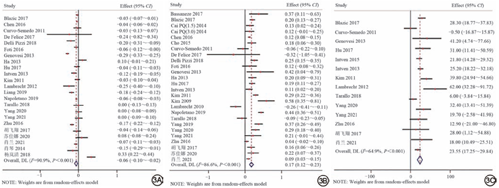
共有23篇文献对完全缓解组及非完全缓解组的新辅助治疗前ADC值进行了比较(图3A),完全缓解组的pre-ADC平均值是0.931×10⁻³ mm2/s,非完全缓解组的平均值是0.995×10-3 mm2/s。进行Meta分析得出完全缓解组与非完全缓解组pre-ADC值相差-0.06×10-3 mm2/s(95% CI:-0.10×10⁻³ mm2/s~-0.02×10-3 mm2/s,P<0.001)。
点击查看大图
图3
完全缓解组与非完全缓解组pre-ADC(3A)、post-ADC(3B)、ΔADC(3C)比较结果。
Fig. 3
Forest plot regarding difference in pre-ADC (3A), post-ADC (3B) and ΔADC (3C) values between patients with complete response and those with incomplete response.
点击查看大图
图3
完全缓解组与非完全缓解组pre-ADC(3A)、post-ADC(3B)、ΔADC(3C)比较结果。
Fig. 3
Forest plot regarding difference in pre-ADC (3A), post-ADC (3B) and ΔADC (3C) values between patients with complete response and those with incomplete response.
2.3.2 新辅助治疗后ADC值定量分析结果

共纳入25篇文献、26组数据比较了完全缓解组及非完全缓解组post-ADC值的差异(图3B),完全缓解组的post-ADC平均值是1.434×10⁻³ mm2/s,非完全缓解组的post-ADC平均值是1.266×10-3 mm2/s。进行Meta分析得出完全缓解组与非完全缓解组post-ADC值相差0.17×10-3 mm2/s(95% CI:0.12×10⁻³ mm2/s~0.23×10-3 mm2/s,P<0.001)。

2.3.3 新辅助治疗前后ΔADC定量分析结果

共纳入17篇文献对完全缓解组及非完全缓解组治疗前后ΔADC进行了比较(图3C),完全缓解组ΔADC平均值是56.07%,非完全缓解组ΔADC平均值是28.62%,两组之间的差异是23.55%(95% CI:17.25%~29.84%,P<0.001)。

2.4 基于ADC值的诊断价值
2.4.1 治疗前ADC值的诊断价值

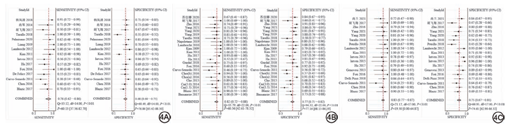
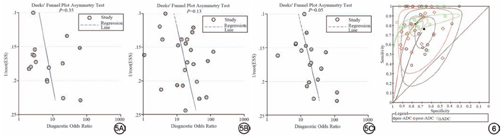
有15篇文献对pre-ADC的诊断价值进行了研究。Spearman相关系数为0.141,P=0.616,故研究间不存在阈值效应;Meta分析显示I2=89%,P<0.001,考虑纳入研究间存在非阈值效应导致的异质性。对纳入文献进行合并效应量,结果如图4A所示,pre-ADC诊断完全缓解的SEN合并是0.76(95% CI:0.62~0.86),SPE合并是0.68(95% CI:0.60~0.75),PLR合并是2.4(95% CI:1.8~3.0),NLR合并是0.35(95% CI:0.22~0.57),DOR合并是6.70(95% CI:3.49~12.83)。绘制Deek's漏斗图(图5A)得出斜率系数P=0.35,提示不存在发表偏倚。拟合HSROC 曲线,AUC=0.77(95% CI:0.73~0.80)(图6)。
点击查看大图
图4
pre-ADC(4A)、post-ADC(4B)、ΔADC(4C)诊断完全缓解的敏感度(左)及特异度森林图(右)。
Fig. 4
Forest plot of sensitivity and specificity of pre-ADC (4A), post-ADC (4B) and ΔADC (4C).
点击查看大图
图4
pre-ADC(4A)、post-ADC(4B)、ΔADC(4C)诊断完全缓解的敏感度(左)及特异度森林图(右)。
Fig. 4
Forest plot of sensitivity and specificity of pre-ADC (4A), post-ADC (4B) and ΔADC (4C).
点击查看大图
图5
pre-ADC(5A)、post-ADC(5B)、ΔADC(5C)的Deek's漏斗图。
图6
不同类型ADC诊断完全缓解的HSROC曲线。
Fig. 5
Publication bias of pre-ADC (5A), post-ADC (5B), ΔADC (5C) using Deek's test funnel plot.
Fig. 6
Summary hierarchical summary receiver operating characteristic for different ADC.
点击查看大图
图5
pre-ADC(5A)、post-ADC(5B)、ΔADC(5C)的Deek's漏斗图。
图6
不同类型ADC诊断完全缓解的HSROC曲线。
Fig. 5
Publication bias of pre-ADC (5A), post-ADC (5B), ΔADC (5C) using Deek's test funnel plot.
Fig. 6
Summary hierarchical summary receiver operating characteristic for different ADC.
2.4.2 治疗后ADC的诊断价值

通过21篇文献、23组数据分析post-ADC的诊断价值,Spearman相关系数为0.216,P=0.322,得出研究间不存在阈值效应;Meta分析I2=93%,P<0.001,提示研究间存在非阈值效应导致的异质性。合并效应量结果显示(图4B)post-ADC诊断完全缓解的SEN合并、SPE合并、PLR合并、NLR合并和DOR合并分别为0.82(95% CI:0.72~0.88)、0.77(95% CI:0.71~0.82)、3.5(95% CI:2.8~4.5)、0.24(95% CI:0.16~0.37)、14.59(95% CI:8.25~25.80)。绘制Deek's漏斗图(图5B)提示不存在发表偏倚(P=0.13)。绘制HSROC 曲线(图6),得出AUC=0.86(95% CI:0.82~0.88)。

2.4.3 ΔADC值的诊断价值

有18篇文献研究了ΔADC的诊断价值,Spearman相关系数为0.411,P=0.090,故不存在阈值效应;Meta分析I2=85%,P=0.001,考虑研究间存在非阈值效应的异质性。合并效应量(图4C)结果显示ΔADC诊断完全缓解的SEN合并、SPE合并、PLR合并、NLR合并和DOR合并分别为0.83(95% CI:0.77~0.87)、0.75(95% CI:0.67~0.81)、3.3(95% CI:2.5~4.3)、0.23(95% CI:0.17~0.30)、14.37(95% CI:9.32~22.15)。绘制Deek's漏斗图(图5C)显示倾斜系数P=0.05,提示存在发表偏倚的可能性小。绘制HSROC 曲线(图6),得出AUC=0.86(95% CI:0.83~0.89)。

2.4.4 Meta回归分析结果

根据纳入文献的研究类型、磁场强度类型、再评估MRI与新辅助治疗时间间隔、再评估MRI与手术时间间隔、病理结果的盲法对纳入文献进行Meta回归分析,发现再评估MRI与手术时间间隔可能造成治疗后ADC研究间的异质性(P<0.05),其他变量P值均大于0.05,不考虑为研究间异质性来源。

3 讨论

本研究使用Meta分析的方法,系统评价了ADC对LARC新辅助治疗后完全缓解的诊断价值。首先对pre-ADC值、post-ADC值及ΔADC值定量分析的研究进行Meta分析,得出完全缓解组的pre-ADC平均值显著低于非完全缓解组(-0.06×10⁻³ mm2/s),post-ADC及ΔADC高于非完全缓解组(差值分别为0.17×10-3 mm2/s、28.62%)。然后对诊断价值进行了Meta分析,得出新辅助治疗前ADC值的诊断价值最低,治疗后ADC值及ΔADC的诊断价值相当,三者的AUC分别是:pre-ADC为0.77、post-ADC为0.86、ΔADC为0.86。

3.1 不同ADC值评估疗效的特点

DWI通过细胞内外水分子的随机布朗运动反映组织内部的微环境。水分子在生物组织中的扩散速率取决于多种因素,包括组织温度、组织细胞密度、细胞外组织情况、细胞膜的完整性和液体的黏度[58]。研究显示使用DWI评估LARC nCRT后是否达完全缓解的准确性优于常规MRI[59, 60]。ADC是评估水分子在组织内扩散的定量参数,ADC值与组织细胞密度呈负相关[22],肿瘤细胞限制水分子的扩散,随着肿瘤生长,肿瘤细胞密度增大,并且细胞外组织结构被破坏,导致ADC值下降[61]。本研究对新辅助治疗前后ADC及ΔADC的定量分析研究进行Meta分析,结果显示完全缓解组的pre-ADC平均值明显低于非完全缓解组(差值为-0.06×10⁻³ mm2/s),这与许多研究的结果一致[22,32,34],考虑可能是因为在非完全缓解组中存在较多肿瘤坏死组织。组织坏死导致组织灌注差,氧气浓度低以及组织微环境呈酸中毒,从而使肿瘤抵抗放化疗,导致新辅助治疗效果差[62],因此在新辅助治疗前进行MRI检查并测定肿瘤的ADC值有助于明确肿瘤特征,预测肿瘤对新辅助治疗的反应,从而确定初始治疗方案,尽早予以个体化治疗。另外,本研究结果显示完全缓解组的post-ADC平均值及ΔADC显著高于非完全缓解组,可见新辅助治疗后完全缓解组的ADC值增加程度大于非完全缓解组,放化疗可诱导肿瘤细胞凋亡和坏死、肿瘤结构完全性丧失,并伴有不同程度的纤维化和炎症;此外血管内皮生长因子大量释放,使血管通透性增加,导致原发病灶局部水肿,因此新辅助治疗后ADC值增加[22,32]。ADC值增加程度越大说明新辅助治疗疗效越好,实现完全缓解的可能性越大。在诊断价值方面,新辅助治疗前ADC值的诊断价值最低,治疗后ADC值及ΔADC的诊断价值相当,三者的AUC分别是:pre-ADC为0.77、post-ADC为0.86、ΔADC为0.86。但是Amodeo等[63]研究表明post-ADC的诊断准确性较ΔADC值低,原因可能是post-ADC不能准确区分残留的肿瘤细胞和治疗后的纤维化。同样,Delli Pizzi等[32]及Chen等[64]研究表明ΔADC相比于pre-ADC、post-ADC可作为诊断完全缓解的可靠指标。ΔADC是根据pre-ADC和post-ADC得出,同时考虑了pre-ADC和post-ADC的变化程度。综上,在临床实践中可使用治疗前ADC值预测肿瘤对新辅助治疗的反应,而在评估新辅助治疗后肿瘤是否达到完全缓解时推荐使用ΔADC。

3.2 影响ADC诊断准确性的因素

本研究对可能导致异质性的因素进行Meta回归分析,发现MRI与手术间隔时间可能为研究间异质性来源。新辅助治疗后MRI评价肿瘤反应的最佳时机取决于新辅助治疗后的手术时机,新辅助治疗对肿瘤的杀伤效应随时间推移而增加[20]。Probst等[65]研究表明新辅助治疗结束至手术间隔时间大于8周可提高完全缓解率;而另有研究表明延迟手术并未使患者获益[66, 67, 68, 69]。目前国内指南推荐新辅助治疗结束5~7周后行手术治疗[70],但关于最佳MRI检查时机仍缺乏共识,有待进一步研究。

3.3 本研究的优势及局限性

本研究对ADC诊断LARC新辅助治疗后完全缓解的相关文献进行了全面检索,纳入文献较全面,纳入研究对象均为LARC并行nCRT的患者,本文首先排除研究间的阈值效应,然后计算合并诊断指标,研究结果更加可靠。但本研究存在以下局限性:(1)本文纳入的少数研究质量不高,这可能影响整体研究结论的可靠性;(2)本文从研究类型、磁场强度、不同间隔时间以及结果盲法方面进行了研究间异质性分析,但是尚有其他一些因素也可导致研究间异质性,如检查前是否进行肠道准备、MRI扫描层厚、检查结果判读者的经验差异等。

综上所述,本研究得出新辅助治疗前ADC值有助于预测肿瘤治疗反应,而新辅助治疗后ADC值及治疗前后ADC变化率的诊断准确性更高。

利益冲突
作者利益冲突声明:

全体作者均声明无利益冲突。

参考文献References
[1]
CercekA, RoxburghCSD, StrombomP, et al. Adoption of total neoadjuvant therapy for locally advanced rectal cancer[J/OL]. JAMA Oncol, 2018, 4 [2022-02-20]. https://jamanetwork.com/journals/jamaoncology/fullarticle/2675916. DOI: 10.1001/jamaoncol.2018.0071.
[2]
KellerDS, BerhoM, PerezRO, et al. The multidisciplinary management of rectal cancer[J]. Nat Rev Gastroenterol Hepatol, 2020, 17(7): 414-429. DOI: 10.1038/s41575-020-0275-y.
[3]
ConroyT, BossetJF, EtiennePL, et al. Neoadjuvant chemotherapy with FOLFIRINOX and preoperative chemoradiotherapy for patients with locally advanced rectal cancer (UNICANCER-PRODIGE 23): A multicentre, randomised, open-label, phase 3 trial[J]. Lancet Oncol, 2021, 22: 702-715. DOI: 10.1016/S1470-2045(21)00079-6.
[4]
BensonAB, VenookAP, Al-HawaryMM, et al. Rectal Cancer, Version 2.2018, NCCN Clinical Practice Guidelines in Oncology[J]. J Natl Compr Canc Netw, 2018, 16(7): 874-901. DOI: 10.6004/jnccn.2018.0061.
[5]
GoldenbergBA, HollidayEB, HelewaRM, et al. Rectal Cancer in 2018: A Primer for the Gastroenterologist[J]. Am J Gastroenterol, 2018, 113(12): 1763-1771. DOI: 10.1038/s41395-018-0180-y.
[6]
LeeJB, KimHS, HamA, et al. Role of Preoperative Chemoradiotherapy in Clinical Stage Ⅱ/Ⅲ Rectal Cancer Patients Undergoing Total Mesorectal Excision: A Retrospective Propensity Score Analysis[J/OL]. Front Oncol, 2020, 10 [2022-02-20]. https://www.ncbi.nlm.nih.gov/pmc/articles/PMC7848147/pdf/fonc-10-609313.pdf. DOI: 10.3389/fonc.2020.609313.
[7]
RyanJE, WarrierSK, LynchAC, et al. Predicting pathological complete response to neoadjuvant chemoradiotherapy in locally advanced rectal cancer: a systematic review[J]. Colorectal Dis, 2016, 18(3): 234-246. DOI: 10.1111/codi.13207.
[8]
CortazarP, ZhangL, UntchM, et al. Pathological complete response and long-term clinical benefit in breast cancer: the CTNeoBC pooled analysis[J]. Lancet, 2014, 384(9938): 164-172. DOI: 10.1016/S0140-6736(13)62422-8.
[9]
MaasM, NelemansPJ, ValentiniV, et al. Long-term outcome in patients with a pathological complete response after chemoradiation for rectal cancer: a pooled analysis of individual patient data[J]. Lancet Oncol, 2010, 11(9): 835-844. DOI: 10.1016/S1470-2045(10)70172-8.
[10]
SmithJJ, StrombomP, ChowOS, et al. Assessment of a Watch-and-Wait Strategy for Rectal Cancer in Patients With a Complete Response After Neoadjuvant Therapy[J/OL]. JAMA Oncol, 2019, 5(4) [2022-02-20]. https://jamanetwork.com/journals/jamaoncology/fullarticle/2720474. DOI: 10.1001/jamaoncol.2018.5896.
[11]
RenehanAG, MalcomsonL, EmsleyR, et al. Watch-and-wait approach versus surgical resection after chemoradiotherapy for patients with rectal cancer (the OnCoRe project): a propensity-score matched cohort analysis[J]. Lancet Oncol, 2016, 17(2): 174-183. DOI: 10.1016/S1470-2045(15)00467-2.
[12]
SmithFM, CresswellK, MyintAS, et al. Is "watch-and-wait" after chemoradiotherapy safe in patients with rectal cancer?[J/OL]. BMJ, 2018, 363 [2022-02-20]. https://www.bmj.com/content/363/bmj.k4472.long. DOI: 10.1136/bmj.k4472.
[13]
WangQX, ZhangR, XiaoWW, et al. The watch-and-wait strategy versus surgical resection for rectal cancer patients with a clinical complete response after neoadjuvant chemoradiotherapy[J/OL]. Radiat Oncol, 2021, 16(1) [2022-02-20]. https://ro-journal.biomedcentral.com/articles/10.1186/s13014-021-01746-0. DOI: 10.1186/s13014-021-01746-0.
[14]
DossaF, ChesneyTR, AcunaSA, et al. A watch-and-wait approach for locally advanced rectal cancer after a clinical complete response following neoadjuvant chemoradiation: a systematic review and meta-analysis[J]. Lancet Gastroenterol Hepatol, 2017, 2(7): 501-513. DOI: 10.1016/S2468-1253(17)30074-2.
[15]
DattaniM, HealdRJ, GoussousG, et al. Oncological and Survival Outcomes in Watch and Wait Patients With a Clinical Complete Response After Neoadjuvant Chemoradiotherapy for Rectal Cancer: A Systematic Review and Pooled Analysis[J]. Ann Surg, 2018, 268(6): 955-967. DOI: 10.1097/SLA.0000000000002761.
[16]
van der ValkMJM, HillingDE, BastiaannetE, et al. Long-term outcomes of clinical complete responders after neoadjuvant treatment for rectal cancer in the International Watch & Wait Database (IWWD): an international multicentre registry study[J]. Lancet, 2018, 391(10139): 2537-2545. DOI: 10.1016/S0140-6736(18)31078-X.
[17]
GranataV, GrassiR, FuscoR, et al. Current status on response to treatment in locally advanced rectal cancer: what the radiologist should know[J]. Eur Rev Med Pharmacol Sci, 2020, 24(23): 12050-12062. DOI: 10.26355/eurrev_202012_23994.
[18]
JhaveriKS, Hosseini-NikH. MRI of Rectal Cancer: An Overview and Update on Recent Advances[J]. AJR Am J Roentgenol, 2015, 205(1): W42-W55. DOI: 10.2214/AJR.14.14201.
[19]
HorvatN, VeeraraghavanH, KhanM, et al. MR Imaging of Rectal Cancer: Radiomics Analysis to Assess Treatment Response after Neoadjuvant Therapy[J]. Radiology, 2018, 287(3): 833-843. DOI: 10.1148/radiol.2018172300.
[20]
SeoN, KimH, ChoMS, et al. Response Assessment with MRI after Chemoradiotherapy in Rectal Cancer: Current Evidences[J]. Korean J Radiol, 2019, 20(7): 1003-1018. DOI: 10.3348/kjr.2018.0611.
[21]
SclafaniF, BrownG, CunninghamD, et al. Comparison between MRI and pathology in the assessment of tumour regression grade in rectal cancer[J]. Br J Cancer, 2017, 117(10): 1478-1485. DOI: 10.1038/bjc.2017.320.
[22]
De FeliceF, MagnanteAL, MusioD, et al. Diffusion-weighted magnetic resonance imaging in locally advanced rectal cancer treated with neoadjuvant chemoradiotherapy[J]. Eur J Surg Oncol, 2017, 43(7): 1324-1329. DOI: 10.1016/j.ejso.2017.03.010.
[23]
Beets-TanRGH, LambregtsDMJ, MaasM, et al. Magnetic resonance imaging for clinical management of rectal cancer: Updated recommendations from the 2016 European Society of Gastrointestinal and Abdominal Radiology (ESGAR) consensus meeting[J]. Eur Radiol, 2018, 28(4): 1465-1475. DOI: 10.1007/s00330-017-5026-2.
[24]
WhitingPF, RutjesAW, WestwoodME, et al. QUADAS-2: a revised tool for the quality assessment of diagnostic accuracy studies[J]. Ann Intern Med, 2011, 155(8): 529-536. DOI: 10.7326/0003-4819-155-8-201110180-00009.
[25]
BassanezeT, GonçalvesJE, FariaJF, et al. Quantitative Aspects of Diffusion-weighted Magnetic Resonance Imaging in Rectal Cancer Response to Neoadjuvant Therapy[J]. Radiol Oncol, 2017, 51(3): 270-276. DOI: 10.1515/raon-2017-0025.
[26]
BlazicIM, LilicGB, GajicMM. Quantitative Assessment of Rectal Cancer Response to Neoadjuvant Combined Chemotherapy and Radiation Therapy: Comparison of Three Methods of Positioning Region of Interest for ADC Measurements at Diffusion-weighted MR Imaging[J]. Radiology, 2017, 282(2): 418-428. DOI: 10.1148/radiol.2016151908.
[27]
CaiPQ, WuYP, AnX, et al. Simple measurements on diffusion-weighted MR imaging for assessment of complete response to neoadjuvant chemoradiotherapy in locally advanced rectal cancer[J]. Eur Radiol, 2014, 24(11): 2962-2970. DOI: 10.1007/s00330-014-3251-5.
[28]
ChenYG, ChenMQ, GuoYY, et al. Apparent Diffusion Coefficient Predicts Pathology Complete Response of Rectal Cancer Treated with Neoadjuvant Chemoradiotherapy[J/OL]. PLoS One, 2016, 11(4) [2022-02-20]. https://journals.plos.org/plosone/article?id=10.1371/journal.pone.0153944. DOI: 10.1371/journal.pone.0153944.
[29]
ChoSH, KimGC, JangYJ, et al. Locally advanced rectal cancer: post-chemoradiotherapy ADC histogram analysis for predicting a complete response[J]. Acta Radiol, 2015, 56(9): 1042-1050. DOI: 10.1177/0284185114550193.
[30]
ChoiMH, OhSN, RhaSE, et al. Diffusion-weighted imaging: Apparent diffusion coefficient histogram analysis for detecting pathologic complete response to chemoradiotherapy in locally advanced rectal cancer[J]. J Magn Reson Imaging, 2016, 44(1): 212-220. DOI: 10.1002/jmri.25117.
[31]
Curvo-SemedoL, LambregtsDM, MaasM, et al. Rectal cancer: assessment of complete response to preoperative combined radiation therapy with chemotherapy--conventional MR volumetry versus diffusion-weighted MR imaging[J]. Radiology, 2011, 260(3): 734-743. DOI: 10.1148/radiol.11102467.
[32]
Delli PizziA, CianciR, GenovesiD, et al. Performance of diffusion-weighted magnetic resonance imaging at 3.0 T for early assessment of tumor response in locally advanced rectal cancer treated with preoperative chemoradiation therapy[J]. Abdom Radiol (NY), 2018, 43(9): 2221-2230. DOI: 10.1007/s00261-018-1457-8.
[33]
FotiPV, PriviteraG, PianaS, et al. Locally advanced rectal cancer: Qualitative and quantitative evaluation of diffusion-weighted MR imaging in the response assessment after neoadjuvant chemo-radiotherapy[J]. Eur J Radiol Open, 2016, 3: 145-152. DOI: 10.1016/j.ejro.2016.06.003.
[34]
GenovesiD, FilipponeA, Ausili CèfaroG, et al. Diffusion-weighted magnetic resonance for prediction of response after neoadjuvant chemoradiation therapy for locally advanced rectal cancer: preliminary results of a monoinstitutional prospective study[J]. Eur J Surg Oncol, 2013, 39(10): 1071-1078. DOI: 10.1016/j.ejso.2013.07.090.
[35]
GurdalN, FaydaM, AlishevN, et al. Neoadjuvant volumetric modulated arc therapy in rectal cancer and the correlation of pathological response with diffusion-weighted MRI and apoptotic markers[J]. Tumori, 2018, 104(4): 266-272. DOI: 10.5301/tj.5000702.
[36]
HaHI, KimAY, YuCS, et al. Locally advanced rectal cancer: diffusion-weighted MR tumour volumetry and the apparent diffusion coefficient for evaluating complete remission after preoperative chemoradiation therapy[J]. Eur Radiol, 2013, 23(12): 3345-3353. DOI: 10.1007/s00330-013-2936-5.
[37]
HuF, TangW, SunY, et al. The value of diffusion kurtosis imaging in assessing pathological complete response to neoadjuvant chemoradiation therapy in rectal cancer: a comparison with conventional diffusion-weighted imaging[J]. Oncotarget, 2017, 8(43): 75597-75606. DOI: 10.18632/oncotarget.17491.
[38]
IntvenM, MonninkhofEM, ReerinkO, et al. Combined T2w volumetry, DW-MRI and DCE-MRI for response assessment after neo-adjuvant chemoradiation in locally advanced rectal cancer[J]. Acta Oncol, 2015, 54(10): 1729-1736. DOI: 10.3109/0284186x.2015.1037010.
[39]
IntvenM, ReerinkO, PhilippensME. Diffusion-weighted MRI in locally advanced rectal cancer : pathological response prediction after neo-adjuvant radiochemotherapy[J]. Strahlenther Onkol, 2013, 189(2): 117-122. DOI: 10.1007/s00066-012-0270-5.
[40]
KimSH, LeeJM, HongSH, et al. Locally advanced rectal cancer: added value of diffusion-weighted MR imaging in the evaluation of tumor response to neoadjuvant chemo- and radiation therapy[J]. Radiology, 2009, 253(1): 116-125. DOI: 10.1148/radiol.2532090027.
[41]
KimSH, LeeJY, LeeJM, et al. Apparent diffusion coefficient for evaluating tumour response to neoadjuvant chemoradiation therapy for locally advanced rectal cancer[J]. Eur Radiol, 2011, 21(5): 987-995. DOI: 10.1007/s00330-010-1989-y.
[42]
LambrechtM, DerooseC, RoelsS, et al. The use of FDG-PET/CT and diffusion-weighted magnetic resonance imaging for response prediction before, during and after preoperative chemoradiotherapy for rectal cancer[J]. Acta Oncol, 2010, 49(7): 956-963. DOI: 10.3109/0284186x.2010.498439.
[43]
LambrechtM, VandecaveyeV, De KeyzerF, et al. Value of diffusion-weighted magnetic resonance imaging for prediction and early assessment of response to neoadjuvant radiochemotherapy in rectal cancer: preliminary results[J]. Int J Radiat Oncol Biol Phys, 2012, 82(2): 863-870. DOI: 10.1016/j.ijrobp.2010.12.063.
[44]
LiangCY, ChenMD, ZhaoXX, et al. Multiple mathematical models of diffusion-weighted magnetic resonance imaging combined with prognostic factors for assessing the response to neoadjuvant chemotherapy and radiation therapy in locally advanced rectal cancer[J]. Eur J Radiol, 2019, 110: 249-255. DOI: 10.1016/j.ejrad.2018.12.005.
[45]
NapoletanoM, MazzuccaD, ProsperiE, et al. Locally advanced rectal cancer: qualitative and quantitative evaluation of diffusion-weighted magnetic resonance imaging in restaging after neoadjuvant chemo-radiotherapy[J]. Abdom Radiol (NY), 2019, 44(11): 3664-3673. DOI: 10.1007/s00261-019-02012-4.
[46]
PalmisanoA, Di ChiaraA, EspositoA, et al. MRI prediction of pathological response in locally advanced rectal cancer: when apparent diffusion coefficient radiomics meets conventional volumetry[J/OL]. Clin Radiol, 2020, 75(10) [2022-02-20]. https://www.sciencedirect.com/science/article/pii/S0009926020302567?via%3Dihub. DOI: 10.1016/j.crad.2020.06.023.
[47]
PetrilloA, FuscoR, GranataV, et al. Assessing response to neo-adjuvant therapy in locally advanced rectal cancer using Intra-voxel Incoherent Motion modelling by DWI data and Standardized Index of Shape from DCE-MRI[J/OL]. Ther Adv Med Oncol, 2018, 10 [2022-2-20]. https://journals.sagepub.com/doi/pdf/10.1177/1758835918809875. DOI: 10.1177/1758835918809875.
[48]
TaralloN, AngerettiMG, BracchiE, et al. Magnetic resonance imaging in locally advanced rectal cancer: quantitative evaluation of the complete response to neoadjuvant therapy[J/OL]. Pol J Radiol, 2018, 83 [2022-02-20]. https://www.ncbi.nlm.nih.gov/pmc/articles/PMC6384410/pdf/PJR-83-81156.pdf. DOI: 10.5114/pjr.2018.81156.
[49]
YangL, XiaC, LiuD, et al. The role of readout-segmented echo-planar imaging-based diffusion-weighted imaging in evaluating tumor response of locally advanced rectal cancer after neoadjuvant chemoradiotherapy[J]. Acta Radiol, 2020, 61(9): 1155-1164. DOI: 10.1177/0284185119897354.
[50]
YangL, XiaC, ZhaoJ, et al. The value of intravoxel incoherent motion and diffusion kurtosis imaging in the assessment of tumor regression grade and T stages after neoadjuvant chemoradiotherapy in patients with locally advanced rectal cancer[J/OL]. Eur J Radiol, 2021, 136 [2022-02-20]. https://www.sciencedirect.com/science/article/pii/S0720048X2030694X?via%3Dihub. DOI: 10.1016/j.ejrad.2020.109504.
[51]
YangL, QiuM, XiaC, et al. Value of high-resolution DWI in combination with texture analysis for the evaluation of tumor response after preoperative chemoradiotherapy for locally advanced rectal cancer[J]. AJR Am J Roentgenol, 2019, 212(6): 1279-1286. DOI: 10.2214/AJR.18.20689.
[52]
ZhuHB, ZhangXY, ZhouXH, et al. Assessment of pathological complete response to preoperative chemoradiotherapy by means of multiple mathematical models of diffusion-weighted MRI in locally advanced rectal cancer: A prospective single-center study[J]. J Magn Reson Imaging, 2017, 46(1): 175-183. DOI: 10.1002/jmri.25567.
[53]
胡飞翔, 童彤, 彭卫军. 弥散峰度成像评价及预测直肠癌新辅助放化疗后病理完全缓解的价值[J]. 肿瘤影像学, 2017, 26(1): 49-57. DOI: 10.3969/j.issn.1008-617X.2017.01.009.
HuFX, TongT, PengWJ. Diffusion kurtosis imaging: assessment of pathological complete response to neoadjuvant chemoradiation therapy in rectal cancer[J]. Oncoradiology, 2017, 26(1): 49-57. DOI: 10.3969/j.issn.1008-617X.2017.01.009.
[54]
苏佳娜, 麦盛始, 陈韵, . 磁共振弥散加权成像体积法对局部晚期直肠癌新辅助放化疗完全反应的评估价值[J]. 广东医科大学学报, 2020, 38(4): 474-478. DOI: 10.3969/j.issn.1005-4057.2020.04.025.
SuJN, MaiSS, ChenY, et al. Diffusion-weighted imaging for assessing complete response of neoadjuvant chemoradiotherapy in locally advanced rectal cancer[J]. Journal of Guangdong Medical University, 2020, 38(4): 474-478. DOI: 10.3969/j.issn.1005-4057.2020.04.025.
[55]
肖兰, 朱丽娜, 赵志伟, . MRI多参数对局部进展期直肠癌新辅助放化疗疗效的评估价值[J]. 临床放射学杂志, 2021, 40(4): 751-756. DOI: 10.13437/j.cnki.jcr.2021.04.028.
XiaoL, ZhuLN, ZhaoZW, et al. Multiple parameters of magnetic resonance imaging for assessing the response to neoadjuvant chemotherapy and radiation therapy in locally advanced rectal cancer[J]. Journal of Clinical Radiology, 2021, 40(4): 751-756. DOI: 10.13437/j.cnki.jcr.2021.04.028.
[56]
肖琴, 叶枫, 金晶, . 表观扩散系数预测直肠癌术前放化疗疗效分析[J]. 中华放射肿瘤学杂志, 2014, 23(3): 194-198. DOI: 10.3760/cma.j.issn.1004-4221.2014.03.005.
XiaoQ, YeF, JinJ, et al. Predictive value of apparent diffusion coefficient for effi cacy of preoperative chemoradiotherapy for locally advanced rectal cancer[J]. Chin J Radiat Oncol, 2014, 23(3): 194-198. DOI: 10.3760/cma.j.issn.1004-4221.2014.03.005.
[57]
杨岚清, 夏春潮, 伍兵. 高分辨弥散加权成像ADC值与直肠癌新辅助治疗后肿瘤转归分级的相关性研究[J]. 四川大学学报(医学版), 2018, 49(6): 970-973. DOI: 10.13464/j.scuxbyxb.2018.06.030.
YangLQ, XiaCC, WuB. Study on the correlation between ADC value of high-resolution diffusion-weighted imaging and tumor regression grade after neoadjuvant therapy for rectal cancer[J]. J Sichuan Univ (Med Sci Edi), 2018, 49(6): 970-973. DOI: 10.13464/j.scuxbyxb.2018.06.030.
[58]
BarralM, EvenoC, HoeffelC, et al. Diffusion-weighted magnetic resonance imaging in colorectal cancer[J]. J Visc Surg, 2016, 153(5): 361-369. DOI: 10.1016/j.jviscsurg.2016.08.004.
[59]
ChandramohanA, SiddiqiUM, MittalR, et al. Diffusion weighted imaging improves diagnostic ability of MRI for determining complete response to neoadjuvant therapy in locally advanced rectal cancer[J/OL]. Eur J Radiol Open, 2020, 7 [2022-2-20]. https://www.ncbi.nlm.nih.gov/pmc/articles/PMC7044654/pdf/main.pdf. DOI: 10.1016/j.ejro.2020.100223.
[60]
LambregtsDMJ, DelliPizzi A, LahayeMJ, et al. A Pattern-Based Approach Combining Tumor Morphology on MRI With Distinct Signal Patterns on Diffusion-Weighted Imaging to Assess Response of Rectal Tumors After Chemoradiotherapy[J]. Dis Colon Rectum, 2018, 61(3): 328-337. DOI: 10.1097/dcr.0000000000000915.
[61]
PhamTT, LineyGP, WongK, et al. Functional MRI for quantitative treatment response prediction in locally advanced rectal cancer[J/OL]. Br J Radiol, 2017, 90(1072) [2022-02-20]. https://www.ncbi.nlm.nih.gov/pmc/articles/PMC5605058/pdf/bjr.20151078.pdf. DOI: 10.1259/bjr.20151078.
[62]
LambregtsDM, VandecaveyeV, BarbaroB, et al. Diffusion-weighted MRI for selection of complete responders after chemoradiation for locally advanced rectal cancer: a multicenter study[J]. Ann Surg Oncol, 2011, 18(8): 2224-2231. DOI: 10.1245/s10434-011-1607-5.
[63]
AmodeoS, RosmanAS, DesiatoV, et al. MRI-Based Apparent Diffusion Coefficient for Predicting Pathologic Response of Rectal Cancer After Neoadjuvant Therapy: Systematic Review and Meta-Analysis[J]. AJR Am J Roentgenol, 2018, 211(5): W205-W216. DOI: 10.2214/ajr.17.19135.
[64]
ChenK, SheHL, WuT, et al. Comparison of percentage changes in quantitative diffusion parameters for assessing pathological complete response to neoadjuvant therapy in locally advanced rectal cancer: a meta-analysis[J]. Abdom Radiol (NY), 2021, 46(3): 894-908. DOI: 10.1007/s00261-020-02770-6.
[65]
ProbstCP, BecerraAZ, AquinaCT, et al. Extended Intervals after Neoadjuvant Therapy in Locally Advanced Rectal Cancer: The Key to Improved Tumor Response and Potential Organ Preservation[J]. J Am Coll Surg, 2015, 221(2): 430-440. DOI: 10.1016/j.jamcollsurg.2015.04.010.
[66]
LefevreJH, MineurL, CachanadoM, et al. Does A Longer Waiting Period After Neoadjuvant Radio-chemotherapy Improve the Oncological Prognosis of Rectal Cancer?: Three Years' Follow-up Results of the Greccar-6 Randomized Multicenter Trial[J]. Ann Surg, 2019, 270(5): 747-754. DOI: 10.1097/SLA.0000000000003530.
[67]
LefevreJH, MineurL, KottiS, et al. Effect of Interval (7 or 11 weeks) Between Neoadjuvant Radiochemotherapy and Surgery on Complete Pathologic Response in Rectal Cancer: A Multicenter, Randomized, Controlled Trial (GRECCAR-6)[J]. J Clin Oncol, 2016, 34(31): 3773-3780. DOI: 10.1200/JCO.2016.67.6049.
[68]
HuntingtonCR, BoselliD, SymanowskiJ, et al. Optimal Timing of Surgical Resection After Radiation in Locally Advanced Rectal Adenocarcinoma: An Analysis of the National Cancer Database[J]. Ann Surg Oncol, 2016, 23(3): 877-887. DOI: 10.1245/s10434-015-4927-z.
[69]
SunZ, AdamMA, KimJ, et al. Optimal Timing to Surgery after Neoadjuvant Chemoradiotherapy for Locally Advanced Rectal Cancer[J]. J Am Coll Surg, 2016, 222(4): 367-374. DOI: 10.1016/j.jamcollsurg.2015.12.017.
[70]
中国结直肠癌诊疗规范(2020年版)[J]. 中华外科杂志, 2020, 58(8): 561-585. DOI: 10.3760/cma.j.cn112139-20200518-00390.
Chinese protocol of diagnosis and treatment of colorectal cancer(2020 edition)[J]. Chin J Surg, 2020, 58(8): 561-585. DOI: 10.3760/cma.j.cn112139-20200518-00390.
 
 
展开/关闭提纲
查看图表详情
回到顶部
放大字体
缩小字体
标签
关键词