临床研究
淋巴结包膜外侵犯的影像表现与前列腺癌病理分级的相关性研究
磁共振成像, 2022,13(9) : 41-45. DOI: 10.12015/issn.1674-8034.2022.09.008
摘要
目的

探讨影像诊断淋巴结包膜外侵犯(radiologic extranodal extension, rENE)与前列腺癌(prostate cancer, PCa)Gleason评分、国际泌尿病理协会(International Society of Urological Pathology, ISUP)分级分组的相关性。

材料与方法

本研究为单中心研究,回顾性分析了空军军医大学西京医院2017年1月至2021年6月收治的90例N1期PCa患者病例,根据有无rENE表现分为rENE+与rENE-两组,其中rENE+组67例,rENE-组23例。采用Wilcoxon检验分析组间差异,计算两组间ISUP分级分组的相对风险(relative risk, RR)值,采用Spearman相关系数分析rENE与Gleason评分和ISUP分级分组的相关性。

结果

两组间Gleason评分和ISUP分级分组差异有统计学意义(P<0.01)。rENE+组患者ISUP 5的风险是rENE-组的2.6倍(RR=2.6,95% CI:1.477~3.676),rENE组患者ISUP≤3的可能是rENE+组的17.4倍(RR=17.4,95% CI:4.2~72.3)。Gleason评分、ISUP分级分组与rENE影像表现呈正相关,相关系数分别为0.547(95% CI:0.363~0.688)、0.570(95% CI:0.367~0.716)。

结论

rENE与PCa患者Gleason评分、ISUP分级分组正相关,相较于rENE-患者,rENE+患者的原发灶恶性程度更高。rENE有望用于无创评估前列腺癌的恶性程度。

引用本文: 韩晔, 任静, 肖遵健, 等.  淋巴结包膜外侵犯的影像表现与前列腺癌病理分级的相关性研究 [J] . 磁共振成像, 2022, 13(9) : 41-45. DOI: 10.12015/issn.1674-8034.2022.09.008.
参考文献导出:   Endnote    NoteExpress    RefWorks    NoteFirst    医学文献王
扫  描  看  全  文

正文
作者信息
基金 0  关键词  0
English Abstract
评论
阅读 0  评论  0
相关资源
引用 | 论文 | 视频

本刊刊出的所有论文不代表本刊编委会的观点,除非特别声明

前列腺癌(prostate cancer, PCa)的发病率在我国位于男性泌尿生殖系统恶性肿瘤第一位[1]。在最新版美国癌症联合委员会(American Joint Committee on Cancer, AJCC)PCa分期指南中,N分期依据有无淋巴结转移分为N0和N1[2],但N1期患者的预后仍存在差异[3]。Gleason评分是判断PCa恶性程度的病理依据[4],2014年,国际泌尿病理协会(International Society of Urology Pathology, ISUP)会议提出将Gleason评分进一步分为5个等级,从而制订了ISUP分级,进一步明确了Gleason评分的临床意义[5]。同为N分期,头颈部鳞癌(head and neck squamous cell carcinoma, HNSCC)对转移淋巴结状态加入了“淋巴结包膜外侵犯(extranodal extension, ENE)”用以细化N分期[6]。此外,近年来不断有研究认为在鼻咽癌、膀胱癌、子宫颈癌、胰腺癌、直肠癌等多种恶性肿瘤中出现ENE提示预后不良[7, 8, 9, 10, 11]。术前ENE的诊断主要依据影像学检查,HNSCC中影像诊断ENE(radiologic ENE, rENE)研究较为成熟[12, 13, 14, 15]。故本文借鉴HNSCC中已形成共识的rENE的影像学征象,探究PCa治疗前rENE+患者与其Gleason评分、ISUP分级分组的相关性。

1 材料与方法
1.1 一般资料

本研究为单中心研究,回顾性分析了空军军医大学西京医院2017年1月1日至2021年6月30日符合下列标准的患者病例。纳入标准:(1)病理确诊PCa患者;(2)首诊时在本院进行了MRI检查;(3)PCa根治术后诊断N1期或MRI诊断存在淋巴结转移。排除标准:(1)MRI图像有明显的呼吸、运动伪影;(2)穿刺活检或术后证实,非前列腺腺癌,如神经内分泌肿瘤等;(3)同时存在其他部位的原发性肿瘤;(4)MRI检查前已进行治疗。原发灶的Gleason评分、ISUP分级分组以术后病理结果为依据,未行手术的病例以超声引导下经直肠穿刺组织活检(transrectal prostate ultrasound, TRUS)最高评分为依据。病例纳排流程见图1。本文经西京医院伦理委员会批准,免除受试者知情同意,批准文号:KY20203055-1。
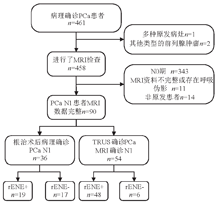
点击查看大图
图1
纳排标准流程图。
Fig. 1
Flow chart of inclusion and exclusion standards.
点击查看大图
图1
纳排标准流程图。
Fig. 1
Flow chart of inclusion and exclusion standards.
1.2 MRI图像采集

MRI检查采用GE 750超导型3.0 T MRI扫描仪,8通道腹部相控阵线圈,扫描序列及参数为:(1)冠状位T2WI抑脂,采用快速翻转恢复快速自旋回波(fast recovery fast spin-echo, FRFSE)序列,TR 5596 ms,TE 102 ms,层厚4 mm,层间距0.4 mm,视野(field of view, FOV)200 mm×200 mm,矩阵288×244,激励次数(number of excitations, NEX) 4;(2)轴位T2WI,采用FRFSE序列,TR 5285 ms,TE 115 ms,层厚4 mm,层间距0.4 mm,FOV 220 mm×220 mm,矩阵288×224,NEX 4;(3)轴位T1WI,采用快速反转回波(fast spin-echo, FSE)序列,TR 600 ms,TE 6.7 ms,层厚4 mm,层间距0.4 mm,FOV 400 mm×400 mm,矩阵288×224,NEX 4;(4)轴位扩散加权成像(diffusion weighted imaging, DWI),采用平面回波成像(echo planar imaging, EPI)序列,TR 5036 ms,TE 86 ms,层厚4 mm,层间距0.4 mm,FOV 280 mm×280 mm,矩阵256×160,NEX 1,b值0、1500 s/mm2。总体扫描时间为18 min 34 s。

1.3 影像学分析

本研究纳入病例为病理证实PCa患者,根治术后确诊N1期患者及MRI诊断盆腔淋巴结转移者。参考国内外文献[16, 17, 18, 19],符合下列征象之一,判定为影像诊断淋巴结转移:(1)淋巴结增大,短径>10 mm;(2)淋巴结融合或中央坏死;(3)淋巴结侵犯邻近组织。

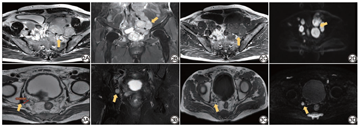
ENE已纳入HNSCC临床分期指南中。本研究依据HNSCC对rENE的相关研究[20, 21, 22]判定rENE+的诊断标准。(1)直接征象:①转移淋巴结包绕、侵犯血管;②转移淋巴结侵犯邻近肌肉;③淋巴结融合;④沿淋巴结包膜见毛刺状突起侵袭周围脂肪。(2)相关征象:①转移淋巴结坏死;②淋巴结形状不规则。有至少一项直接征象或两项相关征象者为rENE+组(图2),无以上征象者为rENE-组(图3)。
点击查看大图
图2
男,64 岁,PCa 患者,rENE+示意图(箭),Gleason 评分5+4;tPSA值1291 ng/mL。2A:T2WI 横断面图像,可见转移淋巴结融合成团,并包绕、侵犯邻近血管;2B:T2WI 脂肪抑制冠状位图像,可见转移淋巴结融合成团;2C:T1WI 横断位图像,可见转移淋巴结融合成团;2D:DWI 横断位图像,转移淋巴结DWI 信号明显增高,提示扩散受限,箭所示淋巴结边界欠清。
图3
男,74 岁,PCa 患者,rENE−示意图(箭),Gleason 评分4+4,tPSA值352.7 ng/mL。3A:T2WI 横断面图像,可见该淋巴结与周围组织分界清晰,短径约1.15 cm;3B:T2WI 脂肪抑制冠状位图像,盆腔右侧闭孔内肌旁见一较大淋巴结,形状规则,与周围组织分界清晰;3C:T1WI 横断位图像,淋巴结边界清晰、包膜完整,未侵犯邻近血管;3D:DWI 横断位图像,该淋巴结呈DWI 高信号,考虑转移。PCa:前列腺癌;rENE:影像诊断淋巴结包膜外侵犯;tPSA:总前列腺特异性抗原;DWI:扩散加权成像。
Fig. 2
Male, 64-year-old, an example of PCa patient with rENE+ (arrows), Gleason score=5+4, tPSA=1291 ng/mL. 2A: Axial T2WI showed metastatic lymph nodes fused into clusters, and invading adjacent blood vessels; 2B: Coronal T2WI fat saturation (FATSAT) sequence image showed metastatic lymph nodes fused into clusters; 2C: Axial T1WI showed metastatic lymph nodes fused into clusters; 2D: Axial DWI, the DWI signal of metastatic lymph nodes was significantly increased, indicating limited diffusion, and the boundary of lymph nodes shown by arrows was not clear.
Fig. 3
Male, 74-year-old, an example of PCa patient with rENE− (arrows), Gleason score=4+4, tPSA=352.7 ng/mL. 3A: Axial T2WI showed that the lymph node was clearly demarcated from the surrounding tissue, with a short diameter of about 1.15 cm; 3B: Coronal T2WI fat saturation (FATSAT) sequence imaging showed a large lymph node located in the right pelvic cavity and next to the internal obturator muscle with regular shape and clear boundary with surrounding tissues; 3C: Axial T1WI showed clear lymph node boundary, complete capsule, and no invasion of adjacent vessels. 3D: DWI showed that the lymph node presented hyperintense, so that metastasis was considered. PCa: prostate cancer; rENE: radiologic extranodal extension; tPSA: total prostate specific antigen; DWI: diffusion weighted imaging.
点击查看大图
图2
男,64 岁,PCa 患者,rENE+示意图(箭),Gleason 评分5+4;tPSA值1291 ng/mL。2A:T2WI 横断面图像,可见转移淋巴结融合成团,并包绕、侵犯邻近血管;2B:T2WI 脂肪抑制冠状位图像,可见转移淋巴结融合成团;2C:T1WI 横断位图像,可见转移淋巴结融合成团;2D:DWI 横断位图像,转移淋巴结DWI 信号明显增高,提示扩散受限,箭所示淋巴结边界欠清。
图3
男,74 岁,PCa 患者,rENE−示意图(箭),Gleason 评分4+4,tPSA值352.7 ng/mL。3A:T2WI 横断面图像,可见该淋巴结与周围组织分界清晰,短径约1.15 cm;3B:T2WI 脂肪抑制冠状位图像,盆腔右侧闭孔内肌旁见一较大淋巴结,形状规则,与周围组织分界清晰;3C:T1WI 横断位图像,淋巴结边界清晰、包膜完整,未侵犯邻近血管;3D:DWI 横断位图像,该淋巴结呈DWI 高信号,考虑转移。PCa:前列腺癌;rENE:影像诊断淋巴结包膜外侵犯;tPSA:总前列腺特异性抗原;DWI:扩散加权成像。
Fig. 2
Male, 64-year-old, an example of PCa patient with rENE+ (arrows), Gleason score=5+4, tPSA=1291 ng/mL. 2A: Axial T2WI showed metastatic lymph nodes fused into clusters, and invading adjacent blood vessels; 2B: Coronal T2WI fat saturation (FATSAT) sequence image showed metastatic lymph nodes fused into clusters; 2C: Axial T1WI showed metastatic lymph nodes fused into clusters; 2D: Axial DWI, the DWI signal of metastatic lymph nodes was significantly increased, indicating limited diffusion, and the boundary of lymph nodes shown by arrows was not clear.
Fig. 3
Male, 74-year-old, an example of PCa patient with rENE− (arrows), Gleason score=4+4, tPSA=352.7 ng/mL. 3A: Axial T2WI showed that the lymph node was clearly demarcated from the surrounding tissue, with a short diameter of about 1.15 cm; 3B: Coronal T2WI fat saturation (FATSAT) sequence imaging showed a large lymph node located in the right pelvic cavity and next to the internal obturator muscle with regular shape and clear boundary with surrounding tissues; 3C: Axial T1WI showed clear lymph node boundary, complete capsule, and no invasion of adjacent vessels. 3D: DWI showed that the lymph node presented hyperintense, so that metastasis was considered. PCa: prostate cancer; rENE: radiologic extranodal extension; tPSA: total prostate specific antigen; DWI: diffusion weighted imaging.

影像资料由两名分别具有20年和5年腹部影像诊断经验的影像医师在不知临床诊断、治疗措施及病理诊断的情况下独立进行征象判定,出现分歧通过讨论达成一致。

1.4 病理分析

本文纳入病例均依据《前列腺穿刺中国专家共识》[23]采用标准超声引导下经直肠前列腺5区13针穿刺活检,部分病例结合MRI图像进行重点部位取样检查。根治术后淋巴结标本由病理科医生进行连续切片检查并评估有无淋巴结转移。Gleason评分由两名分别具有15年和5年诊断经验的病理科专业医师评估报告。

1.5 统计学分析

采用SPSS 19.0统计软件进行数据分析。对符合正态分布的计量资料以均数±标准差(x¯±s)表示,非正态分布的计量资料用中位数(四分位距)MP25P75)表示。两组间各项参数的比较采用Wilcoxon检验。计算两组间ISUP分级分组≤3及ISUP分级分组分别为4、5的相对风险(relative risk, RR)值。rENE与Gleason评分和ISUP分级分组的相关性分析采用Spearman相关系数。P<0.05为差异有统计学意义。

2 结果
2.1 病例入组结果

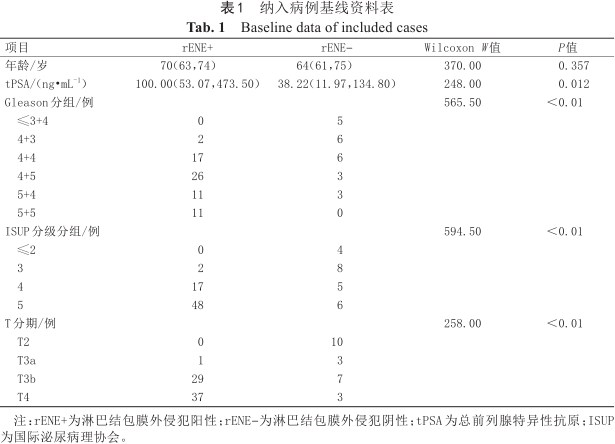
依照本研究制订的纳排标准,共纳入PCa患者90例,中位年龄69(63,75)岁。其中:rENE+ 67例,根治术后病理确诊N1 19例,影像诊断N1期48例;rENE- 23例,根治术后病理确诊N1期17例,影像诊断N1期6例。对计量资料进行正态性检验,患者年龄不符合正态分布,且两组年龄差异无统计学意义(P>0.05),基线资料见表1

点击查看表格
表1

纳入病例基线资料表

Tab. 1

Baseline data of included cases

表1

纳入病例基线资料表

Tab. 1

Baseline data of included cases

项目rENE+rENE-Wilcoxon WP
年龄/岁70(63,74)64(61,75)370.000.357
tPSA/(ng•mL-1100.00(53.07,473.50)38.22(11.97,134.80)248.000.012
Gleason分组/例565.50<0.01
≤3+405
4+326
4+4176
4+5263
5+4113
5+5110
ISUP分级分组/例594.50<0.01
≤204
328
4175
5486
T分期/例258.00<0.01
T2010
T3a13
T3b297
T4373

注:rENE+为淋巴结包膜外侵犯阳性;rENE-为淋巴结包膜外侵犯阴性;tPSA为总前列腺特异性抗原;ISUP为国际泌尿病理协会。

2.2 rENE分组与Gleason评分、ISUP分级分组相关性分析结果

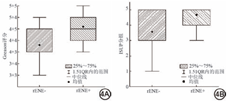
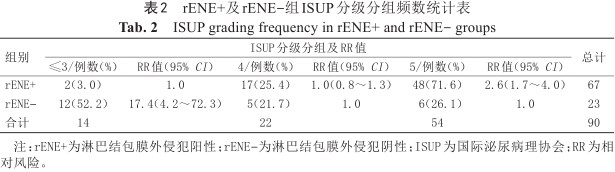
rENE+患者Gleason评分、ISUP分级分组高于rENE-患者,差异有统计学意义(Wilcoxon W=565.50、594.50,Z=-4.58、-4.77,P<0.01,图4)。在rENE-组中,ISUP≤3的可能远大于rENE+组(RR=17.4,95% CI:4.2~72.3),rENE+组中,ISUP 5的风险为rENE-组的2.6倍(RR=2.6,95% CI:1.7~4.0)(表2)。Gleason评分、ISUP分级分组与rENE+呈正相关,相关系数分别为0.547(95% CI:0.363~0.688,P<0.01)、0.570(95% CI:0.367~0.716,P<0.01)。
点击查看大图
图4
Gleason 评分、ISUP 分级与rENE 分组分布箱式图。4A:Gleason 评分与rENE分组分布箱式图;4B:ISUP分级分组与rENE分组分布箱式图。
Fig. 4
Box diagram of distribution of Gleason score, ISUP group in rENE+ and rENE− group. 4A: Box diagram of Gleason score distribution in rENE+ and rENE− groups; 4B: Box diagram of ISUP group distribution in rENE+ and rENE− groups.
点击查看大图
图4
Gleason 评分、ISUP 分级与rENE 分组分布箱式图。4A:Gleason 评分与rENE分组分布箱式图;4B:ISUP分级分组与rENE分组分布箱式图。
Fig. 4
Box diagram of distribution of Gleason score, ISUP group in rENE+ and rENE− group. 4A: Box diagram of Gleason score distribution in rENE+ and rENE− groups; 4B: Box diagram of ISUP group distribution in rENE+ and rENE− groups.
点击查看表格
表2

rENE+及rENE-组ISUP分级分组频数统计表

Tab. 2

ISUP grading frequency in rENE+ and rENE- groups

表2

rENE+及rENE-组ISUP分级分组频数统计表

Tab. 2

ISUP grading frequency in rENE+ and rENE- groups

组别ISUP分级分组及RR值总计
≤3/例数(%)RR值(95% CI4/例数(%)RR值(95% CI5/例数(%)RR值(95% CI
rENE+2(3.0)1.017(25.4)1.0(0.8~1.3)48(71.6)2.6(1.7~4.0)67
rENE-12(52.2)17.4(4.2~72.3)5(21.7)1.06(26.1)1.023
合计14225490

注:rENE+为淋巴结包膜外侵犯阳性;rENE-为淋巴结包膜外侵犯阴性;ISUP为国际泌尿病理协会;RR为相对风险。

3 讨论

多种肿瘤中转移淋巴结出现ENE提示预后不良[12]。HNSCC已将其纳入AJCC分期,其rENE的研究日臻成熟。由于目前PCa病理报告中尚无ENE的描述,且术前对ENE的诊断主要依据影像学表现,故本研究借鉴HNSCC诊断rENE的影像学征象,探究PCa患者rENE与Gleason评分、ISUP分级分组的关系。

3.1 PCa N1患者与Gleason评分、ISUP分级分组的关系

Gleason评分和ISUP分级根据肿瘤细胞形态学表现分级,在临床上用以评估预后并指导治疗,是判断PCa恶性程度的病理基础[24]。本研究结果提示rENE与Gleason评分、ISUP分级分组均呈正相关;与rENE-组相比,rENE+的PCa患者原发灶Gleason评分及ISUP分级分组更高,rENE+患者ISUP 5的风险是rENE-患者的2.6倍;同时,rENE-的患者ISUP分级分组≤3的可能是rENE+患者的17.4倍,提示rENE+患者PCa的侵袭性更强,预后更差。Okubo等[25]从病理角度分析了Gleason分组与淋巴结转移率之间的关系,认为ISUP 4~5组的淋巴结转移率远高于ISUP 2~3组。结合Okubo等的研究结果,原发灶Gleason评分或ISUP分级分组越高,发生淋巴结转移的风险越大;而当转移淋巴结出现rENE+表现时,PCa的侵袭性更强,且病理分级更高。Fleischmann等[26]依据N1期PCa患者是否存在病理诊断ENE(pathologic ENE, pENE)分为了pENE+与pENE-组,发现两组间Gleason评分差异有统计学意义,与本研究结果一致。

3.2 PCa与rENE

2017年,Luchini等[27]对1113例PCa ENE进行了Meta分析,其中658例ENE+,以风险比(hazard ratio, HR)为评价指标,发现ENE+与复发危险率(risk of recurrence, ROR)正相关,ENE可作为PCa N分期细化的指标。多项研究认为[28, 29],pENE与较高的Gleason评分、转移淋巴结的直径、体积及个数关系密切;单因素生存分析中,pENE与患者生化复发相关。多因素生存分析中,ENE却未纳入PCa的独立不良预后影响因素。有研究认为[26],由于ENE与淋巴结直径、Gleason评分等关系密切,故而掩盖了多因素分析中ENE对不良预后的影响。此外,也与纳入的PCa患者样本量较小、队列观察时间较短有关。在PCa的患者诊治中,术前多以超声引导下经直肠穿刺来评定Gleason评分及ISUP分级。穿刺活检有创,且对患者的住院时间、身体条件等有一定的要求。而本研究结果提示,在无创的MRI检查中出现rENE+征象,其PCa恶性程度较高、ISUP分级为5的风险较大,从而在尚未穿刺活检的情况下为临床诊疗提供更多的信息。

3.3 其他相关因素

本文对rENE与PCa Gleason评分、ISUP分级分组进行了直线相关分析,相关系数分别为0.547、0.570,rENE与PCa的病理分级正相关,提示rENE可在一定程度上预测PCa病理恶性程度。本研究对rENE+与rENE-两组患者的T分期、PSA水平等均进行了Wilcoxon秩和检验,组间差异有统计学意义。这些因素也是PCa病理分级及预后的影响因素,进一步说明了当出现rENE+征象时,PCa的侵袭性较强,恶性程度较高。此外,本研究中根治术后确诊N1期的rENE+患者占比低,更多的患者为MRI诊断N1期伴rENE+,这是因为此时部分患者已失去根治术的机会,转而进行放化疗。在拟合的相关曲线中,Gleason评分与ISUP分组分别集中在7~10、3~5组中,这是由于研究对象为N1期PCa患者,已属Ⅳ期、高危组,病理分级的本底较高。

3.4 本研究的局限性

本研究存在一些局限性。(1)样本量不够大,未来可联合多中心进行进一步的大样本探究;(2)本研究纳入的部分患者因已失去手术机会,故病理分级采用穿刺活检标本,这与进行了根治术的那一部分患者在Gleason评分与病理分级之间可能会有一定的误差;(3)由于纳入病例时间为2017至2021年,患者五年生存率较高,故而未行生存分析。

综上所述,rENE与PCa患者Gleason评分、ISUP分级分组正相关,相较于rENE-患者,rENE+患者的PCa原发灶恶性程度更高,侵袭性更强,rENE有望用于无创评估PCa患者的恶性程度和预后。

志      谢
ACKNOWLEDGMENTS

Natural Science Basic Research Program of Shaanxi Province (No. 2021JZ-25); Science and Technology Innovation Team of Shaanxi Province (No. 2021TD-39); Innovation Capability Support Program of Shaanxi Province (No. S2020-ZC-PT-0036).

利益冲突
作者利益冲突声明:

所有作者均声明不存在利益冲突。

参考文献References
[1]
李星, 曾晓勇. 中国前列腺癌流行病学研究进展[J]. 肿瘤防治研究, 2021, 48(1): 98-102. DOI: 10.3971/j.issn.1000-8578.2021.20.0370.
LiX, ZengXY. Advances in epidemiology of prostate cancer in China[J]. Cancer Res Prev Treat, 2021, 48(1): 98-102. DOI: 10.3971/j.issn.1000-8578.2021.20.0370.
[2]
CornfordP, BellmuntJ, BollaM, et al. EAU-ESTRO-SIOG guidelines on prostate cancer. part Ⅱ: treatment of relapsing, metastatic, and castration-resistant prostate cancer[J]. Eur Urol, 2017, 71(4): 630-642. DOI: 10.1016/j.eururo.2016.08.002.
[3]
AbdollahF, KarnesRJ, SuardiN, et al. Predicting survival of patients with node-positive prostate cancer following multimodal treatment[J]. Eur Urol, 2014, 65(3): 554-562. DOI: 10.1016/j.eururo.2013.09.025.
[4]
MottetN, BellmuntJ, BollaM, et al. EAU-ESTRO-SIOG guidelines on prostate cancer. part 1: screening, diagnosis, and local treatment with curative intent[J]. Eur Urol, 2017, 71(4): 618-629. DOI: 10.1016/j.eururo.2016.08.003.
[5]
SamaratungaH, DelahuntB, YaxleyJ, et al. From Gleason to International Society of Urological Pathology (ISUP) grading of prostate cancer[J]. Scand J Urol, 2016, 50(5): 325-329. DOI: 10.1080/21681805.2016.1201858.
[6]
GensheimerMF, LeQT. Radiographic extranodal extension in human papillomavirus-associated oropharyngeal carcinoma: can it help tailor treatment?[J]. Int J Radiat Oncol Biol Phys, 2019, 104(5): 1028-1029. DOI: 10.1016/j.ijrobp.2019.05.022.
[7]
MaoYP, WangSX, LydiattW, et al. Unambiguous advanced radiologic extranodal extension determined by MRI predicts worse outcomes in nasopharyngeal carcinoma: potential improvement for future editions of N category systems[J]. Radiother Oncol, 2021, 157: 114-121. DOI: 10.1016/j.radonc.2021.01.015.
[8]
FajkovicH, ChaEK, JeldresC, et al. Extranodal extension is a powerful prognostic factor in bladder cancer patients with lymph node metastasis[J]. Eur Urol, 2013, 64(5): 837-845. DOI: 10.1016/j.eururo.2012.07.026.
[9]
LuchiniC, VeroneseN, PeaA, et al. Extranodal extension in N1-adenocarcinoma of the pancreas and papilla of Vater: a systematic review and meta-analysis of its prognostic significance[J]. Eur J Gastroenterol Hepatol, 2016, 28(2): 205-209. DOI: 10.1097/MEG.0000000000000520.
[10]
Lars-ChristianH, BettinaH, DanaG, et al. Extracapsular extension of pelvic lymph node metastases is of prognostic value in carcinoma of the cervix uteri[J]. Gynecol Oncol, 2008, 108(1): 63-67. DOI: 10.1016/j.ygyno.2007.08.086.
[11]
HeideJ, KrüllA, BergerJ. Extracapsular spread of nodal metastasis as a prognostic factor in rectal cancer[J]. Int J Radiat Oncol Biol Phys, 2004, 58(3): 773-778. DOI: 10.1016/S0360-3016(03)01616-X.
[12]
KimuraY, SumiM, SakihamaN, et al. MR imaging criteria for the prediction of extranodal spread of metastatic cancer in the neck[J]. AJNR Am J Neuroradiol, 2008, 29(7): 1355-1359. DOI: 10.3174/ajnr.A1088.
[13]
NoorA, MintzJ, PatelS, et al. Predictive value of computed tomography in identifying extracapsular spread of cervical lymph node metastases in p16 positive oropharyngeal squamous cell carcinoma[J]. J Med Imaging Radiat Oncol, 2019, 63(4): 500-509. DOI: 10.1111/1754-9485.12888.
[14]
FroodR, PalkhiE, BarnfieldM, et al. Can MR textural analysis improve the prediction of extracapsular nodal spread in patients with oral cavity cancer?[J]. Eur Radiol, 2018, 28(12): 5010-5018. DOI: 10.1007/s00330-018-5524-x.
[15]
ParkSI, GuenetteJP, SuhCH, et al. The diagnostic performance of CT and MRI for detecting extranodal extension in patients with head and neck squamous cell carcinoma: a systematic review and diagnostic meta-analysis[J]. Eur Radiol, 2021, 31(4): 2048-2061. DOI: 10.1007/s00330-020-07281-y.
[16]
WangXF, HielscherT, RadtkeJP, et al. Comparison of single-scanner single-protocol quantitative ADC measurements to ADC ratios to detect clinically significant prostate cancer[J/OL]. Eur J Radiol, 2021 (36) [2022-03-09]. https://www.ejradiology.com/article/S0720-048X(21)00018-8. DOI: 10.1016/j.ejrad.2021.109538.
[17]
ThoenyHC, BarbieriS, FroehlichJM, et al. Functional and targeted lymph node imaging in prostate cancer: current status and future challenges[J]. Radiology, 2017, 285(3): 728-743. DOI: 10.1148/radiol.2017161517.
[18]
WooS, GhafoorS, VargasHA. Contribution of radiology to staging of prostate cancer[J]. Semin Nucl Med, 2019, 49(4): 294-301. DOI: 10.1053/j.semnuclmed.2019.02.007.
[19]
满育平, 马隆佰, 周平婷, . 多模态MRI对颈部良恶性淋巴结鉴别诊断的临床应用价值[J]. 临床放射学杂志, 2019, 38(8): 1385-1390. DOI: 10.13437/j.cnki.jcr.20190828.040.
ManYP, MaLB, ZhouPT, et al. Value of multimode MRI in differential diagnosis of benign and malignant cervical lymph nodes[J]. J Clin Radiol, 2019, 38(8): 1385-1390. DOI: 10.13437/j.cnki.jcr.20190828.040.
[20]
LeeB, ChoiYJ, KimSO, et al. Prognostic value of radiologic extranodal extension in human papillomavirus-related oropharyngeal squamous cell carcinoma[J]. Korean J Radiol, 2019, 20(8): 1266-1274. DOI: 10.3348/kjr.2018.0742.
[21]
FarajiF, AygunN, CoquiaSF, et al. Computed tomography performance in predicting extranodal extension in HPV-positive oropharynx cancer[J]. Laryngoscope, 2020, 130(6): 1479-1486. DOI: 10.1002/lary.28237.
[22]
HorváthA, PrekoppP, PolonyG, et al. Accuracy of the preoperative diagnostic workup in patients with head and neck cancers undergoing neck dissection in terms of nodal metastases[J]. Eur Arch Otorhinolaryngol, 2021, 278(6): 2041-2046. DOI: 10.1007/s00405-020-06324-w.
[23]
孙颖浩. 前列腺穿刺中国专家共识[J]. 中华泌尿外科杂志, 2016, 37(4): 241-244. DOI: 10.3760/cmaj.i.ssn.1000-6702.2016.04.001
SunYH. Chinese expert consensus on prostate biopsy[J]. Chin J Urol, 2016, 37(4): 241-244. DOI: 10.3760/cmaj.i.ssn.1000-6702.2016.04.001
[24]
OffermannA, HupeMC, SailerV, et al. The new ISUP 2014/WHO 2016 prostate cancer grade group system: first résumé 5 years after introduction and systemic review of the literature[J]. World J Urol, 2020, 38(3): 657-662. DOI: 10.1007/s00345-019-02744-4.
[25]
OkuboY, SatoS, OsakaK, et al. Clinicopathological Analysis of the ISUP Grade Group And Other Parameters in Prostate Cancer: Elucidation of Mutual Impact of the Various Parameters[J/OL]. Front Oncol, 2021, (11) [2022-03-09]. https://www.ncbi.nlm.nih.gov/pmc/articles/PMC8356042/pdf/fonc-11-695251.pdf. DOI: 10.3389/fonc.2021.695251.
[26]
FleischmannA, SchobingerS, MarkwalderR, et al. Prognostic factors in lymph node metastases of prostatic cancer patients: the size of the metastases but not extranodal extension independently predicts survival[J]. Histopathology, 2008, 53(4): 468-475. DOI: 10.1111/j.1365-2559.2008.03129.x.
[27]
LuchiniC, FleischmannA, BoormansJL, et al. Extranodal extension of lymph node metastasis influences recurrence in prostate cancer: a systematic review and meta-analysis[J/OL]. Sci Rep, 2017, 7(1): [2022-03-09]. https://www.nature.com/articles/s41598-017-02577-4. DOI: 10.1038/s41598-017-02577-4.
[28]
PassoniNM, FajkovicH, XylinasE, et al. Prognosis of patients with pelvic lymph node (LN) metastasis after radical prostatectomy: value of extranodal extension and size of the largest LN metastasis[J]. BJU Int, 2014, 114(4): 503-510. DOI: 10.1111/bju.12342.
[29]
FleischmannA, SchobingerS, SchumacherM, et al. Survival in surgically treated, nodal positive prostate cancer patients is predicted by histopathological characteristics of the primary tumor and its lymph node metastases[J]. Prostate, 2009, 69(4): 352-362. DOI: 10.1002/pros.20889.
 
 
展开/关闭提纲
查看图表详情
回到顶部
放大字体
缩小字体
标签
关键词