综述
血管性血友病的研究进展
中华血液学杂志, 2015,36(7) : 616-619. DOI: 10.3760/cma.j.issn.0253-2727.2015.07.021
引用本文: 殷杰, 阮长耿. 血管性血友病的研究进展 [J] . 中华血液学杂志, 2015, 36(7) : 616-619. DOI: 10.3760/cma.j.issn.0253-2727.2015.07.021.
参考文献导出:   Endnote    NoteExpress    RefWorks    NoteFirst    医学文献王
扫  描  看  全  文

正文
作者信息
基金 0  关键词  0
English Abstract
评论
阅读 0  评论  0
相关资源
引用 | 论文 | 视频

版权归中华医学会所有。

未经授权,不得转载、摘编本刊文章,不得使用本刊的版式设计。

除非特别声明,本刊刊出的所有文章不代表中华医学会和本刊编委会的观点。

血管性血友病(von Willebrand disease, VWD)是最常见的遗传性出血性疾病。近年来,世界各地的学者就VWD的发病机制、诊断和治疗进行了深入的研究。

一、VWD的发病机制

血管性血友病因子(VWF)的体内半衰期为12~20 h。正常人血浆中VWF抗原(VWF∶Ag)为5 000~20 000 U/L。受VWF合成的影响,体内VWF水平在中午最高,午夜最低[1]。影响VWF水平的因素很多包括年龄、血型、应激、甲状腺素水平、炎症、肿瘤和妊娠等[2,3]。研究表明,O型血正常人血浆VWF水平较其他血型正常人低25%[4],这可能与血型抗原导致VWF分子糖基化水平改变、加速VWF的清除有关[5]。此外,CLEC4M、STXBP5、SCARA5、STAB2和TC2N等基因多态性也通过调节VWF的分泌或清除影响血浆VWF水平,有些因素甚至与1型VWD相关[6,7,8,9]。VWF基因本身的多态性可以增加或减少血浆中VWF∶Ag水平[10,11,12,13]。但是对血浆VWF水平影响最大的还是VWF基因本身的突变,这也是遗传性血管性血友病的主要发病机制。

国际血栓和止血协会(ISHT)将VWD分为1、2、3型[14,15]。1型VWD患者VWF部分减少;3型VWD患者VWF绝对缺失;2型VWD患者主要表现为VWF功能异常,进一步可分为2A、2B、2M和2N型。2A型患者血浆中缺少中大分子量的VWF; 2B型VWD的VWF与GPⅠb结合能力增加,患者血浆中缺少大分子量VWF; 2M型VWD患者血浆中VWF多聚体分布正常,VWF与GPⅠb或胶原的结合能力下降;2N型VWD患者VWF与凝血因子Ⅷ(FⅧ)的结合能力下降。

二、VWD分型及基因突变之间的关系

1型VWD患者VWF∶Ag和VWF瑞斯托霉素辅因子活性(VWF∶RCo)持续低于300~500 U/L,且两者比值大于0.6[16]。1型VWD表现为常染色体显性遗传,患者VWF功能、血浆VWF多聚体分布均正常[17]。1型VWD患者易与低VWF水平的正常人混淆。两者的鉴别主要是有无明显的出血症状及出血性疾病家族史[18]。但是,由于基因表达的不全显性,有时可能会导致临床诊断困难[19]。欧洲和北美的研究表明,约70%的1型VWD患者存在VWF基因突变[20,21,22]。1型VWD患者VWF∶Ag水平越低,检出VWF基因突变的比例越高。欧洲MCMDM-1研究表明,VWD患者VWF∶Ag≤ 300 U/L, 88%的先证者存在VWF基因突变[20]。在1型VWD患者中,不存在VWF基因突变的热点区域。VWF基因突变类型包括错义突变、无义突变、插入或缺失突变、剪接位点突变、启动子突变等,以错义突变最常见[23]。有些患者还存在1个以上的基因突变,部分患者表现为复合杂合突变。

1型VWD还存在一个特殊亚型:1C型VWD,其特点为:①表现为明显的常染色体显性遗传;②患者血浆中VWF∶Ag降低,但血小板内VWF∶Ag正常;③血浆中VWF清除增快,VWF前导肽(VWFpp)和VWF∶Ag比值增加,去氨加压素(DDAVP)测试显示体内VWF半衰期缩短[24]。1C型VWD基因突变的热点区域为D3和D4区,最常见的基因突变为p.R1205H(Vicenza突变)。此外,p.C1130G/F/R、p.W1144G、p.I1416N和p.S1279F突变也会引起VWF清除增快而导致1C型VWD[5,24,25]。迄今国内未见这一类型VWD的报道。

由于VWF功能异常,2型VWD患者(2N型除外)VWF∶RCo/VWF∶Ag比值<0.6。不同亚型的VWD患者VWF基因突变的区域也不同。因此VWF基因检测有助于2型VWD的分型诊断。2A型VWD患者多为常染色体显性遗传,少数为常染色体隐性遗传,其发病机制:VWF基因突变导致VWF合成减少,VWF蛋白贮存缺陷,VWF多聚化异常,或者VWF对其水解酶ADAMTS13敏感性增高,或者上述几个因素并存[26]。2A型VWD中VWF基因突变区域位于A1-A2、D1-D3及CK区。其中82%位于A1-A2区,约8%与D2区、CK区有关,还有1%在D3区[27]。73%的2A型VWF基因突变位于28号外显子,错义突变占90%[27]

2B型VWD患者表现为常染色体显性遗传。VWF基因突变后导致与血小板GPⅠb自发性结合,结合了血小板的大分子量VWF易被ADAMTS13酶解,因此患者血浆中缺少大分子量的VWF多聚体[28]。此外,患者有血小板减少,在感染、应激、妊娠和使用DDAVP后血小板减少加重。2B型VWD的基因突变区域位于A1区1266-1461位氨基酸,也位于28号外显子编码区。96%的2B型VWD患者为错义突变,以1306 (p.R1306W/Q/L)、1308 (p.R1308C/P)和1341(p.R1341Q/P/L)突变最常见[29]。少数不典型的2B型VWD患者血浆中VWF多聚体正常[30]或无血小板减少[31],易与其他类型VWD混淆。因此,VWF基因检测在2B型VWD的分型诊断中具有重要意义,也有助于与血小板型VWD相鉴别。

2M型VWD患者表现为常染色体显性遗传,基因突变区域主要位于VWF分子的A1和A3区,以错义突变最常见。位于A1区突变的2M型VWD, VWF分子与血小板GPⅠb结合能力明显下降[15]。如果2M型VWD患者的VWF∶RCo/VWF∶Ag <0.4,提示A1区存在突变 [32]。少数突变位于A3区,主要影响VWF分子和胶原结合。2M型VWD患者VWF∶Ag和VWF∶Ag可正常,但是VWF胶原结合试验(VWF∶CB)明显下降[33,34]

2N型VWD表现为常染色体隐性遗传,由VWF基因纯合突变或复合杂合突变所致[35]。主要是VWF的D'区突变,影响VWF和FⅧ结合。大部分基因突变位于18~20号外显子,错义突变占87%[35]。临床上2N型VWD易与血友病A混淆。后者是X连锁隐性遗传,由FⅧ基因突变所致。正常人和血友病A患者血浆中FⅧ活性(FⅧ∶C)通常高于VWF: Ag水平,当F Ⅷ∶C/VWF∶Ag <1时,应考虑2N型VWD [18]。VWF基因检测和VWF∶FⅧ结合试验可鉴别。

3型VWD患者血浆中VWF∶Ag <300 U/L,VWF多聚体缺如。临床上符合常染色体隐性遗传规律。3型VWD无基因热点突变区域,以无义突变最常见,最常见的无义突变是28号外显子编码的p.R1659X [29]。大片段缺失以4号和5号外显子缺失最常见[36],但是常规基因测序方法无法检测到这种大片段缺失,需要采用多重连接依赖的探针扩增技术。此外,基因倒位产生终止突变,也是3型VWD常见的致病机制[37,38]

三、VWD的临床和实验室诊断

诊断VWD的3个主要标准包括:①自幼出现的出血症状;②血浆中VWF活性下降;③家族性出血性疾病史。

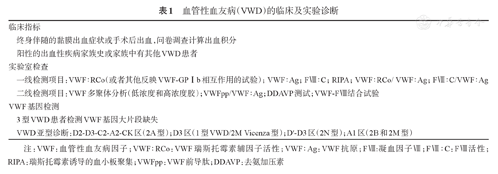
来自意大利的Federici提出了VWD实验室及临床诊断指标(表1)及VWD诊断流程图[18]。ISTH推荐采用出血积分评估表(ISTH-BAT)来评估患者临床出血严重程度。男性>3分、女性>5分被认为存在出血异常,儿童患者由于病史短可适当放宽标准。由表1可见,VWD的实验室检测项目分为一线和二线检测,与中华医学会血液学分会血栓与止血学组提出的血管性血友病诊断与治疗中国专家共识(2012年版)[39]相比有以下差别:①一线实验室检测项目增加了瑞斯托霉素诱导的血小板聚集(RIPA)、血浆VWF∶RCo/VWF∶Ag和FⅧ∶C/VWF∶Ag;②二线实验室检测项目增加了VWFpp/VWF∶Ag和DDAVP测试。在一线检查项目中增加VWF∶RCo/VWF∶Ag有助于1型VWD和2型VWD的鉴别,而FⅧ∶C/VWF∶Ag则有助于2N型VWD与1型VWD的鉴别。二线检查项目中增加了VWFpp/VWF∶Ag和DDAVP测试有助于鉴别1型VWD中的1C亚型。1C型VWD患者注射DDAVP后血浆VWF水平迅速增高,但注射后2 h即恢复到注射前水平[40]。故1C型患者的治疗不宜用DDAVP,应该考虑VWF浓缩物。此外,来自欧洲的资料表明,VWFpp/VWF∶Ag <0.6提示患者VWF基因存在突变并且导致VWF结构异常,因此VWFpp/VWF∶Ag参考值从既往的0.5~0.7更改为0.6 [41]

点击查看表格
表1

血管性血友病(VWD)的临床及实验诊断

表1

血管性血友病(VWD)的临床及实验诊断

临床指标
 终身伴随的黏膜出血症状或手术后出血,问卷调查计算出血积分
 阳性的出血性疾病家族史或家族中有其他VWD患者
实验室检查
 一线检测项目:VWF:RCo(或者其他反映VWF-GPⅠb相互作用的试验);VWF:Ag;FⅧ:C;RIPA;VWF:RCo/VWF:Ag;FⅧ:C/VWF:Ag
 二线检测项目:VWF多聚体分析(低浓度和高浓度胶);VWFpp/VWF:Ag;DDAVP测试;VWF-FⅧ结合试验
VWF基因检测
 3型VWD患者检测VWF基因大片段缺失
 VWD亚型诊断:D2-D3-C2-A2-CK区(2A型);D3区(1型VWD/2M Vicenza型);D'-D3区(2N型);A1区(2B和2M型)

注:VWF:血管性血友病因子;VWF∶RCo:VWF瑞斯托霉素辅因子活性;VWF∶Ag:VWF抗原;FⅧ:凝血因子Ⅷ;FⅧ∶C: FⅧ活性;RIPA:瑞斯托霉素诱导的血小板聚集;VWFpp:VWF前导肽;DDAVP:去氨加压素

四、VWD的临床分类

不同亚型VWD患者出血症状不同,即使是同一亚型的VWD患者出血程度也存在很大的差异。Federici提出根据VWF∶RCo和FⅧ∶C水平将VWD分成轻、中、重三型[18]。①轻型:多见于1型VWD,患者VWF∶RCo 300~500 U/L,FⅧ∶C 40%~70%,需要与低VWF水平的正常人相鉴别,个人出血史和出血性疾病家族史对于轻型VWD患者的诊断尤为重要。②中型:见于2B、2M、2N和部分1型VWD,患者VWF∶RCo 100~300 U/L,FⅧ∶C 20%~40%。③重型:见于3、2A和部分1型VWD,患者VWF∶RCo<100 U/L,FⅧ∶C< 20%。此外,出血积分达到10分以上的患者可反复发生严重出血,也应归为重型VWD。

五、VWD的治疗和预防

在过去的二十年中,VWD的治疗没有太大进展。反复月经过多的女性患者,可单用口服避孕药、DDAVP或氨甲环酸,效果不佳者可考虑联合用药(口服避孕药或氨甲环酸+ DDAVP)。如果药物治疗无效则需考虑替代治疗,严重者且无生育要求的可以行子宫切除术。对于1型VWD女性患者,妊娠9个月时VWF∶RCo >500 U/L且FⅧ∶C> 50%,即使不使用预防治疗,患者也可安全自然分娩或行剖宫产 [42]。对于既往DDAVP治疗有效、VWF∶RCo <500 U/L的妊娠早期1型VWD患者,在进行有创性检查前使用DDAVP是安全可靠的 [43]

以下情况需要预防性治疗[42]:①反复鼻出血和关节出血的年轻患者;②严重月经过多者;③胃肠道出血的老年患者。出血积分大于10分者可能从预防性治疗中获益[44]。正常产妇分娩后14 d VWF∶Ag恢复至孕前水平[45],所以需要预防性治疗的VWD产妇,治疗需维持2周以上。

六、结语

VWD的主要发病机制是VWF基因突变,VWF基因检测有助于VWD的分型和鉴别诊断。VWD的诊断中应重视提示VWF功能异常的VWF∶RCo/VWF∶Ag比值和FⅧ∶C/VWF∶Ag比值。出血积分是评估患者临床出血严重程度的重要工具,有助于发现重型VWD患者。重型VWD患者可考虑预防性治疗以降低严重出血的风险。

参考文献
[1]
TimmA, FahrenkrugJ, JørgensenHL, et al. Diurnal variation of von Willebrand factor in plasma: the Bispebjerg study of diurnal variations[J]. Eur J Haematol, 2014, 93(1):48-53.
[2]
HellgrenM, BlombäckM. Studies on blood coagulation and fibrinolysis in pregnancy, during delivery and in the puerperium. I. Normal condition [J]. Gynecol Obstet Invest, 1981,12 (3):141-154.
[3]
MillerCH, DilleyA, RichardsonL, et al. Population differences in von Willebrand factor levels affect the diagnosis of von Willebrand disease in African-American women [J]. Am J Hematol, 2001,67(2):125-129.
[4]
GillJC, Endres-BrooksJ, BauerPJ, et al. The effect of ABO blood group on the diagnosis of von Willebrand disease [J]. Blood, 1987,69(6):1691-1695.
[5]
CastamanG, TosettoA, RodeghieroF. Reduced von Willebrand factor survival in von Willebrand disease: pathophysiologic and clinical relevance [J]. J Thromb Haemost, 2009, 7Suppl 1:71-74.
[6]
RydzN, SwystunLL, NotleyC, et al. The C-type lectin receptor CLEC4M binds, internalizes, and clears von Willebrand factor and contributes to the variation in plasma von Willebrand factor levels[J]. Blood, 2013,121(26):5228-5237.
[7]
van LoonJE, SandersYV, de WeeEM, et al. Effect of genetic variation in STXBP5 and STX2 on von Willebrand factor and bleeding phenotype in type 1 von Willebrand disease patients[J]. PLoS One, 2012, 7(7):e40624.
[8]
AntoniG, Oudot-MellakhT, DimitromanolakisA, et al. Combined analysis of three genome-wide association studies on vWF and FVIII plasma levels [J]. BMC Med Genet, 2011, 12:102.
[9]
SmithNL, RiceKM, BovillEG, et al. Genetic variation associated with plasma von Willebrand factor levels and the risk of incident venous thrombosis[J]. Blood, 2011, 117 (22):6007-6011.
[10]
LacquemantC, GaucherC, DelormeC, et al. Association between high von willebrand factor levels and the Thr789Ala vWF gene polymorphism but not with nephropathy in type I diabetes. The GENEDIAB Study Group and the DESIR Study Group[J]. Kidney Int, 2000, 57(4):1437-1443.
[11]
KlemmT, MehnertAK, SiegemundA, et al. Impact of the Thr789Ala variant of the von Willebrand factor levels, on ristocetin co-factor and collagen binding capacity and its association with coronary heart disease in patients with diabetes mellitus type 2 [J]. Exp Clin Endocrinol Diabetes, 2005, 113(10):568-572.
[12]
KeightleyAM, LamYM, BradyJN, et al. Variation at the von Willebrand factor (vWF)gene locus is associated with plasma vWF:Ag levels: identification of three novel single nucleotide polymorphisms in the vWF gene promoter [J]. Blood, 1999, 93(12):4277-4283.
[13]
HicksonN, HampshireD, CastamanG, et al. Effect of the VWF promoter (GT)n repeat and single-nucleotide polymorphism c.-2527G>A on circulating von Willebrand factor levels under normal conditions[J]. J Thromb Haemost, 2011,9(3):603-605.
[14]
SadlerJE. A revised classification of von Willebrand disease. For the Subcommittee on von Willebrand Factor of the Scientific and Standardization Committee of the International Society on Thrombosis and Haemostasis[J]. Thromb Haemost, 1994,71(4):520-525.
[15]
SadlerJE, BuddeU, EikenboomJC, et al. Update on the pathophysiology and classification of von Willebrand disease: a report of the Subcommittee on von Willebrand Factor [J]. J Thromb Haemost, 2006, 4(10):2103-2114.
[16]
LaffanMA, LesterW, O' DonnellJS, et al. The diagnosis and management of von Willebrand disease: a United Kingdom Haemophilia Centre Doctors Organization guideline approved by the British Committee for Standards in Haematology[J]. Br J Haematol, 2014, 167(4):453-465.
[17]
BloomAL. von Willebrand factor: clinical features of inherited and acquired disorders[J]. Mayo Clin Proc,1991,66(7):743-751.
[18]
FedericiAB. Clinical and laboratory diagnosis of VWD [J]. Hematology Am Soc Hematol Educ Program, 2014, 2014(1):524-530.
[19]
CollinsPW, CummingAM, GoodeveAC, et al. Type 1 von Willebrand disease: application of emerging data to clinical practice[J]. Haemophilia, 2008, 14(4):685-696.
[20]
GoodeveA, EikenboomJ, CastamanG, et al. Phenotype and genotype of a cohort of families historically diagnosed with type 1 von Willebrand disease in the European study, Molecular and Clinical Markers for the Diagnosis and Management of Type 1 von Willebrand Disease (MCMDM-1VWD)[J]. Blood, 2007, 109(1):112-121.
[21]
JamesPD, NotleyC, HegadornC, et al. The mutational spectrum of type 1 von Willebrand disease: results from a Canadian cohort study[J]. Blood, 2007, 109(1):145-154.
[22]
CummingA, GrundyP, KeeneyS, et al. An investigation of the von Willebrand factor genotype in UK patients diagnosed to have type 1 von Willebrand disease [J]. Thromb Haemost, 2006, 96(5):630-641.
[23]
FloodVH. New insights into genotype and phenotype of VWD[J]. Hematology Am Soc Hematol Educ Program, 2014, 2014(1):531-535.
[24]
HaberichterSL, BalistreriM, ChristophersonP, et al. Assay of the von Willebrand factor (VWF)propeptide to identify patients with type 1 von Willebrand disease with decreased VWF survival[J]. Blood, 2006, 108(10):3344-3351.
[25]
CasonatoA, PontaraE, SartorelloF, et al. Reduced von Willebrand factor survival in type Vicenza von Willebrand disease[J]. Blood, 2002, 99(1):180-184.
[26]
JacobiPM, GillJC, FloodVH, et al. Intersection of mechanisms of type 2A VWD through defects in VWF multimerization, secretion, ADAMTS-13 susceptibility, and regulated storage[J]. Blood, 2012, 119(19):4543-4553.
[27]
GoodeveAC. The genetic basis of von Willebrand disease [J]. Blood Rev, 2010, 24(3):123-134.
[28]
RayesJ, HollestelleMJ, LegendreP, et al. Mutation and ADAMTS13-dependent modulation of disease severity in a mouse model for von Willebrand disease type 2B [J]. Blood, 2010, 115(23):4870-4877.
[29]
BerberE. The molecular genetics of von Willebrand disease [J]. Turk J Haematol, 2012, 29(4):313-324.
[30]
OzekiM, KunishimaS, KasaharaK, et al. A family having type 2B von Willebrand disease with an R1306W mutation: severe thrombocytopenia leads to the normalization of high molecular weight multimers[J]. Thromb Res, 2010, 125(2):e17-22.
[31]
FedericiAB, MannucciPM, CastamanG, et al. Clinical and molecular predictors of thrombocytopenia and risk of bleeding in patients with von Willebrand disease type 2B: a cohort study of 67 patients[J]. Blood, 2009,113(3):526-534.
[32]
JamesPD, NotleyC, HegadornC, et al. Challenges in defining type 2M von Willebrand disease: results from a Canadian cohort study[J]. J Thromb Haemost, 2007, 5(9):1914-1922.
[33]
RibbaAS, LoiselI, LavergneJM, et al. Ser968Thr mutation within the A3 domain of von Willebrand factor (VWF)in two related patients leads to a defective binding of VWF to collagen[J]. Thromb Haemost, 2001, 86(3):848-854.
[34]
KeelingD, BeavisJ, MarrR, et al. A family with type 2M VWD with normal VWF:RCo but reduced VWF:CB and a M1761K mutation in the A3 domain[J]. Haemophilia, 2012, 18(1):e33.
[35]
HampshireDJ, GoodeveAC. The international society on thrombosis and haematosis von Willebrand disease database: an update[J]. Semin Thromb Hemost, 2011, 37(5):470-479.
[36]
SutherlandMS, CummingAM, BowmanM, et al. A novel deletion mutation is recurrent in von Willebrand disease types 1 and 3[J]. Blood, 2009, 114(5):1091-1098.
[37]
GuptaPK, AdamtzikiE, BuddeU, et al. Gene conversions are a common cause of von Willebrand disease [J]. Br J Haematol, 2005, 130(5):752-758.
[38]
EikenboomJC, VinkT, BriëtE, et al. Multiple substitutions in the von Willebrand factor gene that mimic the pseudogene sequence [J]. Proc Natl Acad Sci U S A, 1994, 91 (6):2221-2224.
[39]
中华医学会血液学分会血栓与止血学组血管性血友病诊断与治疗中国专家共识(2012年版)[J].中华血液学杂志, 2012, 33(11):980-981.
[40]
HaberichterSL, CastamanG, BuddeU, et al. Identification of type 1 von Willebrand disease patients with reduced von Willebrand factor survival by assay of the VWF propeptide in the European study: molecular and clinical markers for the diagnosis and management of type 1 VWD (MCMDM-1VWD)[J]. Blood, 2008, 111(10):4979-4985.
[41]
CastamanG, GoodeveA, EikenboomJ, et al. Principles of care for the diagnosis and treatment of von Willebrand disease [J]. Haematologica, 2013, 98(5):667-674.
[42]
NeffAT, SidonioRF. Management of VWD [J]. Hematology Am Soc Hematol Educ Program, 2014, 2014(1):536-541.
[43]
TriggDE, StergiotouI, PeitsidisP, et al. A systematic review: the use of desmopressin for treatment and prophylaxis of bleeding disorders in pregnancy[J]. Haemophilia, 2012, 18(1):25-33.
[44]
FedericiAB, BucciarelliP, CastamanG, et al. The bleeding score predicts clinical outcomes and replacement therapy in adults with von Willebrand disease [J]. Blood, 2014, 123 (26):4037-4044.
[45]
HuqFY, KulkarniA, AgbimEC, et al. Changes in the levels of factor VIII and von Willebrand factor in the puerperium [J]. Haemophilia, 2012, 18(2):241-245.
 
 
展开/关闭提纲
查看图表详情
回到顶部
放大字体
缩小字体
标签
关键词