

间歇性禁食指设定进食时间,并在进食时间之外保持禁食的饮食方式。随着研究的深入,该饮食方式已被证明在慢性病防治中可发挥重要作用。
对国际上间歇性禁食近10余年的研究热点和趋势进行可视化分析,为该领域未来研究提供参考和依据。
2022-04-26,检索Web of Science核心数据库中间歇性禁食主题相关研究,检索时限设定为2010年1月至2022年4月。通过CiteSpace软件对纳入文献的学科分布、作者及机构合作关系、高频关键词、突现性被引关键词等进行分析,并绘制相关图谱。
最终检索纳入2 786篇文献。2010—2022年间歇性禁食相关论文的发文量呈现逐年上升的趋势,但全球研究水平仍然不均衡。发文量最高的国家为美国(650篇),发文量最高的机构为伊利诺伊大学(49篇),发文量最高的作者为伊利诺伊大学的Krista A Varady(26篇)。研究高频关键词主要包括减重、间歇性禁食、肥胖、胰岛素抵抗、代谢、热量限制、基因表达、生物节律和饮食等;研究主题聚类后重新命名得到食物摄入限制、生物节律、体质量控制、代谢相关疾病和其他疾病、相关机制研究;突现关键词包括时间限制性禁食、视交叉上核、老鼠、增长、死亡率等。
间歇性禁食国际研究热点集中于:与生物节律/昼夜节律的关系、改善慢性病和其他疾病的效果、敏感基因和相关机制。未来的研究应着眼于不同人群,如儿童/青少年、孕期女性、老年人和专业运动员/运动健身人群,并探索临床应用中不同模式下的间歇性禁食干预效果和安全性,最终形成个性化的间歇性禁食干预模式,并探讨其生物学机制。



本刊2023年版权归中国全科医学杂志社所有
未经编辑部许可,不得任意转载和摘编
本刊所发表作品仅为作者观点,并不代表编委会和编辑部意见
如有印装质量问题请向本刊发行部调换
间歇性禁食是一种目前受到广泛关注的饮食方案,指设定进食时间,并在进食时间之外保持禁食的饮食方式[1],包括禁食早餐[2]、限制三餐进食时间[3]、隔日禁食[4]和每周禁食2 d[5]等方式。近年来,间歇性禁食已经成为一种有效的慢性病防治饮食干预措施。研究表明,间歇性禁食能够改变生物节律,引发细胞反应,使不同能量代谢通路的分子机制发生改变,从而对多种慢性病(如肥胖、糖尿病、心血管疾病、癌症和神经退行性变等)发挥改善作用[6,7,8]。国际上间歇性禁食的相关研究逐年递增,2021年有500余篇相关研究被Web of Science核心数据库收录。但除了慢性病人群,健康人群利用这种饮食方式是否有利于维持健康?运动人群采用该饮食模式是否会影响运动表现?且间歇性禁食饮食的安全性如何?相关研究仍然较少。故对间歇性禁食领域的研究背景与现状、主题与热点的探究具有重要的意义。CiteSpace是一种被广泛应用于科学文献结构或时间模式分析的视觉分析软件[9],其可以将具有代表性的数据转化为图谱,以聚类、共现等方式探测学科前沿、选择科研方向、开展知识管理和辅助科技决策[10]。本文检索Web of Science核心数据库中间歇性禁食主题的研究,并使用CiteSpace绘制图谱结合相关文献,对间歇性禁食的学科分布、作者合作关系、机构合作关系、高频关键词、突现性关键词等进行分析,讨论间歇性禁食的研究热点和研究前沿,以期为该领域的后期研究提供理论依据。
2022-04-26,以"Intermittent fasting" "Time restricted feeding" "Time restricted eating" "Alternate day fasting" "Modified alternate day fasting" "Intermittent energy restriction" "Intermittent energy and carbohydrate restriction"为关键词,检索Web of Science核心数据库,检索时限为2010年1月至2022年4月。检索策略为:TS=(Intermittent fasting) OR TS=(Time restricted feeding) OR TS=(Time restricted eating) OR TS=(Alternate day fasting) OR TS=(Modified alternate day fasting) OR TS=(Intermittent energy restriction) OR TS=(Intermittent energy and carbohydrate restriction)。文献纳入标准:(1)与间歇性禁食主题相关;(2)语言为英文;(3)文章类型为期刊论文。排除标准:(1)与本主题不符、内容无关文献;(2)重复文献;(3)报告、会议通知和约稿信息,作者信息和单位信息未知文献。
根据纳入和排除标准,由两名研究员独立对文章进行筛选并提取数据,若两名研究员之间出现分歧,则与第三名研究员协商直至达成共识。
使用Microsoft Excel 2013软件对数据来源进行统计分析、对年度发文量进行时间分布分析。使用CiteSpace 5.8.R3软件对导入文献进行转换和可视化分析,时间跨度选择为2010年1月至2022年4月,时区分割阶段选择为"1",使用软件默认的数据库设定、阈值选择和主题词术语来源。节点类型设置中,依次选择"作者""机构"和"国家"进行合作网络分析,选择"关键词""分类"等进行共现网络分析,选择"被引数""最多被引作者"等进行共被引分析。依据普赖斯定律[11]计算核心作者的数量,计算公式N=0.749×(ηmax)×1/2,其中ηmax代表发文量最多的作者所发的论文数量,发文量>N篇的作者称为核心作者。经软件导入、转化与分析后,绘制可视化图谱和表格进行可视化分析,对共现、聚类的关系进行解读,以探究未来研究趋势。
初步检索共获得2 848篇文献,依据纳入与排除标准,排除重复文献11篇,排除与本主题不符、报告、会议通知和约稿信息、作者信息和单位信息未知文献共计51篇,最终纳入目标文献2 786篇。
2010—2022年,间歇性禁食相关论文的发文量大体上呈现逐年上升的趋势,其中在2015年出现轻微下降(159篇)。2010—2018年增速较缓(133篇增至236篇),自2019年开始快速上升(较2018年增加47篇),且在2020年和2021年发文量明显上升(425篇和520篇),见图1。
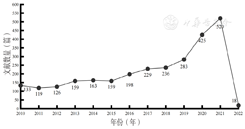
注:2022年文献仅检索至4月
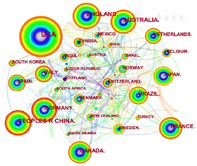
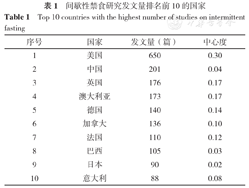
间歇性禁食相关研究发文量排名前10的国家依次为:美国(650篇,23.33%),中国(201篇,7.21%),英国(176篇,6.32%),澳大利亚(173篇,6.21%),德国(140篇,5.03%),加拿大(136篇,4.88%),法国(110篇,3.95%),巴西(105篇,3.77%),日本(90篇,3.23%),意大利(88篇,3.16%)。其中发文中心度排在前3的国家是美国(0.30)、英国(0.17)和澳大利亚(0.17)。尽管中国发文量排在第二名,但发文总体数量与第一名相差较大且发文中心度较低(0.04),见图2、表1。
间歇性禁食研究发文量排名前10的国家
Top 10 countries with the highest number of studies on intermittent fasting
间歇性禁食研究发文量排名前10的国家
Top 10 countries with the highest number of studies on intermittent fasting
| 序号 | 国家 | 发文量(篇) | 中心度 |
|---|---|---|---|
| 1 | 美国 | 650 | 0.30 |
| 2 | 中国 | 201 | 0.04 |
| 3 | 英国 | 176 | 0.17 |
| 4 | 澳大利亚 | 173 | 0.17 |
| 5 | 德国 | 140 | 0.14 |
| 6 | 加拿大 | 136 | 0.10 |
| 7 | 法国 | 110 | 0.12 |
| 8 | 巴西 | 105 | 0.03 |
| 9 | 日本 | 90 | 0.02 |
| 10 | 意大利 | 88 | 0.08 |
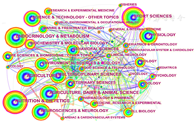
间歇性禁食中排名前10的热点学科领域依次为:营养学(337篇),运动科学(226篇),农业学(207篇),内分泌和代谢(197篇),农业、乳制品和动物科学(191篇),神经科学(154篇),生理学(137篇),科技其他主题(137篇),多学科(134篇),环境科学与生态学(105篇);中心度前3的学科领域依次为:运动科学(0.31)、营养学(0.14)、科技其他主题(0.12)。从结果看,营养学和运动科学在世界范围内处于热点研究领域,形成以这2个领域为核心,以内分泌、新陈代谢、动物科学为外围的多学科交叉体系,见图3、表2。
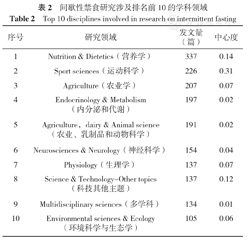
间歇性禁食研究涉及排名前10的学科领域
Top 10 disciplines involved in research on intermittent fasting
间歇性禁食研究涉及排名前10的学科领域
Top 10 disciplines involved in research on intermittent fasting
| 序号 | 研究领域 | 发文量(篇) | 中心度 |
|---|---|---|---|
| 1 | Nutrition & Dietetics(营养学) | 337 | 0.14 |
| 2 | Sport sciences(运动科学) | 226 | 0.31 |
| 3 | Agriculture(农业学) | 207 | 0.07 |
| 4 | Endocrinology & Metabolism(内分泌和代谢) | 197 | 0.02 |
| 5 | Agriculture,dairy & Animal science(农业、乳制品和动物科学) | 191 | 0.02 |
| 6 | Neurosciences & Neurology(神经科学) | 154 | 0.04 |
| 7 | Physiology(生理学) | 137 | 0.07 |
| 8 | Science & Technology-Other topics(科技其他主题) | 137 | 0.12 |
| 9 | Multidisciplinary sciences(多学科) | 134 | 0.01 |
| 10 | Environmental sciences & Ecology(环境科学与生态学) | 105 | 0.06 |
发文量排名前10的期刊为:PLoS One(811篇)、Proceedings of the National Academy of Sciences of the United States of America(711篇)、Science(574篇)、Cell Matablism(548篇)、Nature(526篇)、American Journal of Clinical Nutrition(517篇)、International Journal of Pediatric Obesity(444篇)、Obesity(424篇)、Physiology & Behavior(400篇)、Cell(373篇),平均影响因子为20.100,期刊与影响因子良好,见表3。
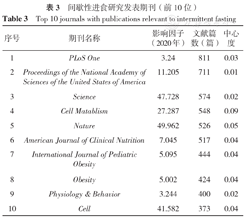
间歇性进食研究发表期刊(前10位)
Top 10 journals with publications relevant to intermittent fasting
间歇性进食研究发表期刊(前10位)
Top 10 journals with publications relevant to intermittent fasting
| 序号 | 期刊名称 | 影响因子(2020年) | 文献篇数(篇) | 中心度 |
|---|---|---|---|---|
| 1 | PLoS One | 3.24 | 811 | 0.03 |
| 2 | Proceedings of the National Academy of Sciences of the United States of America | 11.205 | 711 | 0.01 |
| 3 | Science | 47.728 | 574 | 0.02 |
| 4 | Cell Matablism | 27.287 | 548 | 0.09 |
| 5 | Nature | 49.962 | 526 | 0.05 |
| 6 | American Journal of Clinical Nutrition | 7.045 | 517 | 0.04 |
| 7 | International Journal of Pediatric Obesity | 5.095 | 444 | 0.04 |
| 8 | Obesity | 5.002 | 424 | 0.04 |
| 9 | Physiology & Behavior | 3.244 | 400 | 0.02 |
| 10 | Cell | 41.582 | 373 | 0.04 |
结果表明,共有11位核心作者,总计发表论文147篇,占全部纳入文献的5.28%;其中发文前3的作者为Krista A Varady(美国,伊利诺伊大学,26篇)、Satchidananda Panda(美国,索尔克研究所,18篇)及Mark P Mattson(美国,约翰斯·霍普金斯大学,16篇)。多数发文作者呈现广泛网络,排名前3位发文作者和多数团队显示紧密合作关系,个别作者独立分散,尚未形成团队,见表4、图4。
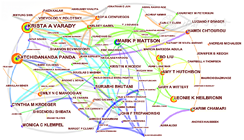
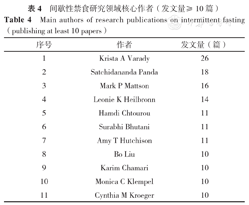
间歇性禁食研究领域核心作者(发文量≥10篇)
Main authors of research publications on intermittent fasting(publishing at least 10 papers)
间歇性禁食研究领域核心作者(发文量≥10篇)
Main authors of research publications on intermittent fasting(publishing at least 10 papers)
| 序号 | 作者 | 发文量(篇) |
|---|---|---|
| 1 | Krista A Varady | 26 |
| 2 | Satchidananda Panda | 18 |
| 3 | Mark P Mattson | 16 |
| 4 | Leonie K Heilbronn | 14 |
| 5 | Hamdi Chtourou | 11 |
| 6 | Surabhi Bhutani | 11 |
| 7 | Amy T Hutchison | 11 |
| 8 | Bo Liu | 10 |
| 9 | Karim Chamari | 10 |
| 10 | Monica C Klempel | 10 |
| 11 | Cynthia M Kroeger | 10 |
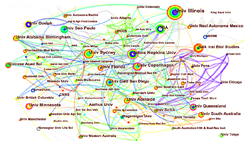
对研究机构进行共现分析后发现,间歇性禁食相关文章产出较多的前3位机构为University of Illinois(伊利诺伊大学,49篇),其次为University of Sydney(悉尼大学,27篇)及Johns Hopkins University(约翰斯·霍普金斯大学,25篇)。发文量排名前10的机构间呈现紧密状态,特别是排名前3的机构,在图谱中呈现多条线互相连接,说明该3所机构与其他机构紧密合作,见表5、图5。
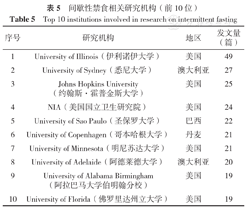
间歇性禁食相关研究机构(前10位)
Top 10 institutions involved in research on intermittent fasting
间歇性禁食相关研究机构(前10位)
Top 10 institutions involved in research on intermittent fasting
| 序号 | 研究机构 | 地区 | 发文量(篇) |
|---|---|---|---|
| 1 | University of Illinois(伊利诺伊大学) | 美国 | 49 |
| 2 | University of Sydney(悉尼大学) | 澳大利亚 | 27 |
| 3 | Johns Hopkins University(约翰斯·霍普金斯大学) | 美国 | 25 |
| 4 | NIA(美国国立卫生研究院) | 美国 | 24 |
| 5 | University of Sao Paulo(圣保罗大学) | 巴西 | 22 |
| 6 | University of Copenhagen(哥本哈根大学) | 丹麦 | 21 |
| 7 | University of Minnesota(明尼苏达大学) | 美国 | 21 |
| 8 | University of Adelaide(阿德莱德大学) | 澳大利亚 | 20 |
| 9 | University of Alabama Birmingham(阿拉巴马大学伯明翰分校) | 美国 | 19 |
| 10 | University of Florida(佛罗里达州立大学) | 美国 | 19 |
关于间歇性禁食的重要文献,结合表6,分别发现两篇高被引文献和两篇高中心性的核心文献。被引频率较高的文献的作者分别是Sutton EF和Mattson MP,高中心性的两篇文献的作者分别是Harvie MN和Hatori M。HARVIE等[12]的研究中,比较了间歇性与持续性能量限制在减肥、胰岛素敏感性和降低其他代谢性疾病风险标志物方面的可行性和有效性,结果发现在减肥、胰岛素敏感性和降低其他健康生物标志物方面,间歇性能量限制与持续性能量限制一样有效。HATORI等[13]的研究中,分别采用热量相同的随意进食与限时喂养,以观察小鼠的营养利用和能量消耗,结果发现限时喂养方案改善了小鼠环磷腺苷效应元件结合蛋白、哺乳动物西罗莫司靶蛋白和腺苷酸活化蛋白激酶通路功能及生物钟的振荡及其靶基因的表达,通过这些复杂的信号通路和转录效应网络,最终改变了机体的能量代谢。被引用频率最高的SUTTON等[14]的研究,在人体身上首次实现了与昼夜节律保持一致的早期限时进食(全天进食限制在6 h内,晚餐在15:00前完成),结果发现在食物摄入量并不减少的情况下,5周的早期限时进食虽然没有造成体质量的降低,却改善了糖尿病前期男性的胰岛素水平、胰岛素敏感性、β细胞反应性、血压和氧化应激水平。
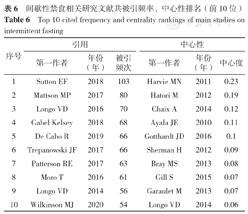
间歇性禁食相关研究文献共被引频率、中心性排名(前10位)
Top 10 cited frequency and centrality rankings of main studies on intermittent fasting
间歇性禁食相关研究文献共被引频率、中心性排名(前10位)
Top 10 cited frequency and centrality rankings of main studies on intermittent fasting
| 序号 | 引用 | 中心性 | ||||
|---|---|---|---|---|---|---|
| 第一作者 | 年份(年) | 被引频次 | 第一作者 | 年份(年) | 中心度 | |
| 1 | Sutton EF | 2018 | 103 | Harvie MN | 2011 | 0.23 |
| 2 | Mattson MP | 2017 | 80 | Hatori M | 2012 | 0.19 |
| 3 | Longo VD | 2016 | 70 | Chaix A | 2014 | 0.12 |
| 4 | Gabel Kelsey | 2018 | 68 | Ayala JE | 2010 | 0.11 |
| 5 | De Cabo R | 2019 | 66 | Gotthardt JD | 2016 | 0.1 |
| 6 | Trepanowski JF | 2017 | 66 | Sherman H | 2012 | 0.09 |
| 7 | Patterson RE | 2017 | 63 | Bray MS | 2013 | 0.08 |
| 8 | Moro T | 2016 | 61 | Gill S | 2015 | 0.07 |
| 9 | Longo VD | 2014 | 56 | Garaulet M | 2013 | 0.07 |
| 10 | Wilkinson MJ | 2020 | 54 | Longo VD | 2014 | 0.06 |
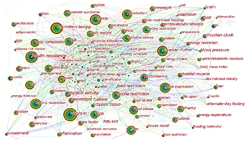
通过生成关键词的共现映射,分析关键词的频率和中心性,可以确定研究的前沿[15,16]。对Web of Science数据库文献进行分析,以关键词为节点,运行CiteSpace软件,得到节点数469,连线数1 371的关键词共现图谱(图6)。如表7所示,频次排在前5位的关键词是weight loss(减重,212次)、intermittent fasting(间歇性禁食,202次)、obesity(肥胖,161次)、insulin resistance(胰岛素抵抗,151次)、metabolism(代谢,132次)。中心性排在前5位的关键词是risk(风险,0.11)、behavior(行为,0.07)、insulin resistance(胰岛素抵抗,0.06)、time(时间,0.06)、metabolism(代谢,0.05)、calorie restriction(热量限制,0.05)。
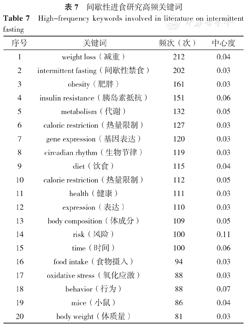
间歇性进食研究高频关键词
High-frequency keywords involved in literature on intermittent fasting
间歇性进食研究高频关键词
High-frequency keywords involved in literature on intermittent fasting
| 序号 | 关键词 | 频次(次) | 中心度 |
|---|---|---|---|
| 1 | weight loss(减重) | 212 | 0.04 |
| 2 | intermittent fasting(间歇性禁食) | 202 | 0.03 |
| 3 | obesity(肥胖) | 161 | 0.03 |
| 4 | insulin resistance(胰岛素抵抗) | 151 | 0.06 |
| 5 | metabolism(代谢) | 132 | 0.05 |
| 6 | caloric restriction(热量限制) | 127 | 0.03 |
| 7 | gene expression(基因表达) | 120 | 0.03 |
| 8 | circadian rhythm(生物节律) | 119 | 0.03 |
| 9 | diet(饮食) | 115 | 0.04 |
| 10 | calorie restriction(热量限制) | 112 | 0.05 |
| 11 | health(健康) | 111 | 0.03 |
| 12 | expression(表达) | 110 | 0.03 |
| 13 | body composition(体成分) | 109 | 0.05 |
| 14 | risk(风险) | 100 | 0.11 |
| 15 | time(时间) | 100 | 0.06 |
| 16 | food intake(食物摄入) | 94 | 0.03 |
| 17 | oxidative stress(氧化应激) | 88 | 0.03 |
| 18 | behavior(行为) | 88 | 0.07 |
| 19 | mice(小鼠) | 86 | 0.04 |
| 20 | body weight(体质量) | 81 | 0.03 |
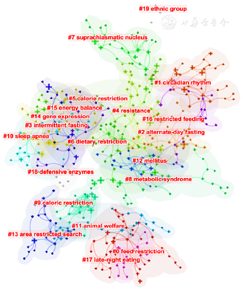
在得到关键词共现之后,通过CiteSpace的对数似然比检验算法(LLR算法)对关键词聚类,得到了19个关键词聚类标签,对间歇性禁食的主要研究内容有了更进一步的了解[17]。如图7所示,Modularity Q值约为0.799 6,表示聚类结构显著;Mean Silhouette值约为0.907 2,表明聚类结果合理。如表8所示,其中轮廓值越接近1,反映图谱的同质性越高。对聚类中包含的具体关键词进行总结归纳,并对其研究主题重新命名,其中聚类#0、#11、#13可归纳为食物摄入限制,聚类#1、#7、#16、#17可归纳为生物节律,聚类#2、#3、#5、#7、#9、#15可归纳为体质量控制,聚类#4、#6、#8、#10、#12可归纳为代谢相关疾病和其他疾病,聚类#14、#18、#19可归纳为相关机制研究。
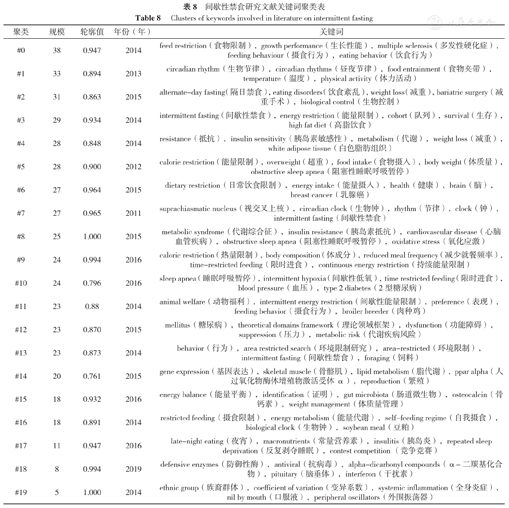
间歇性禁食研究文献关键词聚类表
Clusters of keywords involved in literature on intermittent fasting
间歇性禁食研究文献关键词聚类表
Clusters of keywords involved in literature on intermittent fasting
| 聚类 | 规模 | 轮廓值 | 年份(年) | 关键词 |
|---|---|---|---|---|
| #0 | 38 | 0.947 | 2014 | feed restriction(食物限制),growth performance(生长性能),multiple sclerosis(多发性硬化症),feeding behaviour(摄食行为),eating behavior(饮食行为) |
| #1 | 33 | 0.894 | 2013 | circadian rhythm(生物节律),circadian rhythms(昼夜节律),food entrainment(食物夹带),temperature(温度),physical activity(体力活动) |
| #2 | 31 | 0.863 | 2015 | alternate-day fasting(隔日禁食),eating disorders(饮食紊乱),weight loss(减重),bariatric surgery (减重手术),biological control(生物控制) |
| #3 | 29 | 0.934 | 2014 | intermittent fasting(间歇性禁食),energy restriction(能量限制),cohort(队列),survival(生存),high fat diet(高脂饮食) |
| #4 | 28 | 0.848 | 2014 | resistance(抵抗),insulin sensitivity(胰岛素敏感性),metabolism(代谢),weight loss(减重),white adipose tissue(白色脂肪组织) |
| #5 | 28 | 0.900 | 2012 | calorie restriction(能量限制),overweight(超重),food intake(食物摄入),body weight(体质量),obstructive sleep apnea(阻塞性睡眠呼吸暂停) |
| #6 | 27 | 0.964 | 2015 | dietary restriction(日常饮食限制),energy intake(能量摄入),health(健康),brain(脑),breast cancer(乳腺癌) |
| #7 | 27 | 0.965 | 2011 | suprachiasmatic nucleus(视交叉上核),circadian clock(生物钟),rhythm(节律),clock(钟),intermittent fasting(间歇性禁食) |
| #8 | 25 | 1.000 | 2015 | metabolic syndrome(代谢综合征),insulin resistance(胰岛素抵抗),cardiovascular disease(心脑血管疾病),obstructive sleep apnea(阻塞性睡眠呼吸暂停),oxidative stress(氧化应激) |
| #9 | 24 | 0.994 | 2016 | caloric restriction(热量限制),body composition(体成分),reduced meal frequency(减少就餐频率),time-restricted feeding(限时进食),continuous energy restriction(持续能量限制) |
| #10 | 24 | 0.796 | 2016 | sleep apnea(睡眠呼吸暂停),intermittent hypoxia(间歇性低氧),time restricted feeding(限时进食),blood pressure(血压),type 2 diabetes(2型糖尿病) |
| #11 | 23 | 0.88 | 2014 | animal welfare(动物福利),intermittent energy restriction(间歇性能量限制),preference(表现),feeding behavior(摄食行为),broiler breeder(肉种鸡) |
| #12 | 23 | 0.870 | 2015 | mellitus(糖尿病),theoretical domains framework(理论领域框架),dysfunction(功能障碍),suppression(压力),metabolic risk(代谢疾病风险) |
| #13 | 23 | 0.873 | 2014 | behavior(行为),area restricted search(环境限制研究),area-restricted(环境限制),intermittent fasting(间歇性禁食),foraging(饲料) |
| #14 | 20 | 0.761 | 2015 | gene expression(基因表达),skeletal muscle(骨骼肌),lipid metabolism(脂代谢),ppar alpha(人过氧化物酶体增殖物激活受体α),reproduction(繁殖) |
| #15 | 18 | 0.932 | 2016 | energy balance(能量平衡),identification(证明),gut microbiota(肠道微生物),osteocalcin(骨钙素),weight management(体质量管理) |
| #16 | 18 | 0.891 | 2014 | restricted feeding(摄食限制),energy metabolism(能量代谢),self-feeding regime(自我摄食),biological clock(生物钟),soybean meal(豆粕) |
| #17 | 11 | 0.947 | 2016 | late-night eating(夜宵),macronutrients(常量营养素),insulitis(胰岛炎),repeated sleep deprivation(反复剥夺睡眠),contest competition (竞争竞赛) |
| #18 | 8 | 0.994 | 2019 | defensive enzymes(防御性酶),antiviral(抗病毒),alpha-dicarbonyl compounds(α-二羰基化合物),pituitary(脑垂体),interferon(干扰素) |
| #19 | 5 | 1.000 | 2014 | ethnic group(族裔群体),coefficient of variation(变异系数),systemic inflammation(全身炎症),nil by mouth(口服液),peripheral oscillators(外围振荡器) |
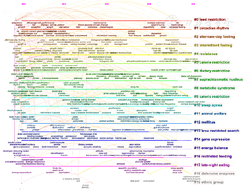
对共被引文献进行聚类分析,时区选择2010—2022年,以"Cited references"为节点,经多次调节后阈值选择Top 5,运行后得到网络图谱,见图7。图谱共有469个节点和662个链接,图谱的聚类参数Q和S分别是0.80和0.91,表示该聚类合理。共得到19个聚类,分别为#0 feed restriction(食物限制)、#1 circadian rhythm(生物节律)、#2 alternate-day fasting(隔日禁食)、#3 intermittent fasting(间歇性禁食)、#4 resistance(抵抗)、#5 calorie restriction(热量限制)、#6 dietary restriction(日常饮食限制)、#7 suprachiasmatic nucleus(视交叉上核)、#8 metabolic syndrome(代谢综合征)、#9 caloric restriction(热量限制)、#10 sleep apnea(睡眠呼吸暂停)、#11 animal welfare(动物福利)、#12 mellitus(糖尿病)、#13 area restricted search(环境限制研究)、#14 gene expression(基因表达)、#15 energy balance(能量平衡)、#16 restricted feeding(摄食限制)、#17 late-night eating(夜宵)、#18 defensive enzymes(防御性酶)、#19 ethnic group(族裔群体),各聚类的时间线见图8。
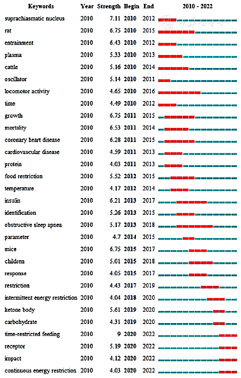
本研究根据引文突发最强的关键词分布来预测研究前沿[18]。由图9可知,2010—2022年均有突现词出现,2010—2022年突现词强度排名前5的依次为:time-restriction feeding(时间限制性禁食,9.00)、suprachiasmatic nucleus(视交叉上核,7.11),rat(老鼠,6.75)、growth(增长,6.75)、mice(老鼠,6.75)。进一步分析后发现,2010—2014年主要的突现词有:suprachiasmatic nucleu(视交叉上核)、rat(老鼠)、entrainment(夹带)、plasma(血浆)、cattle(牛)、oscillator(振荡器)、locomotor activity(体力活动)、time(时间)、growth(生长)、mortality(死亡率)、coronary heart disease(冠心病)、cardiovascular disease(心血管疾病)、protein(蛋白质)、food restriction(食物限制)、temperature(温度)、insulin(胰岛素)、identification(识别)、obstructive sleep apnea(阻塞性睡眠呼吸暂停)、parameter(参数)、growth(增长)。2015—2018年主要的突现词有:mice(小鼠)、children(儿童)、response(反应)、restriction(限制)、intermittent energy restriction(间歇性能量限制)。2019—2022年出现的突现词有:ketone body(酮体)、carbohydrate(碳水化合物)、time-restricted feeding(时间限制性禁食)、receptor(受体)、impact(影响)、continuous energy restriction(持续能量限制)。
2010—2022年,学界对间歇性禁食的关注度逐渐增加。从发文数量较多的国家来看,排名前5位的国家依次为美国、中国、英国、澳大利亚和德国。美国在间歇性禁食领域的相关研究处于领先地位,无论是发文数量还是中心性都位居第一;中国虽然发文数量位列第二,但是中心度却远低于前5位的其他国家。从发文机构来分析,排名前10的机构中有9所机构来自发达国家,其中6所机构来自美国,该6所机构全是世界知名的美国高校和研究所,且此6所机构均与其他机构之间形成了密切合作关系。中国虽然发文数量进入了前10,但并未有任何机构进入前10,也说明中国间歇性禁食相关研究机构较分散和多样。从发文作者来看,发文前3的作者全部来自美国,发文前10的作者中有6名来自美国,其余4名来自澳大利亚(2名)、突尼斯(非洲,1名)和卡塔尔(亚洲,1名),充分体现了美国在间歇性禁食研究方面的领军地位。间歇性禁食的发文目前已经不局限于营养学领域,其与运动科学领域形成了较多交叉,且运动科学领域中心性最高,说明运动科学领域研究者已经对间歇性禁食相关研究产生了广泛的研究兴趣,并已产出较多研究成果。
策划和确定有价值的选题,对于期刊的发展至关重要[19]。而期刊对于该选题研究的发表,也极大地促进了该选题的理论价值提升和广泛传播。从间歇性禁食发文的期刊来看,世界顶级期刊,如Science、Nature和Cell分别刊出过574、526、373篇该领域的文章,足见间歇性禁食研究的新颖性和前沿性。
基于研究中高频关键词、研究热点共现图谱、关键词聚类的分析,可以得出间歇性禁食的研究热点。
生物钟是一种自主的计时机制,其允许生物体预测和适应光、温度、食物供应的环境节律。哺乳动物中,位于下丘脑视交叉上核的主生物钟和时钟基因的昼夜节律振荡主要由光重置[20,21];而外周组织(如肝脏、脂肪细胞和骨骼肌)也可以调节昼夜节律,其受到非光因素(如食物的供应、运动、体温等)调节。早期关注生物节律与进食规律的研究者们,探索了进食/禁食时间、进食方式等饮食变化和昼夜节律的时间"窗口"如何相互配合,以调节主生物钟和外周生物钟相关基因的转录,从而影响物质代谢和能量代谢[22,23,24],最终诱发代谢性疾病的发生等相关机制。
近十几年的研究发现,间歇性禁食对肥胖、糖尿病、心血管疾病、癌症、神经退行性脑病及其风险因素都有不同程度的干预效果。动物实验和人体试验的证据均表明,不同模式下的间歇性禁食,即无论是进行间歇性能量限制还是限制时间的饮食,都可以降低脂代谢异常、胰岛素抵抗和其他健康生物标志物水平紊乱的风险,且改善的效果与限制饮食的时间呈正比[12,14,25,26,27,28,29]。但是,研究也指出,间歇性禁食虽然可以减少体内的脂肪,但同时也易造成瘦体质量的丢失[30]。另外,间歇性禁食还可改善与心血管疾病相关的各项风险因子的水平,如血压、静息心率、高密度脂蛋白胆固醇和低密度脂蛋白胆固醇、总胆固醇[31,32,33],并减少与动脉粥样硬化相关的全身炎症和氧化应激标志物水平[34]。当前的研究虽然支持间歇性禁食对于上述疾病和风险因子水平的正向调节效果,但是这些研究都是短期的,间歇性禁食是否能够长期保持上述效果(>6个月),并且保证安全性,还有待进一步探索。
间歇性禁食还可以对部分肿瘤(如淋巴瘤、自发性肿瘤和胶质母细胞瘤等)的生长产生影响[35,36]。与此同时,将间歇性禁食与化疗进行组合可持续、有效提高化疗效果[37,38]。但是相关研究也提示:将2周或者更长时间的间歇性禁食引入临床试验中必须要考虑营养不良可能造成免疫功能下降进而增加某些感染的风险,所以必须要有更严谨的和更加个性化的研究方案[39]。另外,动物实验模型证明,间歇性禁食可通过多种机制对神经系统产生有利影响,进而预防癫痫的发作,并延缓阿尔茨海默病和帕金森病的发生、发展[40,41],但是目前尚缺乏临床随机对照试验的数据。
对间歇性禁食的研究关键词时间视线图和突发关键词的可视化图进行分析,可以得出间歇性禁食的研究前沿。
相关研究已经从最开始关注肥胖、糖尿病等慢性病人群应用间歇性禁食治疗的效果,逐渐发展到关注儿童/青少年[52,53]、孕期女性[54,55]、老年人[56,57]和专业运动员/运动健身人群[58,59]应用间歇性禁食治疗的效果。针对专业运动员和运动健身人群所形成的新的研究领域,研究者们着眼于探索在改善身体成分的同时,间歇性禁食对运动表现的影响(包括无氧运动能力和有氧运动能力[58,59])。虽然目前相关研究尚少,但也体现出目前和未来的研究在满足健康需求的基础上,会更加个性化地解决不同人群的实际需求。
间歇性禁食的重点是人们可以在一天或一周内调整进食的时间。intermittent energy restriction(间歇性能量限制)、time-restricted feeding(限时进食)突现关键词也证明,不同的禁食模式也是间歇性禁食研究的核心前沿。间歇性禁食模式的相关研究不仅关注单一间歇性禁食模式的效果,还关注不同禁食模式下的效果比较,如隔日禁食、限食进食、间歇性能量限制、生酮饮食等[60],或者组合干预方式的效果,如多种禁食方式的组合、间歇性禁食组合药物、间歇性禁食组合运动等[61,62],这也是未来重要的研究方向。
ketone body(酮体)(2019—2020年)、receptor(受体)(2020—2022年)、impact(影响)(2020—2022年)是近3年来的突现关键词。在禁食期间,肝脏将脂肪酸转化为酮体可为许多组织及器官,尤其是大脑,提供重要的能量来源。除此以外,酮体及其受体水平的变化还可影响过氧化物酶体增殖物激活受体γ共激活因子1α、酰胺腺嘌呤二核苷酸、二磷酸腺苷等一系列分子的表达和活性,从而对全身代谢产生深远影响[63,64]。另外,间歇性禁食对胰岛素相关受体、能量代谢信号通路相关分子、自噬相关蛋白表达、脂质组学、蛋白质组学、肠道微生物等影响的相关机制分析,也成为新的热门研究领域[65,66,67]。
本研究只针对Web of Science进行了2010—2022年国际文献内容的分析,并未进行中文数据库相关文献的分析。但是从全球的研究文献来看,间歇性禁食研究的热度在逐年增加,研究的重要文献和中心性文献均来自欧美发达国家,也体现了全球研究水平的不均衡性。目前,相关研究已经证明不同模式的间歇性禁食对肥胖、糖尿病、心血管疾病、癌症、神经系统疾病和其他健康状况具有广泛益处。未来需要聚焦将间歇性禁食应用于不同人群的效果,包括儿童/青少年、女性、老年人和运动等人群,并制订个性化的研究方案;在评估何种间歇性禁食模式对目标人群效果更好的基础上,也需要关注间歇性禁食对目标人群的安全性;在保证有效性和安全性的基础上,可以进一步提出剂量-效应关系,包括确定各间歇性禁食模式在目标人群中显示效果的时间和停止该种饮食方式后效果的持续时间。另外,目前的研究多数涉及的是短期的干预措施,持续数年的间歇性禁食需要大幅度改变饮食习惯,是否可带来更多的益处,也是未来需要回答的问题。
本研究并未对中文数据库相关研究进行分析,但是我国的间歇性禁食研究尚处于起步阶段,目前尚缺乏临床人体试验的研究数据。中国人的饮食模式较欧美国家更为复杂,这也为我国开展间歇性禁食的临床研究提出了机遇和挑战。在"健康中国"国家战略的大背景下,未来,将流行病学数据、健康长寿人群及其饮食特点数据、不同模式下的人类间歇性禁食方案研究的数据结合起来将非常重要。我国未来的研究不仅要着眼于大型临床研究的设计,也要着眼于如何将禁食的效果与饮食的可接受方式结合起来(如与生物钟匹配的间歇性禁食方案),以便产生更好的依从性和效果。最后,可通过更好地了解间歇性禁食影响各种细胞类型和器官系统的分子机制,进而开发出个性化地针对各种疾病、各种人群健康需求的新型预防和治疗干预措施。
郭娴,周雁冰,刘晶莹,等.间歇性禁食国际研究进展与热点的可视化分析[J].中国全科医学,2023,26(16):2036-2046,2054.[www.chinagp.net]
GUO X,ZHOU Y B,LIU J Y,et al. Visualization analysis of global advances and hot spots in intermittent fasting[J]. Chinese General Practice,2023,26(16):2036-2046,2054.
本文无利益冲突。


