Meta分析" />
发育行为
母亲孕期或产后抑郁情绪对子代情绪和行为的影响:Meta分析
中华实用儿科临床杂志, 2022,37(4) : 284-289. DOI: 10.3760/cma.j.cn101070-20201123-01794
摘要
目的

分析母亲孕期和产后抑郁情绪对儿童情绪和行为的影响。

方法

在PubMed、Embase、Web of Knowledge、PsycINFO、Cochrane、万方数据库和中国知网,以"母亲(maternal) AND抑郁(depression) AND儿童或子代(child OR offspring) AND神经心理(neuropsychology)"为检索词检索有关母亲抑郁情绪对子代情绪和行为产生影响的病例对照研究和队列研究,检索时间为2000年1月1日至2020年10月31日。根据纳入标准和排除标准筛选文献,采用RevMan 5.3进行Meta分析。

结果

共纳入14篇文献,包括病例组3 914例,对照组17 016例。结果显示,母亲在孕期或产后存在抑郁情绪,儿童罹患情绪或行为障碍的风险是母亲无抑郁情绪儿童的2.03倍(OR=2.03,95%CI:1.55~2.65);孕期和产后抑郁情绪均可增加子代情绪或行为障碍的发生风险,但2个时期的差异无统计学意义(Z=-0.371,95%CI:0.796~1.168);这种影响可持续至子代学龄前和学龄期,且学龄期儿童发生情绪或行为障碍的风险大于学龄前期(Z=-2.340,95%CI:0.643~0.962)。

结论

孕期和产后抑郁情绪均会增加子代情绪或行为障碍的发生风险,而且这种影响不会随着年龄的增长而减少。

引用本文: 林雪梅, 杨建辉, 陈佩珊, 等.  母亲孕期或产后抑郁情绪对子代情绪和行为的影响:Meta分析 [J] . 中华实用儿科临床杂志, 2022, 37(4) : 284-289. DOI: 10.3760/cma.j.cn101070-20201123-01794.
参考文献导出:   Endnote    NoteExpress    RefWorks    NoteFirst    医学文献王
扫  描  看  全  文

正文
作者信息
基金 0  关键词  0
English Abstract
评论
阅读 0  评论  0
相关资源
引用 | 论文 | 视频

版权归中华医学会所有。

未经授权,不得转载、摘编本刊文章,不得使用本刊的版式设计。

除非特别声明,本刊刊出的所有文章不代表中华医学会和本刊编委会的观点。

孕期或产后抑郁的发生率为15%~20%[1,2],儿童抑郁或焦虑的发生率为5%~15%[3,4]。儿童的社交情绪能力在生命早期就开始发育[5],而且情绪感知较成人敏感,更易受父母情绪和行为的影响[6,7]。母亲存在抑郁情绪的儿童较母亲情绪正常儿童的积极情绪少[8],其抑郁的发生率也较母亲情绪正常的儿童高[9,10]。有研究发现,母亲产后抑郁对儿童情绪发育的影响较大,这是由于存在产后抑郁情绪的母亲与孩子的日常互动较少[11],且体罚的使用率较高[12]。但有学者认为孕期抑郁对子代情绪和行为发育的影响更大[13,14],可增加子代出现行为障碍的风险[15,16]。目前关于母亲抑郁情绪对子代情绪和行为发育影响的研究主要存在2个方面的问题:(1)样本量不够大;(2)子代年龄的差异较大,而儿童年龄因素对情绪和行为障碍的影响是不容忽视的[14]。因此,本研究使用Meta分析评价母亲孕期和产后抑郁情绪对子代情绪和行为发育的影响,并根据儿童年龄进行亚组分析,旨在比较母亲孕期或产后抑郁情绪对不同年龄段(学龄前和学龄期)儿童的情绪或行为障碍发生风险的影响。

1 资料与方法
1.1 数据库与检索词

遵循系统回顾和Meta分析(PRISMA)指南的条目[17,18],使用PubMed、Embase、Cochrane library、Web of Knowledge、PsycINFO、万方数据库及中国知网7个数据库进行检索。检索时间为2000年1月1日至2020年10月31日。最后1次检索时间为2020年12月。采用布尔运算符,使用以下检索词的主题词及自由词进行检索:母亲(maternal) AND抑郁(depression) AND儿童或子代(child OR offspring) AND神经心理(neuropsychology)。

1.2 纳入标准和排除标准
1.2.1 纳入标准

(1)病例对照研究或队列研究;(2)文献涉及母亲抑郁情绪与儿童情绪和/或行为障碍的相关性[19];(3)母亲在孕期或产后1年内被诊断为抑郁或通过抑郁量表提示有抑郁情绪[20];(4)儿童年龄≤16岁。

1.2.2 排除标准

(1)病例报告;(2)摘要、评论和会议报告;(3)文章提供的信息不完整或不能用于meta分析;(4)重复发表的研究,仅纳入样本量最大者。

1.3 数据提取与质量评估

由2名研究者进行文献筛选,并各自独立提取数据,绘制表格,进行交换和核对,最后统一数据。提取以下数据:(1)第一作者姓名;(2)发表时间;(3)国家;(4)样本量;(5)研究类型;(6)母亲抑郁情绪和儿童情绪或行为障碍的评估工具。使用纽卡斯尔渥太华质量评估量表(NOS)[21]评估纳入文献的质量,并剔除低质量文献。NOS分数为0~9分,7分以上为高质量。

1.4 统计学处理

采用RevMan 5.3软件(Cochrane Collaboration,Software Update,Oxford,United Kingdom)对数据进行分析。采用比值比(odds ratio,OR)或相对危险度(relative risk,RR),以及95%CI作为研究效应的指标。研究间的异质性通过合并检验统计量I2进行评估。合并检验统计量I2值≤50%,说明纳入文献间的异质性较小,可采用固定效应模型进行合并;合并检验统计量I2值>50%,则使用随机效应模型。如存在异质性,需要找出异质性的原因,如对纳入的文献进行亚组分析和敏感性分析。本研究采用的亚组分析包括:(1)孕期抑郁情绪和产后抑郁情绪;(2)学龄前儿童和学龄期儿童。采用Stata 12.0软件进行Begg′s法和Egger′s线性回归分析。P≤0.05为差异有统计学意义。

2 结果
2.1 纳入文献的基线资料

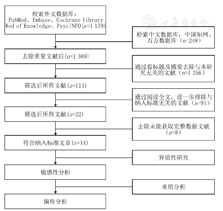
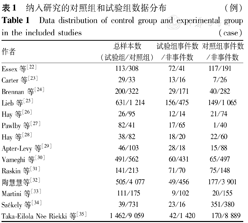
共检索到文献1 427篇。去除重复文献,根据纳入标准,最终纳入14项研究(图1),试验组和对照组抽取的样本数见表1

点击查看大图
图1
纳入文献筛选及研究流程图
Figure 1
Flow diagram of study search and study selection
点击查看大图
图1
纳入文献筛选及研究流程图
Figure 1
Flow diagram of study search and study selection
点击查看表格
表1

纳入研究的对照组和试验组数据分布(例)

Table 1

Data distribution of control group and experimental group in the included studies(case)

表1

纳入研究的对照组和试验组数据分布(例)

Table 1

Data distribution of control group and experimental group in the included studies(case)

作者总样本数(试验组/对照组)试验组事件数/非事件数对照组事件数/非事件数
Essex等[22]113/30872/41117/191
Carter等[23]29/3313/167/26
Brennan等[24]200/32229/17140/282
Lieb等[25]631/1 214156/475149/1 065
Hay等[26]26/9512/1421/74
Pawlby等[27]82/4117/651/40
Hay等[28]38/8218/2022/60
Apter-Levy等[29]46/10328/1815/88
Vameghi等[30]491/56260/43165/497
Raskin等[31]141/21371/7075/148
陶慧慧等[32]505/4 07749/456177/3 901
Martini等[33]111/1759/10220/155
Székely等[34]39/73123/16351/380
Taka-Eilola Nèe Riekki等[35]1 462/9 05942/1 420170/8 889
2.2 异质性分析

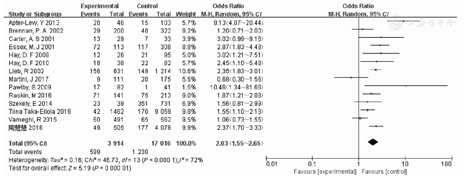
14项研究中,病例组3 914例,对照组17 016例。各研究的Hardy-Weinberg平衡P值均高于0.05,说明纳入的文献具有良好的群体代表性。以RR值或OR值以及95%CI作为有效指标,对各模型的文献进行异质性检验。由于固定模型纳入的研究存在异质性,故采用随机效应模型进行分析(图2)。重新检查原始数据是否准确地包含在研究中。显著模型合并后:P<0.000 01,OR=2.03,95%CI:1.55~2.65,I2=72%,结果表明:孕期或产后抑郁情绪对子代情绪和行为发育存在不良影响。母亲在孕期或产后存在抑郁情绪的儿童罹患情绪或行为障碍的风险是母亲无抑郁情绪儿童的2.03倍。
点击查看大图
图2
孕期和产后抑郁情绪对子代情绪或行为障碍发生风险的影响(随机效应模型)
Figure 2
A forest diagram of random-effects model to assess the effects of antenatal and postnatal depressed mood on the incidence of emotional disorders or behavioral disorders in offspring
点击查看大图
图2
孕期和产后抑郁情绪对子代情绪或行为障碍发生风险的影响(随机效应模型)
Figure 2
A forest diagram of random-effects model to assess the effects of antenatal and postnatal depressed mood on the incidence of emotional disorders or behavioral disorders in offspring
2.3 敏感性分析

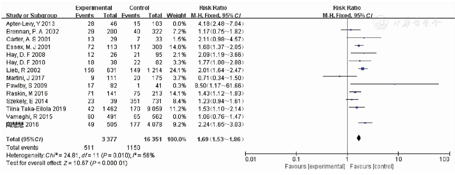
由于纳入文献间存在异质性,为确定异质性的来源,对纳入的数据进行敏感性分析。将纳入文献的显著模型合并,采用固定随机模型重新计算。将权重最大的研究(Apter-levy,2013)从模型中剔除后,再次使用固定效应模型进行计算,结果显示:合并RR=1.61,95%CI:1.47~1.77,I2=62%,Z=10.09,P<0.001。接着对文献进行回顾并检查提取的数据是否正确,然后从模型中剔除权重第二的研究(Vameghi,2015),结果显示:合并RR=1.69,95%CI:1.53~1.86,I2=56%,Z=10.67(图3)。这表明,剔除这2篇文章后,异质性降低。
点击查看大图
图3
孕期和产后抑郁情绪对子代情绪或行为障碍发生风险的影响的敏感性分析(固定效应模型)
Figure 3
A forest diagram of fixed-effects model to assess the effects of antenatal and postnatal depressed mood on the incidence of emotional disorders or beha-vioral disorders in offspring after removed weighted studies
点击查看大图
图3
孕期和产后抑郁情绪对子代情绪或行为障碍发生风险的影响的敏感性分析(固定效应模型)
Figure 3
A forest diagram of fixed-effects model to assess the effects of antenatal and postnatal depressed mood on the incidence of emotional disorders or beha-vioral disorders in offspring after removed weighted studies
2.4 亚组分析

根据被调查儿童的年龄,将数据分为学龄前组和学龄期组。学龄前组中,RR=1.40,95%CI:1.18~1.66,I2=77%,Z=3.86。学龄期组中,RR=1.78,95%CI:1.60~1.98,I2=64%,Z=10.51。为比较母亲在孕期或产后存在抑郁情绪对学龄前和学龄期儿童情绪或行为障碍发生风险的影响的差异,计算相对风险比(ratio of relative risk,RRR)=0.787,交互作用检验(Z值)=-2.340,RRR的95%CI:0.643~0.962。如果|Z|>1.96,则说明亚组间存在差异。上述结果表明:母亲在孕期或产后存在抑郁情绪的学龄前儿童和学龄期儿童的情绪或行为障碍的发生风险分别是母亲情绪正常儿童的1.40倍和1.78倍,2个年龄组间的差异有统计学意义,说明母亲在孕期或产后存在抑郁情绪的儿童在学龄期发生情绪或行为障碍的风险高于学龄前(图4)。
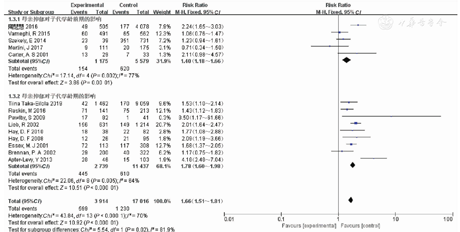
点击查看大图
图4
母亲孕期或产后抑郁情绪对学龄前和学龄期儿童情绪或行为障碍发生风险的影响(亚组分析,固定效应模型)
Figure 4
A forest diagram of fixed-effects model to assess the effects of antenatal and postnatal depressed mood on the incidence of emotional disorders or beha-vioral disorders in offspring for the subgroup analysis of preschool age group and school age group
点击查看大图
图4
母亲孕期或产后抑郁情绪对学龄前和学龄期儿童情绪或行为障碍发生风险的影响(亚组分析,固定效应模型)
Figure 4
A forest diagram of fixed-effects model to assess the effects of antenatal and postnatal depressed mood on the incidence of emotional disorders or beha-vioral disorders in offspring for the subgroup analysis of preschool age group and school age group

按母亲抑郁情绪的发生时间,将数据分为孕期抑郁组和产后抑郁组。孕期抑郁组:RR=1.62,95%CI:1.38~1.89,I2=62%,Z=6.07。产后抑郁组:RR=1.68,95%CI:1.50~1.87,I2=79%,Z=9.08。为比较孕期抑郁组和产后抑郁组对儿童情绪或行为障碍发生风险的影响的差异,计算RRR=0.964,Z=-0.371,95%CI:0.796~1.168。上述结果表明:母亲有孕期和产后抑郁情绪的儿童的情绪或行为障碍的发生风险分别是母亲无抑郁情绪儿童的1.62倍和1.69倍,但孕期抑郁情绪和产后抑郁情绪对子代情绪或行为障碍发生风险的影响差异无统计学意义(图5)。
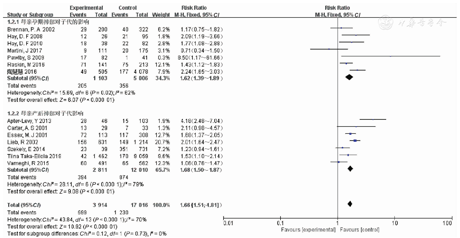
点击查看大图
图5
母亲孕期或产后抑郁情绪对儿童情绪或行为障碍发生风险的影响(亚组分析,固定效应模型)
Figure 5
A forest diagram of fixed-effects model to assess the effects of maternal depressed mood on the incidence of emotional disorders or behavioral disorders in offspring for the subgroup analysis of antenatal group and postnatal group
点击查看大图
图5
母亲孕期或产后抑郁情绪对儿童情绪或行为障碍发生风险的影响(亚组分析,固定效应模型)
Figure 5
A forest diagram of fixed-effects model to assess the effects of maternal depressed mood on the incidence of emotional disorders or behavioral disorders in offspring for the subgroup analysis of antenatal group and postnatal group
2.5 偏倚发表

Begg′s检验:Z=0.44,Pr>|Z|=0.661。Egger′s检验:t=0.62,P>|t|=0.546。根据 α=0.1的检验水平,说明纳入文献不存在发表偏倚。

3 讨论

本研究结果表明,母亲孕期和产后抑郁情绪均可增加儿童情绪或行为障碍的发生风险,这与Prenoveau等[9]及Hentges等[10]的研究结果一致。母亲在孕期或产后存在抑郁情绪的儿童罹患情绪或行为障碍的风险较母亲情绪正常的儿童高1.03倍;Tirumalaraju等[36]在一项纳入15 584例母婴的meta分析中发现,围生期抑郁症母亲的子代患抑郁症的风险是母亲无抑郁儿童的1.7倍,本研究结果与之相似。本研究发现,抑郁情绪发生在孕期还是产后,对儿童情绪或行为障碍发生风险的影响差异无统计学意义。但Tryphonopoulos和Letourneau[11]却认为母亲产后抑郁对儿童情绪发育的影响较大,而Rotheram-Fuller等[13]和Rees等[14]则认为孕期抑郁对子代情绪和行为发育的影响更大。根据本研究和其他学者的研究结果,作者认为可能孕期抑郁情绪更多通过生物学机制影响子代情绪和行为发育,而产后抑郁则更多通过行为机制影响子代情绪和行为的发展。孕期抑郁和产后抑郁本身存在密切联系[37],因此孕期抑郁情绪和产后抑郁情绪对子代情绪和行为发育的影响是不可分割的,难以通过统计学进行比较。

本研究结果显示,母亲孕期或产后抑郁情绪对子代情绪和行为的影响会一直持续至学龄前和学龄期,这与Xerxa等[38]的研究结果一致。与母亲在孕期或产后情绪正常的儿童相比,母亲有抑郁情绪的学龄前儿童和学龄期儿童罹患情绪或行为障碍的风险分别为前者(母亲情绪正常的儿童)的1.40倍和1.78倍。而且母亲在孕期或产后存在抑郁情绪的儿童在学龄期发生情绪或行为障碍的风险大于学龄前期,说明母亲孕期或产后抑郁情绪对儿童情绪和行为发育的影响,并不会随着子代年龄的增加而减少。

本研究结果提示,需要关注母亲在孕期和产后抑郁情绪对子代情绪和行为的影响,因为这种影响是长期的,并且不会随着子代年龄的增长而减少。本研究仍存在一些局限性,主要是部分纳入的文献未提供关于家庭环境和经济水平的信息,无法分析家庭环境对儿童情绪或行为障碍的影响。

综上,儿童情绪和行为发育与母亲的情绪状况密切相关,母亲在任何时期发生的抑郁情绪都可能增加儿童情绪或行为障碍的发生风险。孕妇、产妇和儿童的心理健康是母婴健康的重要组成部分,应从孕期,甚至备孕期,就开始关注母亲或准母亲的情绪健康,将备孕期、孕期和产后的情绪管理纳入母婴保健的范畴,从而减少母亲情绪问题对子代的长远影响。

利益冲突
利益冲突

所有作者均声明不存在利益冲突

参考文献
[1]
ShoreyS, CheeCYI, NgEDet al.Prevalence and incidence of postpartum depression among healthy mothers:a systematic review andmeta-analysis[J].J Psychiatr Res2018104:235-248.DOI:10.1016/j.jpsychires.2018.08.001.
[2]
ZegeyeA, AlebelA, GebrieAet al.Prevalence and determinants of antenatal depression among pregnant women in Ethiopia:a systematic review andmeta-analysis[J].BMC Pregnancy Childbirth201818(1):462.DOI:10.1186/s12884-018-2101-x.
[3]
GhandourRM, ShermanLJ, VladutiuCJet al.Prevalence and treatment of depression,anxiety,and conduct problems in US children[J].J Pediatr2019206:256-267,e3.DOI:10.1016/j.jpeds.2018.09.021.
[4]
MishraSK, SrivastavaM, TiwaryNKet al.Prevalence of depression and anxiety among children in rural and suburban areas of Eastern Uttar Pradesh:a cross-sectional study[J].J Family Med Prim Care20187(1):21-26.DOI:10.4103/jfmpc.jfmpc_248_17.
[5]
SprungM, MünchHM, HarrisPLet al.Children′s emotion understan-ding:ameta-analysis of training studies[J].Dev Rev201537:41-65.DOI:10.1016/j.dr.2015.05.001.
[6]
BehrendtHF, ScharkeW, Herpertz-DahlmannBet al.Like mother,like child? Maternal determinants of children′s early social-emotional deve-lopment[J].Infant Ment Health J201940(2):234-247.DOI:10.1002/imhj.21765.
[7]
陈雷音张丽霞李猛对立违抗障碍患儿家庭社会经济状态与心理特征关系的研究[J].中华实用儿科临床杂志201934(9): 689-692.DOI:10.3760/cma.j.issn.2095-428X.2019.09.012.
ChenLY, ZhangLX, LiMet al.Study on socioeconomic status and psychological characteristics of children with oppositional defiant disorder[J].Chin J Appl Clin Pediatr201934(9):689-692.DOI:10.3760/cma.j.issn.2095-428X.2019.09.012.
[8]
WaldN, CarthyT, Shenaar-GolanVet al.Influence of maternal negative emotion reactivity and cognitive reappraisal on child anxiety disorder[J].Depress Anxiety201835(4):353-359.DOI:10.1002/da.22745.
[9]
PrenoveauJM, CraskeMG, WestVet al.Maternal postnatal depression and anxiety and their association with child emotional negativity and behavior problems at two years[J].Dev Psychol201753(1):50-62.DOI:10.1037/dev0000221.
[10]
HentgesRF, GrahamSA, FearonPet al.The chronicity and timing of prenatal and antenatal maternal depression and anxiety on child outcomes at age 5[J].Depress Anxiety202037(6):576-586.DOI:10.1002/da.23039.
[11]
TryphonopoulosPD, LetourneauNPromising results from a video-feedback interaction guidance intervention for improving maternal-infant interaction quality of depressed mothers:a feasibility pilot study[J].Can J Nurs Res202052(2):74-87.DOI:10.1177/0844562119892769.
[12]
KnoxM, RosenbergerR, SarwarSet al.History of postpartum depression and the odds of maternal corporal punishment[J].Fam Syst Health201533(4):395-399.DOI:10.1037/fsh0000157.
[13]
Rotheram-FullerEJ, TomlinsonM, SchefflerAet al.Maternal patterns of antenatal and postnatal depressed mood and the impact on child health at 3-years postpartum[J].J Consult Clin Psychol201886(3):218-230.DOI:10.1037/ccp0000281.
[14]
ReesS, ChannonS, WatersCS.The impact of maternal prenatal and postnatal anxiety on children′s emotional problems:a systematic review[J].Eur Child Adolesc Psychiatry201928(2):257-280.DOI:10.1007/s00787-018-1173-5.
[15]
ScheinostD, SinhaR, CrossSNet al.Does prenatal stress alter the developing connectome?[J].Pediatr Res201781(1-2):214-226.DOI:10.1038/pr.2016.197.
[16]
GurTL, ShayL, PalkarAVet al.Prenatal stress affects placental cytokines and neurotrophins,commensal microbes,and anxiety-like beha-vior in adult female offspring[J].Brain Behav Immun201764:50-58.DOI:10.1016/j.bbi.2016.12.021.
[17]
MoherD, LiberatiA, TetzlaffJet al.Preferred reporting items for systematic reviews andMeta-analyses:the PRISMA statement[J].J Clin Epidemiol200962(10):1006-1012.DOI:10.1016/j.jclinepi.2009.06.005.
[18]
LiberatiA, AltmanDG, TetzlaffJet al.The PRISMA statement for reporting systematic reviews andmeta-analyses of studies that evaluate health care interventions:explanation and elaboration[J].PLoS Med20096(7):e1000100.DOI:10.1371/journal.pmed.1000100.
[19]
BattleDE.Diagnostic and Statistical Manual of Mental Disorders (DSM)[J].Codas201325(2):191-192.DOI:10.1590/s2317-17822013000200017.
[20]
CoxJL, HoldenJM, SagovskyRDetection of postnatal depression.Development of the 10-item Edinburgh Postnatal Depression Scale[J].Br J Psychiatry1987150:782-786.DOI:10.1192/bjp.150.6.782.
[21]
StangACritical evaluation of the Newcastle-Ottawa scale for the assessment of the quality of nonrandomized studies inmeta-analyses[J].Eur J Epidemiol201025(9):603-605.DOI:10.1007/s10654-010-9491-z.
[22]
EssexMJ, KleinMH, MiechRet al.Timing of initial exposure to maternal major depression and children′s mental health symptoms in kindergarten[J].Br J Psychiatry2001179:151-156.DOI:10.1192/bjp.179.2.151.
[23]
CarterAS, Garrity-RokousFE, Chazan-CohenRet al.Maternal depression and comorbidity:predicting early parenting,attachment security,and toddler social-emotional problems and competencies[J].J Am Acad Child Adolesc Psychiatry200140(1):18-26.DOI:10.1097/00004583-200101000-00012.
[24]
BrennanPA, HammenC, KatzARet al.Maternal depression,paternal psychopathology,and adolescent diagnostic outcomes[J].J Consult Clin Psychol200270(5):1075-1085.DOI:10.1037//0022-006x.70.5.1075.
[25]
LiebR, IsenseeB, HöflerMet al.Parental major depression and the risk of depression and other mental disorders in offspring:a prospective-longitudinal community study[J].Arch Gen Psychiatry200259(4):365-374.DOI:10.1001/archpsyc.59.4.365.
[26]
HayDF, PawlbyS, WatersCSet al.Antepartum and postpartum exposure to maternal depression:different effects on different adolescent outcomes[J].J Child Psychol Psychiatry200849(10):1079-1088.DOI:10.1111/j.1469-7610.2008.01959.x.
[27]
PawlbyS, HayDF, SharpDet al.Antenatal depression predicts depression in adolescent offspring:prospective longitudinal community-based study[J].J Affect Disord2009113(3):236-243.DOI:10.1016/j.jad.2008.05.018.
[28]
HayDF, PawlbyS, WatersCSet al.Mothers′ antenatal depression and their children′s antisocial outcomes[J].Child Dev201081(1):149-165.DOI:10.1111/j.1467-8624.2009.01386.x.
[29]
Apter-LevyY, FeldmanM, VakartAet al.Impact of maternal depression across the first 6 years of Life on the child′s mental health,social engagement,and empathy:the moderating role of oxytocin[J].Am J Psychiatry2013170(10):1161-1168.DOI:10.1176/appi.ajp.2013.12121597.
[30]
VameghiR, Amir Ali AkbariS, SajjadiHet al.Correlation between mothers′depression and developmental delay in infants aged 6-18 months[J].Glob J Health Sci20158(5):11-18.DOI:10.5539/gjhs.v8n5p11.
[31]
RaskinM, EasterbrooksMA, LamoreauRSet al.Depression trajectories of antenatally depressed and nondepressed young mothers:implications for child socioemotional development[J].Womens Health Issues201626(3):344-350.DOI:10.1016/j.whi.2016.02.002.
[32]
陶慧慧邵婷倪玲玲母亲孕期情绪症状与学龄前儿童情绪和行为问题关系的出生队列研究[J].中华预防医学杂志201650(2): 129-135.DOI:10.3760/cma.j.issn.0253-9624.2016.02.006.
TaoHH, ShaoT, NiLLet al.The relationship between maternal emotional symptoms during pregnancy and emotional and behavioral problems in preschool children:a birth cohort study[J].Chin J Prev Med201650(2):129-135.DOI:10.3760/cma.j.issn.0253-9624.2016.02.006.
[33]
MartiniJ, PetzoldtJ, KnappeSet al.Infant,maternal,and familial predictors and correlates of regulatory problems in early infancy:the diffe-rential role of infant temperament and maternal anxiety and depression[J].Early Hum Dev2017115:23-31.DOI:10.1016/j.earlhumdev.2017.08.005.
[34]
SzékelyE, LucassenN, TiemeierHet al.Maternal depressive symptoms and sensitivity are related to young children′s facial expression recognition:the Generation R Study[J].Dev Psychopathol201426(2):333-345.DOI:10.1017/S0954579413001028.
[35]
Taka-Eilola Nèe RiekkiT, VeijolaJ, MurrayGKet al.Severe mood disorders and schizophrenia in the adult offspring of antenatally depressed mothers in the Northern Finland 1966 Birth Cohort:relationship to parental severe mental disorder[J].J Affect Disord2019249:63-72.DOI:10.1016/j.jad.2019.02.011.
[36]
TirumalarajuV, SuchtingR, EvansJet al.Risk of depression in the adolescent and adult offspring of mothers with perinatal depression:a systematic review andmeta-analysis[J].JAMA Netw Open20203(6):e208783.DOI:10.1001/jamanetworkopen.2020.8783.
[37]
Al RawahiA, Al KiyumiMH, Al KimyaniRet al.The effect of ante-partum depression on the outcomes of pregnancy and development of postpartum depression:a prospective cohort study of omani women[J].Sultan Qaboos Univ Med J202020(2):e179-186.DOI:10.18295/squmj.2020.20.02.008.
[38]
XerxaY, DelaneySW, RescorlaLAet al.Association of poor family functioning from pregnancy onward with preadolescent behavior and subcortical brain development[J].JAMA Psychiatry202178(1):29-37.DOI:10.1001/jamapsychiatry.2020.2862.
 
 
展开/关闭提纲
查看图表详情
回到顶部
放大字体
缩小字体
标签
关键词