论著·影像集锦
CT检查三段公式法判断食管胃结合部腺癌Siewert分型的临床价值
中华消化外科杂志, 2022,21(1) : 135-142. DOI: 10.3760/cma.j.cn115610-20211215-00656
摘要
目的

探讨CT检查三段公式法判断食管胃结合部腺癌(AEG)Siewert分型的临床价值。

方法

采用回顾性描述性研究方法。收集2019年1月至2021年1月国内2家医学中心收治的62例(北京大学肿瘤医院33例、陆军军医大学第一附属医院29例)AEG患者的临床病理资料;男53例,女9例;年龄为(66±9)岁。患者行CT检查获取冠状位和轴位图像,确定肿瘤上下缘及食管胃结合部3个层面,导入公式进行Siewert分型。观察指标:(1)CT检查和病理学检查结果。(2)医师间CT检查结果一致性判断。(3)CT检查结果与病理学检查结果一致性判断。病理学检查结果为大体病理学检查和术后组织病理学检查结果。正态分布的计量资料以x±s表示,计数资料以绝对数或构成百分比表示。一致性系数Kappa(κ)评价阅读者间诊断的一致性,κ≥0.75为一致性非常好,0.40<κ<0.75为一致性良好,κ≤0.40为一致性差。Wilcoxon秩和检验评价CT检查三段公式法与病理学检查结果之间是否具有统计学差异,以组织病理学检查结果为标准,计算CT检查三段公式法诊断的灵敏度、特异度和准确率及其95%可信区间。

结果

(1)CT检查和病理学检查结果:62例患者均顺利进行CT检查,获得冠状位和轴位图像确定肿瘤上下缘及食管胃结合部层面并进行Siewert分型。62例患者经北京大学肿瘤医院判定Siewert Ⅰ型3例,Ⅱ型47例,Ⅲ型12例;经陆军军医大学第一附属医院判定Siewert Ⅰ型3例,Ⅱ型49例,Ⅲ型10例;仲裁后CT检查三段公式法判定Siewert Ⅰ型2例,Ⅱ型48例,Ⅲ型12例。病理学T分期:T1期7例,T2期10例,T3期24例,T4a期14例,T4b期7例。62例患者病理学检查结果为Siewert Ⅰ型2例,Ⅱ型48例,Ⅲ型12例。(2)医师间CT检查结果一致性判断:2位医师运用CT检查三段公式法判定Siewert分型一致性良好(κ=0.74,P<0.001)。(3)CT检查结果与病理学检查结果一致性判断:以病理学检查的Siewert分型为参照,CT检查三段公式法判断Siewert分型准确率为90.3%,一致性良好(κ=0.73,P<0.001。CT检查三段公式法判断Siewert Ⅰ型的灵敏度为66.7%(95%可信区间为20.8%~93.9%),特异度为100.0%(95%可信区间为93.9%~100.0%);判断Siewert Ⅱ型的灵敏度为97.7%(95%可信区间为88.2%~99.6%),特异度为72.2%(95%可信区间为49.1%~87.5%);判断Siewert Ⅲ型的灵敏度为73.3%(95%可信区间为48.0%~89.1%),特异度为97.9%(95%可信区间为88.9%~99.9%)。

结论

CT检查三段公式法可用于判断AEG的Siewert分型,具有较高准确率。

引用本文: 刘一婷, 李晓明, 李晓婷, 等.  CT检查三段公式法判断食管胃结合部腺癌Siewert分型的临床价值 [J] . 中华消化外科杂志, 2022, 21(1) : 135-142. DOI: 10.3760/cma.j.cn115610-20211215-00656.
参考文献导出:   Endnote    NoteExpress    RefWorks    NoteFirst    医学文献王
扫  描  看  全  文

正文
作者信息
基金 0  关键词  0
English Abstract
评论
阅读 0  评论  0
相关资源
引用 | 论文 | 视频

版权归中华医学会所有。

未经授权,不得转载、摘编本刊文章,不得使用本刊的版式设计。

除非特别声明,本刊刊出的所有文章不代表中华医学会和本刊编委会的观点。

食管胃结合部腺癌(adenocarcinoma of esopha-gogastric junction,AEG)位于胸腹交界,其中心点位置、累及长度范围等指标评估,影响手术方式与路径选择、肿瘤分期以及疗效评价。Siewert分型是AEG术前常规使用分型方法1, 2, 3。不同Siewert分型具有不同的致病原因及淋巴结转移途径,从而导致分期及手术方式不同4, 5, 6, 7, 8。其中Siewert Ⅱ型AEG的归属仍存在争议9, 10, 11, 12, 13, 14。美国癌症联合会(AJCC)第8版TNM分期、美国国立综合癌症网络(NCCN)胃癌指南和《中国临床肿瘤学会(CSCO)胃癌诊疗指南》均推荐增强CT检查作为胃癌首选的影像学检查手段15, 16, 17, 18。但目前指南均未明确规定如何在增强CT检查中判断Siewert分型。本研究回顾性分析2019年1月至2021年1月国内2家医学中心收治的62例(北京大学肿瘤医院33例、陆军军医大学第一附属医院29例)AEG患者的临床病理资料,探讨CT检查三段公式法判断AEG Siewert分型的临床价值。

资料与方法
一、一般资料

采用回顾性描述性研究方法。收集国内2家医学中心收治的62例AEG患者(2019年3月至2020年11月北京大学肿瘤医院收治AEG患者33例、2019年1月至2021年1月陆军军医大学第一附属医院收治AEG患者29例)的临床病理资料;男53例,女9例;年龄为(66±9)岁。本研究通过北京大学肿瘤医院医学伦理委员会审批,批号为2020KT71,豁免患者知情同意书。

二、纳入标准和排除标准

纳入标准:(1)术前胃镜活组织病理学检查确诊为AEG。(2)腹部CT检查增强扫描,均获得轴位和冠状位重建图像。(3)CT检查后1个月内手术治疗。(4)完整的术后组织病理学资料,包括病理学T分期及Siewert分型。

排除标准:(1)行新辅助治疗(放化疗、靶向治疗及免疫治疗)。(2)CT检查中胃腔充盈差或图像伪影重,影响指标测定。(3)CT检查图像无法清晰显示或定位病变,或病变边缘无法判断。(4)临床病理资料缺失。

三、CT检查方法

患者检查前空腹6~8 h。检查前10~15 min肌肉注射盐酸消旋山莨菪碱10 mg,采用气充盈或水充盈充分扩张胃腔。气充盈者检查开始前口服产气粉6 g,之后迅速转为仰卧扫描体位,减轻气体对贲门口的压力,嘱患者勿嗳气。水充盈根据患者耐受能力,口服温纯水500~1 000 mL,因病变在近段胃邻近贲门口,不强求大量饮水以免造成患者不适。快速呼吸训练1~2次,保证吸气末屏气效果。严格低张、充盈及呼吸训练质控流程管理。

扫描设备采用64层螺旋CT(美国GE公司Lightspeed系列、德国Siemens公司SOMATOM Definition系列、荷兰Philips公司产品)行常规仰卧位扫描,扫描范围上起左膈顶上方>5 cm水平,下缘至少到达腹主动脉分叉水平且全胃必须包括在扫描范围之内。经肘正中静脉注射非离子型碘对比剂,根据患者体质量调整注射剂量(2 mL/kg,浓度300 mgI/mL),注射速率为3.5 mL/s,于注射后35~40 s及70 s行动脉期及门静脉期扫描。扫描参数:球管电压为120 kV,球管电流采用自动毫安技术,探测器准直为64.000 mm×0.625 mm,螺距为0.984,扫描层厚为5.000 mm,重建层厚为0.625~1.500 mm。重组冠状位、轴位图像。

四、Siewert分型CT检查三段法公式

图像传输至PACS工作站。2位放射科医师(北京大学肿瘤医院1位,放射诊断经验3年和陆军军医大学第一附属医院1位,放射诊断经验8年)联合冠状位和轴位图像,设置3个步骤,顺次、盲法进行肿瘤Siewert分型。当2位医师分型结果不一致时,由第3位医师进行仲裁(北京大学肿瘤医院医师,放射诊断经验17年)。

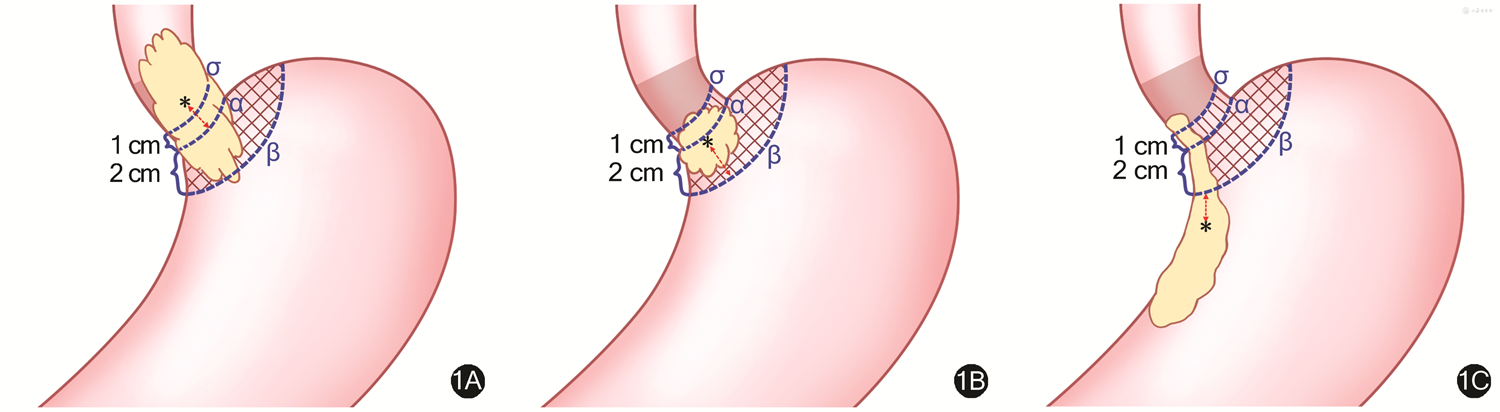
CT检查三段线法计算依据:联合冠状位和轴位图像获得肿瘤上下缘及食管胃结合部(esophago-gastric junction,EGJ)层面,获取肿瘤中心与EGJ以上1 cm或EGJ以下2 cm的相对距离。见图1

点击查看大图
图1
CT检查三段公式法计算依据示意图 1A:Siewert Ⅰ型食管胃结合部腺癌的肿瘤中心位于食管胃结合部上方时,获取肿瘤中心与σ线的相对距离;1B:Siewert Ⅱ型食管胃结合部腺癌肿瘤中心位于食管胃结合部下方时,获取肿瘤中心与β线的相对距离;1C:Siewert Ⅲ型食管胃结合部腺癌肿瘤中心位于食管胃结合部下方时,获取肿瘤中心与β线的相对距离
Figure 1
Schematic diagram of calculation basis of computer tomography-based three-section formula 1A: The relative distance between tumor center and the line with 1 cm above esophagogastric junction is obtained when the tumor center of Siewert type Ⅰ adenocarcinoma of esophagogastric junction (AEG) is located above the esophagogastric junction; 1B: The relative distance between tumor center and the line with 2 cm below esophagogastric junction is obtained when the tumor center of Siewert type Ⅱ AEG is located below the esophagogastric junction; 1C: The relative distance between tumor center and the line with 2 cm below esophagogastric junction is obtained when the tumor center of Siewert type Ⅲ AEG is located below the esophagogastric junction
点击查看大图

注:α线为食管胃交界线,β线为胃侧2 cm线,σ线为食管侧1 cm线,*为肿瘤中心

图1
CT检查三段公式法计算依据示意图 1A:Siewert Ⅰ型食管胃结合部腺癌的肿瘤中心位于食管胃结合部上方时,获取肿瘤中心与σ线的相对距离;1B:Siewert Ⅱ型食管胃结合部腺癌肿瘤中心位于食管胃结合部下方时,获取肿瘤中心与β线的相对距离;1C:Siewert Ⅲ型食管胃结合部腺癌肿瘤中心位于食管胃结合部下方时,获取肿瘤中心与β线的相对距离
Figure 1
Schematic diagram of calculation basis of computer tomography-based three-section formula 1A: The relative distance between tumor center and the line with 1 cm above esophagogastric junction is obtained when the tumor center of Siewert type Ⅰ adenocarcinoma of esophagogastric junction (AEG) is located above the esophagogastric junction; 1B: The relative distance between tumor center and the line with 2 cm below esophagogastric junction is obtained when the tumor center of Siewert type Ⅱ AEG is located below the esophagogastric junction; 1C: The relative distance between tumor center and the line with 2 cm below esophagogastric junction is obtained when the tumor center of Siewert type Ⅲ AEG is located below the esophagogastric junction

第一步,在门静脉期冠状位CT图像上找到角切迹A点,即食管和胃大弯解剖交界点,沿胃底大弯外壁连线逆时针向小弯侧延伸,跨过EGJ与胃体小弯的交点设为B点,两点之间的柔滑弧线即为食管胃交界线(α线)。之后通过定位线找到冠状位AB连线中点所对应的轴位层面,作为食管胃交界层面(“零点层面”)。

第二步,轴位图像公式法区分Siewert Ⅲ型与Siewert Ⅰ/Ⅱ型(区分食管或胃来源)。其中,肿瘤的上下缘层面均利用CT多平面定位进行确定:

+ 2 - + 2   c m

上述公式中前半部分为肿瘤中心点的图像序号计算值,后半部分为食管交界线胃侧2 cm线的图像序号计算值。公式计算值即为肿瘤中心距食管胃交界线胃侧2 cm线的相对值。若计算值为正值则判定为Siewert Ⅲ型;若为负值,则为Siewert Ⅰ型或Ⅱ型。

第三步,轴位图像公式法判断肿瘤为Siewert Ⅰ型还是Ⅱ型:

+ 2 - - 1   c m

若计算值为正值,则判定为Siewert Ⅱ型,若为负值,则为Siewert Ⅰ型。

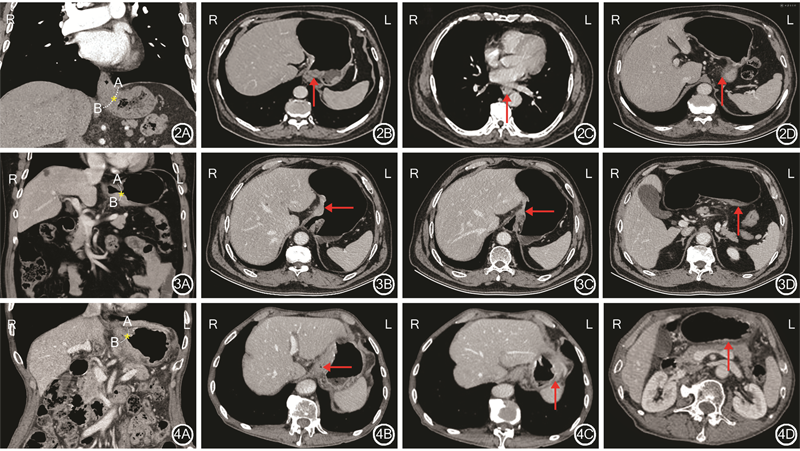
Siewert Ⅰ、Ⅱ、Ⅲ型患者实例展示见图2, 3, 4

点击查看大图
图2
Siewert Ⅰ型食管胃结合部腺癌CT三段公式法检查结果 2A:冠状位图像确定食管胃交界中心点位置(AB线中点*);2B:轴位图像确定零点层面即食管胃交界中心点位置层面(←);2C:轴位图像确定肿瘤上缘层面(↑);2D:轴位图像确定肿瘤下缘层面(↑)
图3
Siewert Ⅱ型食管胃结合部腺癌CT三段公式法检查结果 3A:冠状位图像确定食管胃交界中心点位置(AB线中点*);3B:轴位图像确定零点层面即食管胃交界中心点位置层面(←);3C:轴位图像确定肿瘤上缘层面(↑);3D:轴位图像确定肿瘤下缘层面(↑)
图4
Siewert Ⅲ型食管胃结合部腺癌CT三段公式法检查结果 4A:冠状位图像确定食管胃交界中心点位置(AB线中点*);4B:轴位图像确定零点层面即食管胃交界中心点位置层面(←);4C:轴位图像确定肿瘤上缘层面(↑);4D轴位图像确定肿瘤下缘层面(↑)
Figure 2
Figure 2 Results of computer tomography-based three-section formula for Siewert type Ⅰ adenocarcinoma of esophagogastric junction 2A: Determination of the central point of esophagogastric junction by coronal image (the * point within the AB line); 2B: Determination of the position of central point of the esophagogastric junction by axial image (←); 2C: Determination of the position of upper edge of tumor by axial image (↑); 2D: Determination of the position of lower edge of tumor by axial image (↑)
Figure 3
Figure 3 Results of computer tomography-based three-section formula for Siewert type Ⅱ adenocarcinoma of esophagogastric junction 3A: Determination of the central point of esopha-gogastric junction by coronal image (the * point within the AB line); 3B: Determination of the position of central point of the esophagogastric junction by axial image (←); 3C: Determination of the position of upper edge of tumor by axial image (↑); 3D: Determination of the position of lower edge of tumor by axial image (↑)
Figure 4
Figure 4 Results of computer tomography-based three-section formula for Siewert type Ⅲ adenocarcinoma of esophagogastric junction 4A: Determination of the central point of esophagogastric junction by coronal image (the * point within the AB line); 4B: Determination of the position of central point of the esophagogastric junction by axial image (←); 4C: Determination of the position of upper edge of tumor by axial image (↑); 4D: Determination of the position of lower edge of tumor by axial image (↑)
点击查看大图
图2
Siewert Ⅰ型食管胃结合部腺癌CT三段公式法检查结果 2A:冠状位图像确定食管胃交界中心点位置(AB线中点*);2B:轴位图像确定零点层面即食管胃交界中心点位置层面(←);2C:轴位图像确定肿瘤上缘层面(↑);2D:轴位图像确定肿瘤下缘层面(↑)
图3
Siewert Ⅱ型食管胃结合部腺癌CT三段公式法检查结果 3A:冠状位图像确定食管胃交界中心点位置(AB线中点*);3B:轴位图像确定零点层面即食管胃交界中心点位置层面(←);3C:轴位图像确定肿瘤上缘层面(↑);3D:轴位图像确定肿瘤下缘层面(↑)
图4
Siewert Ⅲ型食管胃结合部腺癌CT三段公式法检查结果 4A:冠状位图像确定食管胃交界中心点位置(AB线中点*);4B:轴位图像确定零点层面即食管胃交界中心点位置层面(←);4C:轴位图像确定肿瘤上缘层面(↑);4D轴位图像确定肿瘤下缘层面(↑)
Figure 2
Figure 2 Results of computer tomography-based three-section formula for Siewert type Ⅰ adenocarcinoma of esophagogastric junction 2A: Determination of the central point of esophagogastric junction by coronal image (the * point within the AB line); 2B: Determination of the position of central point of the esophagogastric junction by axial image (←); 2C: Determination of the position of upper edge of tumor by axial image (↑); 2D: Determination of the position of lower edge of tumor by axial image (↑)
Figure 3
Figure 3 Results of computer tomography-based three-section formula for Siewert type Ⅱ adenocarcinoma of esophagogastric junction 3A: Determination of the central point of esopha-gogastric junction by coronal image (the * point within the AB line); 3B: Determination of the position of central point of the esophagogastric junction by axial image (←); 3C: Determination of the position of upper edge of tumor by axial image (↑); 3D: Determination of the position of lower edge of tumor by axial image (↑)
Figure 4
Figure 4 Results of computer tomography-based three-section formula for Siewert type Ⅲ adenocarcinoma of esophagogastric junction 4A: Determination of the central point of esophagogastric junction by coronal image (the * point within the AB line); 4B: Determination of the position of central point of the esophagogastric junction by axial image (←); 4C: Determination of the position of upper edge of tumor by axial image (↑); 4D: Determination of the position of lower edge of tumor by axial image (↑)
五、观察指标和评价标准

观察指标:(1)CT检查和病理学检查结果包含2家医学中心Siewert分型判定结果、仲裁后Siewert分型判定结果、病理学检查结果。(2)医师间CT检查结果一致性判断。(3)CT检查结果与病理学检查结果一致性判断。

评价标准:病理学检查结果为大体病理学检查和组织病理学检查结果。

六、统计学分析

应用SPSS 26.0统计软件进行分析。正态分布的计量资料以x±s表示,计数资料以绝对数或构成百分比表示。一致性系数Kappa(κ)评价阅读者间诊断的一致性,κ≥0.75为一致性非常好,0.40<κ<0.75为一致性良好,κ≤0.40为一致性差。Wilcoxon秩和检验评价CT检查三段公式法与病理学检查之间是否具有统计学差异,以病理学检查结果为标准,计算CT检查三段公式法诊断的灵敏度、特异度和准确率及其95%CIP<0.05为差异有统计学意义。

结果
一、CT检查和病理学检查结果

62例患者均顺利进行CT检查,获得冠状位和轴位图像确定肿瘤上下缘及EGJ层面并进行Siewert分型。62例患者经北京大学肿瘤医院判定Siewert Ⅰ型3例,Ⅱ型47例,Ⅲ型12例;经陆军军医大学第一附属医院判定Siewert Ⅰ型3例,Ⅱ型49例,Ⅲ型10例;仲裁后CT检查三段公式法判定Siewert Ⅰ型2例,Ⅱ型48例,Ⅲ型12例。病理学T分期:T1期7例,T2期10例,T3期24例,T4a期14例,T4b期7例。62例患者病理学检查结果为Siewert Ⅰ型2例,Ⅱ型48例,Ⅲ型12例。

二、医师间CT检查结果一致性判断

2位医师运用CT检查三段公式法判定Siewert分型一致性良好(κ=0.74,P<0.001)。

三、CT检查结果与病理学检查结果一致性判断

以病理学检查的Siewert分型为参照,CT检查三段公式法判断Siewert分型准确率为90.3%,一致性良好(κ=0.73,P<0.001)。CT检查三段公式法判断Siewert Ⅰ型的灵敏度为66.7%(95%CI为20.8%~93.9%),特异度为100.0%(95%CI为93.9%~100.0%),判断Siewert Ⅱ型的灵敏度为97.7%(95%CI为88.2%~99.6%),特异度为72.2%(95%CI为49.1%~87.5%),判断Siewert Ⅲ型的灵敏度为73.3%(95%CI为48.0%~89.1%),特异度为97.9%(95%CI为88.9%~99.9%)。

讨论

目前临床主要通过X线气钡双对比造影、EUS和CT检查进行Siewert分型19, 20, 21。与术后病理学检查结果比较,各影像学检查分型效能不甚满意,尤其是对于Siewert Ⅱ、Ⅲ型的区分。Pedrazzani等22的研究结果显示:EUS检查区分Siewert Ⅱ、Ⅲ型AEG时特异度极低(44%)。Parry等23的研究结果显示:EUS检查判断Siewert Ⅱ型AEG的准确率为66%,而CT检查仅为57%。Curtis等24利用EUS及CT检查进行术前Siewert分型,有42%经病理学检查结果证实的Siewert Ⅲ型AEG被误判为Ⅱ型。究其原因,Siewert分型的主要依据是肿瘤中心与EGJ交界线的距离,而大多数患者难以在一个方位或断层显示肿瘤走行全程,CT检查多平面重建图像(冠状位、矢状位、轴位)难以准确测量肿瘤上下界距肿瘤中心的距离、EUS传感器可视范围有限等问题影响分型的准确率25

针对上述复杂情况,结合文献[1626, 27],本研究通过CT检查轴位和冠状位双平面联合,设计Siewert分型三段公式法,其结果显示:CT检查三段公式法仅需联合冠状位、轴位图像确定肿瘤上下缘及EGJ 3个层面,操作简洁、计算简便。该方法能够引入智能胃癌结构式影像报告系统,阅片医师输入层号及层厚,即可得到分型结果。该方法首先判断Siewert Ⅲ型,进一步再区分Ⅰ型和Ⅱ型,有利于提高工作效率。本研究结果显示:以病理学检查结果的Siewert分型为参照,CT检查三段公式法判断Siewert分型准确率达90.3%,优于既往研究报道的CT检查多平面重建及EUS检查结果20, 21

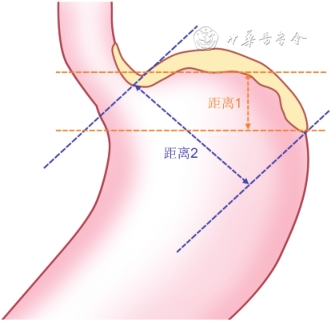
本研究存在局限性。研究样本量较小,CT检查三段法公式的设计基础是假定肿瘤长径沿垂直长轴生长,而仰卧位扫描时,胃远端相对前倾,更接近于水平方向,而EGJ的胃腔长轴更接近于垂直方向,故胃浸润范围的计算值较实际情况偏短,导致Siewert Ⅲ型误判为Siewert Ⅱ型(图5)。未来需扩大样本量,结合轴冠状位图像的联合修正,得到更精确的计算方法。Siewert分型仅基于肿瘤中心的位置,不能完全反映肿瘤的长径及远端食管的浸润范围,而食管浸润长度对手术入路的选择、淋巴结清扫范围等至关重要,与患者的生存和预后也相关28, 29, 30。如何准确地测量上述2项指标并制订临床上易于推行的分型方案,后续研究将联合曲面重建技术以及薄层MRI检查进行深入探索。
点击查看大图
图5
CT检查三段公式法将Siewert Ⅲ型误判为Ⅱ型的示意图 公式设计基础为假定肿瘤最长径线沿垂直长轴生长,得出的距离相对值计算为冠状长径,如距离1所示(长虚线),而仰卧位扫描时胃相对前倾,导致肿瘤相对距离的计算值较实际情况偏短,如距离2所示(短虚线),导致误判
Figure 5
Schematic diagram of misjudgment of adenocar-cinoma of esophagogastric junction of Siewert type Ⅲ as Siewert type Ⅱ by computer tomo-graphy-based three-section formula. The design basis of the formula is to assume that the longest diameter line of the tumor is along the vertical long axis and the coronal long diameter is calculated by the relative value of the distance which is shown as “distance 1” (long dotted line), while the stomach is relatively forward during supine scanning, resulting in the calculated value of the relative distance of tumor shorter than the actual situation which is shown as “distance 2” (short dotted line), leading to misjudgment
点击查看大图
图5
CT检查三段公式法将Siewert Ⅲ型误判为Ⅱ型的示意图 公式设计基础为假定肿瘤最长径线沿垂直长轴生长,得出的距离相对值计算为冠状长径,如距离1所示(长虚线),而仰卧位扫描时胃相对前倾,导致肿瘤相对距离的计算值较实际情况偏短,如距离2所示(短虚线),导致误判
Figure 5
Schematic diagram of misjudgment of adenocar-cinoma of esophagogastric junction of Siewert type Ⅲ as Siewert type Ⅱ by computer tomo-graphy-based three-section formula. The design basis of the formula is to assume that the longest diameter line of the tumor is along the vertical long axis and the coronal long diameter is calculated by the relative value of the distance which is shown as “distance 1” (long dotted line), while the stomach is relatively forward during supine scanning, resulting in the calculated value of the relative distance of tumor shorter than the actual situation which is shown as “distance 2” (short dotted line), leading to misjudgment

综上,CT检查三段公式法可用于AEG的Siewert分型,具有较高准确率。

利益冲突
利益冲突

所有作者均声明不存在利益冲突

参考文献
[1]
SiewertJR, SteinHJ. Classification of adenocarcinoma of the oesophagogastric junction[J]. Br J Surg,1998,85(11):1457-1459. DOI:10.1046/j.1365-2168.1998.00940.x.
[2]
AldersonD, CunninghamD, NankivellM, et al. Neoadju-vant cisplatin and fluorouracil versus epirubicin, cisplatin, and capecitabine followed by resection in patients with oesophageal adenocarcinoma (UK MRC OE05): an open-label, randomised phase 3 trial[J]. Lancet Oncol,2017,18(9):1249-1260. DOI:10.1016/S1470-2045(17)30447-3.
[3]
National Comprehensive Cancer Network. NCCN Clinical Practice Guidelines in Oncology: Gastric Cancer, V.1. 2020 [R]. National Comprehensive Cancer Network,2020.
[4]
YuasaN, MiyakeH, YamadaT, et al. Clinicopathologic com-parison of Siewert type Ⅱ and Ⅲ adenocarcinomas of the gastroesophageal junction[J]. World J Surg,2006,30(3):364-371. DOI:10.1007/s00268-005-0434-x.
[5]
GotoH, TokunagaM, MikiY, et al. The optimal extent of lymph node dissection for adenocarcinoma of the esopha-gogastric junction differs between Siewert type Ⅱ and Siewert type Ⅲ patients[J]. Gastric Cancer,2014,18(2):375-381. DOI:10.1007/s10120-014-0364-0.
[6]
LiuK, FengF, ChenXZ, et al. Comparison between gastric and esophageal classification system among adenocarci-nomas of esophagogastric junction according to AJCC 8th edition: a retrospective observational study from two high-volume institutions in China[J]. Gastric Cancer,2019, 22(3):506-517. DOI:10.1007/s10120-018-0890-2.
[7]
ImamuraY, WatanabeM, OkiE, et al. Esophagogastric junction adenocarcinoma shares characteristics with gas-tric adenocarcinoma: literature review and retrospective multicenter cohort study[J]. Ann Gastroenterol Surg,2021,5(1):46-59. DOI:10.1002/ags3.12406.
[8]
Rüdiger SiewertJ, FeithM, WernerM, et al. Adenocarci-noma of the esophagogastric junction: results of surgical therapy based on anatomical/topographic classification in 1,002 consecutive patients[J]. Ann Surg,2000,232(3):353-361. DOI:10.1097/00000658-200009000-00007.
[9]
KumagaiK, SanoT. Revised points and disputed matters in the eighth edition of the TNM staging system for gastric cancer[J]. Jpn J Clin Oncol,2021,51(7):1024-1027. DOI:10.1093/jjco/hyab069.
[10]
RiceTW, GressDM, PatilDT, et al. Cancer of the esopha-gus and esophagogastric junction-major changes in the American Joint Committee on Cancer eighth edition cancer staging manual[J]. CA Cancer J Clin,2017,67(4):304-317. DOI:10.3322/caac.21399.
[11]
RiceTW, PatilDT, BlackstoneEH. 8th editionAJCC/UICC staging of cancers of the esophagus and esophagogastric junction: application to clinical practice[J]. Ann Cardiothorac Surg,2017,6(2):119-130. DOI:10.21037/acs.2017.03.14.
[12]
HosokawaY, KinoshitaT, KonishiM, et al. Clinicopatholo-gical features and prognostic factors of adenocarcinoma of the esophagogastric junction according to Siewert classi-fication: experiences at a single institution in Japan[J]. Ann Surg Oncol,2012,19(2):677-683. DOI:10.1245/s10434-011-1983-x.
[13]
付佳,唐磊,李子禹,.CT区分Siewert Ⅱ型食管胃结合部腺癌cT3与cT4a:国际抗癌联盟/美国癌症联合委员会(UICC/AJCC)第8版分期与国际胃癌协会(IGCA)第4版分期对照研究[J].中华胃肠外科杂志,2018,21(9):1013-1018. DOI:10.3760/cma.j.issn.1671-0274.2018.09.008.
[14]
SunRJ, TangL, LiXT, et al. CT findings in diagnosis of gastric bare area invasion: potential prognostic factors for proximal gastric carcinoma[J]. Jpn J Radiol,2019,37(7):518-525. DOI:10.1007/s11604-019-00837-z.
[15]
AjaniJA, D′AmicoTA, AlmhannaK, et al. Gastric Cancer, Version 3. 2016, NCCN Clinical Practice Guidelines in Oncology[J]. J Natl Compr Canc Netw,2016,14(10):1286-1312. DOI:10.6004/jnccn.2016.0137.
[16]
AminMB, GreeneFL, EdgeSB, et al. The Eighth Edition AJCC Cancer Staging Manual: Continuing to build a bridge from a population-based to a more "personalized" app-roach to cancer staging[J]. CA Cancer J Clin,2017,67(2):93-99. DOI:10.3322/caac.21388.
[17]
MaCL, LiXD, SunXR, et al. Using 18F-fluorodeoxyglucose positron emission tomography/computed tomography to estimate the length of gross tumor and involvement of lymph nodes in esophagogastric junction carcinoma[J]. J Cancer Res Ther,2018,14(4):896-901. DOI:10.4103/jcrt.JCRT_1049_17.
[18]
中国临床肿瘤学会指南工作委员会组织编写.中国临床肿瘤学会(CSCO)胃癌诊疗指南[M].北京:人民卫生出版社,2021.
[19]
唐磊,李佳铮.食管胃结合部腺癌浸润范围的影像学评价[J].中华胃肠外科杂志,2019,22(2):119-125. DOI:10.3760/cma.j.issn.1671-0274.2019.02.005.
[20]
Luna AufroyA, Navarro SotoS. Diagnostic tests for pre-operative staging of esophagogastric junction tumors: performance and evidence-based recomendations[J]. Cir Esp (Engl Ed),2019,97(8):427-431. DOI:10.1016/j.ciresp.2019.03.015.
[21]
张晓鹏,唐磊.食管胃结合部腺癌的影像学评价[J].中国实用外科杂志,2012,32(4):273-277.
[22]
PedrazzaniC, BerniniM, GiacopuzziS, et al. Evaluation of Siewert classification in gastro-esophageal junction adeno-carcinoma: what is the role of endoscopic ultrasonogra-phy?[J]. J Surg Oncol,2005,91(4):226-231. DOI:10.1002/jso.20302.
[23]
ParryK, HaverkampL, BruijnenRC, et al. Staging of adeno-carcinoma of the gastroesophageal junction[J]. Eur J Surg Oncol,2016,42(3):400-406. DOI:10.1016/j.ejso.2015.11.014.
[24]
CurtisNJ, NobleF, BaileyIS, et al. The relevance of the Siewert classification in the era of multimodal therapy for adenocarcinoma of the gastro-oesophageal junction[J]. J Surg Oncol,2014,109(3):202-207. DOI:10.1002/jso.23484.
[25]
HamadaK, ItohT, KawauraK, et al. Examination of endo-scopic ultrasonographic diagnosis for the depth of early gastric cancer[J]. J Clin Med Res,2021,13(4):222-229. DOI:10.14740/jocmr4465.
[26]
国际食管疾病学会中国分会(CSDE)食管胃结合部疾病跨界联盟,中国医师协会内镜医师分会腹腔镜外科专业委员会,中国医师协会外科医师分会上消化道外科医师专业委员会,.食管胃结合部腺癌外科治疗中国专家共识(2018年版)[J].中华胃肠外科杂志,2018,21(9):961-975. DOI:10.3760/cma.j.issn.1671-0274.2018.09.001.
[27]
杨宏,武爱文,季加孚,.食管胃结合部腺癌471例Siewert分型临床研究[J].中国实用外科杂志,2012,32(4):310-315.
[28]
KeB, LiangH. Current status of lymph node dissection in gastric cancer[J]. Chin J Cancer Res,2021,33(2):193-202. DOI:10.21147/j.issn.1000-9604.2021.02.07.
[29]
KurokawaY, TakeuchiH, DokiY, et al. Mapping of lymph node metastasis from esophagogastric junction tumors: a prospective nationwide multicenter study[J]. Ann Surg,2021,274(1):120-127. DOI:10.1097/SLA.0000000000003499.
[30]
NiclaussN, JungMK, ChevallayM, et al. Minimal length of proximal resection margin in adenocarcinoma of the eso-phagogastric junction: a systematic review of the litera-ture[J]. Updates Surg,2019,71(3):401-409. DOI:10.1007/s13304-019-00665-w.
 
 
展开/关闭提纲
查看图表详情
回到顶部
放大字体
缩小字体
标签
关键词