
This study is aimed to investigate the differences in pharmaceutical quality and therapeutic efficacy of calcipotriol ointments between the original product and the generics.
We evaluated the pharmaceutical quality of the original product and the generics including pH, content and related substance, and calcipotriol stability in the matrix. Intradermal retention of calcipotriol ointments in vitro was investigated using skin of Bama miniature pig. The pharmacodynamics study was performed in psoriasis guinea pig models.
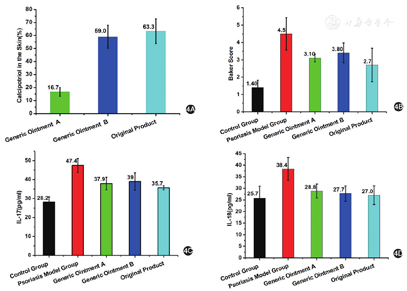
The matrix of original product is better than the generics, and influenced the drug diffusion, stability and in vitro retention, thus resulted in the difference in pharmacodynamics. The retention amount of calcipotriol in the original product was significantly higher than that of generic B, and approximately 4 folds higher than that of generic A. All of the three ointments improved pathological indexed in psoriasis guinea pigs, and there was a significant difference between the preparation group and the model group (P = 0.001). Guinea pigs in the original group had the lowest interleukin -17 level (35.7 ± 1.13 μg/ml) and Baker Score (2.70 ± 0.97) compared with generic A (37.9 ± 3.3 μg/ml, 3.10 ± 0.22, respectively) and generic B (39 ± 4.6μg/ml, 3.80 ± 0.57, respectively), but no statistical difference was found among the three groups (all P > 0.05).
Difference occurs in the internal quality between the original product and the generics. The original preparation owns suitable balance between matrix stability and transdermal ability so that showes superiority in pharmaceutical properties, intradermal retention and therapeutic effect in vitro and in vivo, which suggests that more attention should be paid to the formulation and process during the research and development of the generics. The original product is recommended with priority for treatment especially at emergency.



版权归中华医学会所有。
未经授权,不得转载、摘编本刊文章,不得使用本刊的版式设计。
除非特别声明,本刊刊出的所有文章不代表中华医学会和本刊编委会的观点。
Psoriasis is chronic and non-infectious skin disease with epidermal heterogeneity, mostly present scales papules, abnormal hyperplasia and inflammation[1]. The incurable feature of psoriasis is troubling about 125 million people worldwide, and seriously affecting their life quality[2]. Topical treatment, systematical treatment and their combination with photo therapy are the common treatment methods for psoriasis,among which topical treatment plays the critical role in long term maintenance therapy of psoriasis.
Nowadays, topical treatments for psoriasis include corticosteroids, tar preparations, vitamin A analogs, vitamin D analogs, calcineurin inhibitors, etc. Vitamin D analogues, which are directly targeted at keratinocytes in the skin top layer, are the first-line drugs recommended by the treatment guidelines for psoriasis. Calcipotriol is one of vitamin D analogs, which is commercially applied in ointment and liniment for psoriasis treatment. However, ointment is more widely used due to its lower alcohol amount in the formulation, and contributes to better compliance than liniment.
Currently, there are 3 calcipotriol ointments with different specifications available in the market from 3 pharmaceutical companies. The products provided by different manufacturers may show inequable quality, which maybe because manufacturers prepared their products in different preparations, prescriptions and technological conditions. This is one of the most important reasons why generic drugs do not own the same efficacy as the original product. In order to analyze source of difference on various preparations, we conducted this study to compare the ointment quality, stability, intradermal retention and pharmacodynamics of the original calcipotriol product with generics in vitro and in vivo. In terms of biological safety, the pH and the related substances of the three products were evaluated; according to the requirements of quality stability, description, and content, variations in description and content at ultimate temperatures and influence factors were determined by HPLC; in terms of effectiveness, intradermal retention and pharmacodynamics were compared between the original product and generics.
Calcipotriol original and generics ointments were obtained as gifts from Shanghai Dermatology Hospital. Calcipotriol standard sample was purchased from European Directorate for the Quality of Medicines. Propranolol crude drug was obtained as a gift from Professor Zhou Wei, China Pharmaceutical University. Interleukin (IL)-17 and IL-18 ELISA Kit were products from Shanghai MLBIO Biotechnology Co., Ltd. Skin samples from Bama little pigs were provided by Insititute of Yadong Experiment Animal of Jiangsu Province (No.SCXK-2016-0009). Petroleum jelly was purchased from Shanghai Shangxiweikang Medical Supplies Co., Ltd. Stearic acid and paraffin liquid were purchased from Shanghai Lifeng Chemical Co., Ltd. Sodium dodecyl sulphate (CP) was purchased from Nanjing Chemical Reagent Co., Ltd. All other reagents used were of analytical grade.
Two-month old male guinea pigs (about 220 g, n = 44) were purchased from Animal Breeding Center of Nanjing Qinglongshan (NO.201616196). All the animal experiments were conducted in animal facility of China Pharmaceutical University, and conformed to the requirements of animal ethics.
The mainly pharmaceutical parameters that affect the pharmacodynamics of ointment are appearance, pH, content of the active ingredients, the content of related substances and the stability of preparations[3]. The detailed measurements of above characteristics are as follows.
(1) Appearance: the homogeneity of the ointment matrix was observed by eyes.
(2) PH: two grams of the ointments were weighed accurately and mixed with five times amount of distilled water by grinding and ultrasonicating for 10 min, the samples were filtered before measuring.
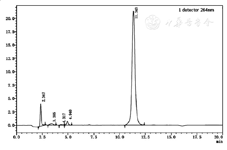
(3) Content and related substances detection: ointment samples for content and related substances detection were weighed 2 and 10 grams, respectively, and mixed with 5 ml methanol at 60°C water-bath and was melted by ultrasonication for 3 min. The mixtures were diluted to 10 ml with methanol after cooling down to room temperature, filtered with 0.22 μm organic membrane and collected for the experiment of high-performance liquid chromatography (HPLC) detection according to the following protocol. The liquid chromatograph is equipped with a NUCLEOSIL C8 column (4.6 mm × 250 mm, 5 μm) at 40 ℃. The mobile phase is a mixture of methanol and water (V∶V, 7∶3). The UV wavelength, flow rate, and injection volume of detection were 264 nm, 1 ml/min and 20 μl, respectively. The retention time for calcipotriol under these conditions is approximately 11 min and the HPLC diagram is shown in Figure 1. The result showed good precision, linearity and accuracy over the concentration range (0.5 - 100 μg/ml, R2 = 0.9993). Intra- and inter-day precision (% RSD) for three standards representative of high, medium and low drug concentrations ranged from 0.98 to 1.28% and 1.02 to 1.56%, respectively. Accuracy of the same three concentrations ranged between 98.94% and 100.62%. The chromatograms of samples were recorded and the quantity was calculated using the following formula:
Calcipotriol % = (Cr/Sr × 10St)/0.005%W
Calcipotriol % is the label content of calcipotriol, Cr is the concentration, in μg/ml, of reference substance solution, Sr and St is the area of the calcipotriol peak in reference substance solution and test solution, respectively. W is the quality of ointment that precisely weighed before. Besides, normalization method was used to calculate the percentage of related substances, and the results were provided by chromatography workstation automatically.
The ointments with package were exposed under the condition of -20 ℃, 4 ℃, 40 ℃, and 50 ℃, respectively, for 10 days. The content detection of the three ointments was performed as the same method in "Content detection" section.
This test is to investigate the quality and "appearance" and "content detection" of opened ointments under extreme conditions including strong illumination (4500 Lx), high temperature (60 ℃) and high humidity (75%).
The skin used for in vitro transdermal diffusion study was obtained from Bama little pig and frozen at -80 ℃. The fatty tissue of the skin was removed and washed with physiological saline before use. All skin samples were sandwiched between the donor and receptor compartments of a modified franz diffusion cell with an effective penetrate area of 3 cm2 and a receptor volume of 20 ml. The dermal side of skin was contacting with receiving solution, which was a mixture of pH7.4 buffer and anhydrous ethanol (W/W, 70∶30)[4]. The samples were equilibrated for 30 min before transdermal diffusion assay. And then 0.15 g original product and two generics were smeared on cut-in layer of the skin evenly and the experiments were performed at (35 ± 1) ℃ with stirring at centrifugal force of 0.6 gram under dark condition (n = 3)[5]. One milliliter sample was drawn at 2 h, 4 h and 8 h and replaced by equal fresh receptor medium. At the end of experiment, skin samples were wiped to remove the remaining ointment and cleaned using saline water, and then preserved in the eppendorf tube and held in 4 ℃. The quality of calcipotriol penetrated into the stratum corneum was quantified by HPLC method after the tissue homogenating, and the drawn receiving samples were analyzed by HPLC, too. The chromatographic conditions and the calculation is the same as the "content detection" .
Forty-four guinea pigs were randomly divided into control group (n = 10) and psoriasis group (n = 34). The ears of guinea pigs in the control group were smeared with ointment matrix without drug (self-made) three times a day while the psoriasis group were give 5% propranolol ointment (self-made) three times a day for 3 weeks[6,7,8]. The self-made formulation was described in Table 1.
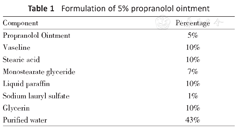
Formulation of 5% propranolol ointment
Formulation of 5% propranolol ointment
| Component | Percentage |
|---|---|
| Propranolol Ointment | 5% |
| Vaseline | 10% |
| Stearic acid | 10% |
| Monostearate glyceride | 7% |
| Liquid paraffin | 10% |
| Sodium lauryl sulfate | 1% |
| Glycerin | 10% |
| Purified water | 43% |
Four guinea pigs (two in the psoriasis group and two in the control group) were randomly selected for H&E staining in order to confirm the model establishment. And then the left 32 guinea pigs in the psoriasis group were randomly divided into four sub-groups (three ointment groups and one psoriasis model group) to test the three calcipotriol ointments.
The calcipotriol groups were applied ointment twice per day while the psoriasis model group and control group were given the matrix of ointment. After the 10 days treatment, 10 guinea pigs were selected from 5 groups (including the control group) to make H&E staining and the left 30 pigs were taken for analysis of IL-17 and IL-18 levels in ear tissue by ELISA kit[9]. Baker score was used as an index for evaluation of psoriasis histological tissue. Five field of views of each group were chosen randomly to give scores, and the criterion was shown in Table 2[10,11].
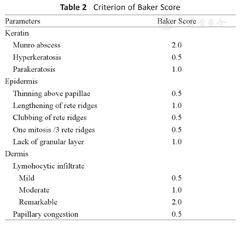
Criterion of Baker Score
Criterion of Baker Score
| Parameters | Baker Score | ||
|---|---|---|---|
| Keratin | |||
| Munro abscess | 2.0 | ||
| Hyperkeratosis | 0.5 | ||
| Parakeratosis | 1.0 | ||
| Epidermis | |||
| Thinning above papillae | 0.5 | ||
| Lengthening of rete ridges | 1.0 | ||
| Clubbing of rete ridges | 0.5 | ||
| One mitosis/3 rete ridges | 0.5 | ||
| Lack of granular layer | 1.0 | ||
| Dermis | |||
| Lymohocytic infiltrate | |||
| Mild | 0.5 | ||
| Moderate | 1.0 | ||
| Remarkable | 2.0 | ||
| Papillary congestion | 0.5 | ||
The experimental data were statistically analyzed using SPSS19.0 software (SPSS Inc., Chicago, IL, USA). Data between groups were analyzed with one-way ANONA, and result was showed in mean ± standard deviation ( ± s). P < 0.05 was considered significant.
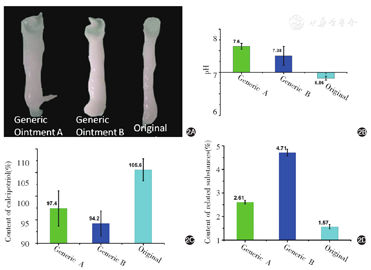
The appearance, pH values, contents, related substances of the three ointments was shown in Figure 2. The matrixes of ointments are all homogeneous. Generics A and B are pure white ointments, while the original product exhibites in white translucent uniformity (Figure 2A). The pH values of three ointments are close to neutral and meet to the requirements, however, pH of the original product was closest to 7.0 (Figure 2B). The contents of calcipotriol in the three ointments all met the standard (90%-110%) for clinics (Figure 2C). The amount of related substances, which mainly came from the process of production and only a small part was degradable during placement, was shown in Figure 2D. The related substance in the original one was less than one third of that in the generic B, and it is closest to the standard.
The results of matrix stability test were shown in Figure 3A. Three ointments were stable in condition of -20 ℃ and 4 ℃. Calcipotriol in the original product and generic ointment B decreased 25.1% and 27.8%, respectively, at 50 ℃. However, calcipotriol in the original product only decreased 50% of that in the generic ointment B at 40 ℃ attributed to the protection of the matrix. It was worth noting that the content of calcipotriol in generic ointment A only showed a slight change under 40 ℃ or 50 ℃.
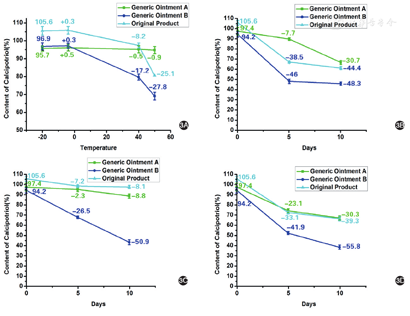
Influencing factors include high temperature, humidity and light. As shown in Figure 3B and 3D, calcipotriol in all the ointments were decreasing gradually with the time at high temperature (60 ℃) and under strong illumination. The content in the generic B mostly decrease followed by the original product and the generic A, which was consistent with the results of "Stability test of the matrix". However, as a result of oxidation, the content of the generic decreased more than that in the "Stability test of the matrix" . The original product and the generic A decreased at a similar degree of 8% in the high humidity study, which was much lower compared with approximately 50% decrease in the generic B.
The result showed that the concentration of calcipotriol contained was below the limitation of quantitation. The intradermal calcipotriol in the original product was significantly higher than that of the generic ointments, and approximately 4 folds higher than that of generic A (Figure 4A).
The ears of guinea pigs were a bit burning, red and swollen after treated with 5% propranolol ointment for three weeks. The appearance of guinea pigs was dispirit, less watering and eating. The skin of their ears was covered with thin layer of silver scale (Figure 5B). H&E slices showed pathological changes of psoriasis (Figure 5D), including parakeratosis, irregular acanthosis and thinner granular layer, which indicated that the psoriasis model was established successfully[12].
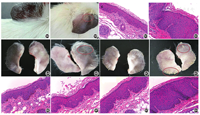
After treatment with calcipotriol ointments, ears in the original product group were completely clean without silver scale observed, while the ones were slightly covered in the generic groups (Figure 6A-C). Meanwhile, there was a bit parakeratosis in the generic B group.
H&E stainings of ears after treatment are shown in Figure 6E-G. Irregular acanthosis were observed at different levels. The pathological statement of the samples in the original product group was most closed to that of the control group. The generic A group showed slight epidermal cuticle pakakeratosis and acanthosis cell layer thickening, and generic B group was in the weakest pathological remission.
Baker Score of pathological statement of guinea pigs ears was shown in Figure 4B. The Baker Score in the psoriasis group was up to 4.5 ± 0.94. Except for the control group, the lowest Baker Score was measured in the original product group. And no statistical difference was found among the three groups (P = 0.05). The IL-17 and 18 levels in ear tissue were shown in Figure 4C and 4D. IL-17 level in the psoriasis model group was increase from (28.2 ± 2.75) μg/ml to (47.4 ± 3.66) μg/ml compared with the control group, the statistical difference (P) is 0.01, which indicating the psoriasis models was established (Figure 4C). IL-17 was decreased at different degree in groups after treatments, so did IL-18 (Figure 4D). Although no statistical difference was found among three groups, IL-17 level of original product group is the lowest.
Generic products so far still occupy a very high proportion of prescription and market from the view of global pharmaceutical, but it was reprted that a difference on efficacy existed between the original drug and the generics, which depended on the types and the therapeutic window of drugs[13]. Invisible differences between the original products and generics occur during production process, excipients, pharmaceutical machinery and so on. Moreover, the period of research and development process of the generics is short and it is free of clinical data before marketing[14]. Therefore, it is make sense to compare the pharmacology and pharmacodynamics indexes between the original and the generic products. Based on the comparison of the three calcipotriol ointments in pharmaceutical and pharmacodynamic studies, we found that the original product and the generics were effective on the indications. But there were significant differences on internal quality, which is a common problem between original research product and generics[15].
The quality examination of the ointment was the foundation of clinical therapy. Results showed that the matrixes of three ointments are all homogeneous, pH values were close to neutral, and the content and related substances of the three ointments were conforming to the requirements of the pharmacopoeia, which ensure the safety and effectiveness of the ointment while applying. But among these, the matrix of original product was shown in a most transparent appearance and its pH value was closest to water, which will reduce its skin irritation and own a better compliance in clinical. Besides, its lowest amount of related substances means the better preparation technology.
The result of matrix stability test showed that the three ointments were stable under the condition of -20 ℃ and 4 ℃. The matrix of original product was also relatively stable under the condition of 40 ℃ while the generic B showing a sharp drop in the content. And the result of that at the condition of 50 ℃ and the result of influencing factor test all proved that calcipotriol was unstable to heat and light and the stability of generic A was higher than that of the original product. But further validations demonstate that original product showed the highest intradermal amount of calcipotriol among the three ointments at 8 h diffusion. The generic A, which owned the most stable matrix, the intradermal amount of calcipotriol was only one fourth of original product. It suggested that too high matrix-stability was responsible for hindering the release of active ingredients in ointment. As calcipotriol plays its role in keratin cells in the stratum corneum for psoriasis therapy[16], the higher remaining amount of calcipotriol in the skin means higher effectiveness. The result of pharmacodynamics study showed the pathological changes of psoriasis guinea pigs were all improved by different ointments. But among the groups, guinea pigs in original product exhibited the lowest IL-17 level and Baker Score, which means the best therapeutic effect on the psoriasis model.
In conclusion, carpotriol is sensitive to light and heat, all of three ointments are recommended to be used as soon as possible and kept in shade/cool condition once open. Original product reached advantage in all indicators, which might be attributed to the suitable balance between matrix stability and transdermal ability when applying. These results suggested that high stability of preparations does not necessarily mean better therapeutic effect in certain cases, and we need more clinical data to prove its effectiveness. Original product held superior promise in therapeutic efficacy and was a better choice for psoriasis therapy than generics in this study. The results remind us that more attention should be paid to the formulation and process during the research and development of the generics. The original product is recommended in certain disease, especially in an emergency[17].
Therefore, it is of great importance to implement the generics consistency evaluation policy for enhancement of the quality of domestic medicine and the development of pharmaceutical market in China. It is expected to be a strong strategy and good chance to regular the domestic generics market, leaving the safe, effective and economic medicine to meet the market requests. Besides, it is not enough to evaluate a preparation from the perspective of pharmacology alone, generics are encouraged and more clinical research during the development process should be conducted so that generics achieve the consistency not only in pharmacy but also in clinics.
The authors reported no conflicts of interest.


