综述
替代供者异基因造血干细胞移植治疗重型再生障碍性贫血研究进展
中华器官移植杂志, 2021,42(6) : 377-380. DOI: 10.3760/cma.j.cn421203-20200724-00249
摘要

本文对重型再生障碍性贫血(SAA)行替代供者异基因造血干细胞移植(allo-HSCT)的疗效与适应证、影响疗效的因素、植入失败与二次移植等方面的最新研究进展进行综述。


引用本文: 王洁茹, 白雪莲, 冯四洲. 替代供者异基因造血干细胞移植治疗重型再生障碍性贫血研究进展 [J] . 中华器官移植杂志, 2021, 42(6) : 377-380. DOI: 10.3760/cma.j.cn421203-20200724-00249.
参考文献导出:   Endnote    NoteExpress    RefWorks    NoteFirst    医学文献王
扫  描  看  全  文

正文
作者信息
基金 0  关键词  0
English Abstract
评论
阅读 0  评论  0
相关资源
引用 | 论文 | 视频

版权归中华医学会所有。

未经授权,不得转载、摘编本刊文章,不得使用本刊的版式设计。

除非特别声明,本刊刊出的所有文章不代表中华医学会和本刊编委会的观点。

重型再生障碍性贫血(SAA)是一种严重的骨髓造血功能衰竭性疾病,免疫抑制疗法(IST)与人类白细胞抗原(HLA)表型相合同胞供者(MSD)异基因造血干细胞移植(allo-HSCT)为其一线治疗方案[1]。而有MSD的SAA者仅占20%~30%,因此可考虑替代供者allo-HSCT,其供者来源包括HLA表型相合无血缘供者(MUD)、单倍体相同的供者(HID)及脐带血(CB)[2]。本文对替代供者allo-HSCT治疗SAA的适应证、疗效及其影响因素、植入失败与二次移植等方面的最新研究进展进行综述。

一、替代供者allo-HSCT的疗效与适应证

《2016年英国再生障碍性贫血诊治指南》(以下简称《指南》)[3]推荐在IST无效且无MSD时考虑替代供者allo-HSCT。随着方案改进,替代供者allo-HSCT疗效提高,有研究者建议将其作为缺少MSD时的一线选择[1]

近年来,MUD allo-HSCT的疗效取得重大进展。多中心研究表明,在儿童SAA中,MUD allo-HSCT能获得与MSD allo-HSCT相近的疗效,且优于IST,总存活率可达90%以上[3,4];而当MUD allo-HSCT作为IST失败后的二线治疗时,其总存活率欠佳[5]。对成年SAA患者的回顾性研究也得到了相似结果[6],总存活率可达85%以上,因此有研究者建议,<60岁SAA患者确诊后应及早进行高分辨率HLA分型,并寻找MUD,以便在IST失败后尽快移植,<40岁者则可在评估后选择MUD allo-HSCT作为一线治疗[2,4]

HID allo-HSCT和脐带血移植(CBT)通常在IST治疗无效且无MSD及MUD时考虑[2]。在经验丰富的移植中心,HID allo-HSCT可作为无MSD的年轻SAA患者的首选,其长期疗效甚至与MSD allo-HSCT相近。Xu等[7]对比首选HID allo-HSCT(89例)与MSD allo-HSCT(69例)的SAA受者,其3年总存活率与无治疗失败存活率(FFS)差异均无统计学意义(86.1%和91.3%,P=0.358;85%和89.8%,P=0.413)。大样本荟萃分析显示,尽管选择HID allo-HSCT者感染及移植物抗宿主病(GVHD)风险较高,其长期FFS稳定高于首选IST者,作为首选方案时疗效更佳[8]。CBT受限于干细胞数量低,排斥风险高,植入延迟,通常不作为SAA的首选治疗方案[3],关于SAA患者CBT长期疗效的研究仍较少,本文暂不做综述。

二、影响替代供者allo-HSCT疗效的因素
(一)患者自身因素
1.年龄与体能状态

通常认为高龄是影响移植疗效的重要因素。有研究显示患者年龄每增加1岁,GVHD及死亡风险增加2%~3%[9]。但高龄不是绝对禁忌证,需要更多地评估受者移植前体能状态及共患病指数(HCT-CI)。Sheth等[10]研究发现,老年受者(≥50岁)与<50岁者MUD allo-HSCT疗效相近,而HCT-CI≥3分者5年总存活率低于HCT-CI<3分者(76%和98%,P=0.005)。同样,移植前体能状况也明显影响移植疗效[7],Karnofsky体能状态评分(KPS)≥90和美国东部肿瘤协作组(ECOG)体力状况评分≤2分者总存活率较高。

2.供者特异性抗体

在替代供者移植中,供、受者遗传差异较大,双向反应强烈,供者特异性抗体(DSA)会增加排斥反应,导致原发性植入失败(PGF)[11]。当DSA平均荧光强度(MFI)≥2 000时PGF发生率较高(MFI≥2 000组和MFI<2 000组为27.3%和1.9%,P=0.003),MFI≥10 000时移植后总存活率明显降低[12],因此建议所有受者进行移植前DSA检测,若MFI>1 000,应完善C1q、Luminex微珠法或补体依赖的细胞毒法细胞检测,选择合适供者;MFI>5 000或C1q(+)应进行移植前脱敏治疗[11],MFI≥10 000应更换供者。

(二)供者相关因素
1.供者选择

供者选择至关重要,其中HLA不全相合是移植疗效的重要负面因素,GVHD与植入失败风险较高[13]。而最新研究表明[14],HID allo-HSCT中HLA高度错配不会对疗效产生不利影响,且每种基因错配有不同意义。但这一数据多来自恶性血液病资料,是否适用于SAA仍需探索。

同样,供者年龄、性别及ABO相合度也影响移植疗效。父母、同胞及子女都是HID allo-HSCT的可选供者,年轻供者最佳,ABO次要不合是急性GVHD的独立危险因素[15,16]

2.造血干细胞来源与数量

移植物来源包括骨髓与外周血造血干细胞(PBSC)。对MUD allo-HSCT,骨髓仍是首选移植物;PBSC移植后Ⅱ~Ⅳ度急性GVHD风险较高,但疗效未受显著影响[4]。在HID allo-HSCT中,国内常以粒细胞集落刺激因子(G-CSF)动员的骨髓与PBSC联合植入,从而降低GVHD风险[7]

移植物成分及数量也会影响疗效,与恶性血液病相比,SAA患者需要更高数量干细胞以降低植入失败风险。MUD allo-HSCT总有核细胞(TNC)数量应≥3×10⁸/kg,或CD34+细胞≥3×106/kg[3];对HID allo-HSCT尚无统一建议,但移植物中较高数量的CD34+、CD14+细胞能提高植入和总存活率[17]。因此,不仅要有充足的TNC数量,也要考虑各细胞亚群比例,达到提高植入率、降低GVHD风险的最佳平衡。

(三)治疗相关因素
1.输血与铁过载

SAA患者常需输血支持,但大量输注红细胞会造成铁过载,引起多器官损害并影响骨髓造血。移植前大量输血(>32 U红细胞)明显增加TRM风险[18]。高血清铁蛋白(SF>1 000 μg/L)会增加移植物排斥、严重感染和输血依赖风险[19]。《指南》建议,首先应避免过量输注红细胞,监测患者SF,必要时祛铁治疗,但口服铁螯合剂祛铁治疗进展缓慢,对预后的积极意义仍需进一步研究;根据笔者经验,移植后静脉放血治疗也可取得较好效果。

2.预处理方案

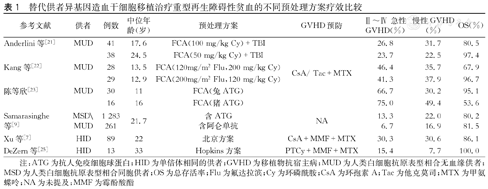
MUD allo-HSCT:多中心研究表明,FCA方案[氟达拉滨、环磷酰胺、抗人胸腺细胞球蛋白(ATG)]联合低剂量全身照射(TBI)2 Gy是MUD allo-HSCT常用的预处理方案,氟达拉滨的加入可以降低环磷酰胺剂量(50~150 mg/kg),减少毒性[20]。环磷酰胺的最佳剂量尚未达成共识,研究显示,同样应用FCA+TBI方案,50 mg/kg环磷酰胺预处理是早期疗效最理想的剂量,1年总存活率可达97.4%[21]。无TBI的FCA方案,通过适当增加氟达拉滨、降低环磷酰胺剂量也可获得良好植入且免受辐射,但其标准预处理剂量尚未明确[22]

ATG来源也影响移植疗效,选择兔ATG能降低急性GVHD风险,疗效优于马ATG[20]。陈欣等[23]在替代供者allo-HSCT中应用猪ATG预处理,也获得了与兔ATG相近的疗效,且不增加移植物发生排斥反应、GVHD和感染的风险,能兼顾经济与疗效。而回顾性分析显示,与ATG预处理相比,应用阿仑单抗预处理的受者GVHD风险较低[9]。含阿仑单抗的FCC预处理方案,既能降低慢性GVHD风险,改善受者长期生存质量,又能避免TBI辐射危害,可作为替代供者allo-HSCT的首选方案。

HID allo-HSCT:目前尚无统一预处理方案,国外采用Hopkins方案(环磷酰胺29 mg/kg+氟达拉滨120 mg/m2+TBI 2 Gy),同时以移植后大剂量环磷酰胺(PTCy)预防GVHD;国内常用北京方案(环磷酰胺200 mg/kg+ATG 10 mg/kg+白消安6.4 mg/kg)预处理,在该方案中加入氟达拉滨也有较好疗效,总存活率可达80%以上[7]

总之,目前MUD allo-HSCT常用FCA±2Gy TBI预处理方案,环磷酰胺以50~100 mg/kg最佳,ATG多用兔ATG,而FCC方案可避免TBI毒性危害,改善生存质量。HID allo-HSCT国外多用Hopkins方案,国内以北京方案为主。(表1)
点击查看表格
表1

替代供者异基因造血干细胞移植治疗重型再生障碍性贫血的不同预处理方案疗效比较

表1

替代供者异基因造血干细胞移植治疗重型再生障碍性贫血的不同预处理方案疗效比较

参考文献供者例数中位年龄(岁)预处理方案GVHD预防Ⅱ~Ⅳ急性GVHD(%)慢性GVHD(%)OS(%)
Anderlini等[21]MUD4117.6FCA(100 mg/kg Cy)+TBICsA/ Tac+MTX26.831.780.5
  3824.5FCA(50 mg/kg Cy)+TBI23.722.597.4
Kang等[22]MUD2813.5FCA(120mg/m2 Flu,200 mg/kg Cy)46.435.767.9
  2912.9FCA(200mg/m2 Flu,120 mg/kg Cy)41.337.996.7
陈等欣[23]MUD3011FCA(兔ATG)66.730.295.1
  1616FCA(猪ATG)75.049.453.6
Samarasinghe等[9]MSD\ MUD1 28321.7含ATGNA13.322.080.2
261含阿仑单抗6.716.981.5
Xu等[7]HID8922北京方案CsA+MMF+MTX30.330.686.1
DeZern等[25]HID1333Hopkins方案PTCy+MMF+MTX15.47.7100.0

注:ATG为抗人免疫细胞球蛋白;HID为单倍体相同的供者;GVHD为移植物抗宿主病;MUD为人类白细胞抗原表型相合无血缘供者;MSD为人类白细胞抗原表型相合同胞供者;OS为总存活率;Flu为氟达拉滨;Cy为环磷酰胺;CsA为环孢素A;Tac为他克莫司;MTX为甲氨蝶呤;NA为未提及;MMF为霉酚酸酯

3.移植后GVHD预防

移植前应用ATG或阿仑单抗预处理能降低GVHD风险[9],而移植后GVHD预防也至关重要。目前MUD allo-HSCT多以甲氨蝶呤+钙调磷酸酶抑制剂(CNI),如环孢素A、他克莫司作为GVHD预防方案[1]。Inamoto等[24]回顾性研究发现,应用甲氨蝶呤+他克莫司方案预防GVHD的受者比应用甲氨蝶呤+环孢素A方案者死亡风险低(HR=0.42,95%CI 0.23~0.80,P=0.008)。近年来以PTCy为基础的方案广泛应用,也能明显降低GVHD风险[25]。对于HID allo-HSCT,国内外不同GVHD预防方案均取得了不错疗效。DeZern等[25]采用PTCy+他克莫司+霉酚酸酯方案,植入良好且GVHD风险较低,总存活率达94.6%。而国内研究对89例受者应用短程甲氨蝶呤+环孢素A+霉酚酸酯方案,Ⅱ~Ⅳ度急性GVHD和慢性GVHD发生率分别为30.3%和30.6%,疗效与同期MSD allo-HSCT相近[7](表1)。总之,国外多应用Hopkins+ PTCy方案,疗效佳但需更多大样本数据支持;国内方案多样,但GVHD风险高,需更多研究改进。

体外去T淋巴细胞移植物能促进受者形成稳定混合嵌合体,是GVHD预防的新选择[26]。Kim等[27]对67例儿童受者应用体外去T淋巴细胞移植物,5年总存活率和FFS分别为93.8%与83.3%。然而目前研究仍局限于小样本,缺乏与体内去T淋巴细胞方案的随机对照研究验证。

4.间充质干细胞

间充质干细胞(MSCs)能诱导免疫耐受,促进干细胞植入[28]。多中心研究显示,儿童SAA患者的HID allo-HSCT中应用造血干细胞(HSCs)+骨髓MSCs联合移植,Ⅱ~Ⅳ度急性GVHD与慢性GVHD发生率分别为25.71%和22.86%,中位随访22个月,总存活率可达85.71%[29]。同样,人脐带MSCs联合植入也有较好的疗效[30]。MSCs+HSCs联合移植能降低排斥反应与GVHD风险,改善移植疗效,是很有前景的选择。

三、植入失败与二次移植

替代供者allo-HSCT后混合嵌合(MC)发生率高,可达50%以上,其排斥与植入失败风险高[31,32]。预处理方案强度和移植物干细胞数量与MC相关,HID allo-HSCT需采用更高强度预处理方案(如加用白消安或美法仑),同时保证移植物中CD34+细胞数量充足。当MC中供者细胞比例明显下降时,可予供者淋巴细胞输注(DLI)治疗;当移植失败不可避免时,考虑二次移植,总存活率可达46%[32]。监测嵌合状态有助于早期预测移植预后,指导预防性治疗,而如何选择合适时机与方案进行干预仍需进一步研究。

随着移植疗效的提高,替代供者allo-HSCT已经成为无MSD SAA患者的替代方案,在经验丰富的移植中心可以作为首选治疗。移植前应注意评估其年龄、体能状态与合并症,并选择最佳供者。同时应避免大量输血,监测DSA与血清铁蛋白水平。对MUD allo-HSCT,可以根据实际选择骨髓移植(BMT)或外周血造血干细胞移植(PBSCT),年轻受者的预处理方案常选择FCA+2Gy TBI方案,年长者可选择FCC方案。对HID allo-HSCT,通常采用粒细胞集落刺激因子(G-CSF)动员BM+PBSC联合植入及北京方案预处理。一般应用甲氨蝶呤+CNI或后置坏磷酰胺(PTCy)进行GVHD预防,体外T淋巴细胞去除也是一种新的选择。移植后应注意监测受者嵌合状态,及时进行预防性治疗。若移植失败,可进行二次移植挽救治疗。

利益冲突
利益冲突

所有作者均声明不存在利益冲突

参考文献
[1]
GeorgesGEDoneyKStorbRSevere aplastic anemia:allogeneic bone marrow transplantation as first-line treatment[J].Blood Adv20182(15):2020-2028.DOI:10.1182/bloodadvances.2018021162.
[2]
BacigalupoAAlternative donor transplants for severe aplastic anemia[J].Hematology Am Soc Hematol Educ Program20182018(1):467-473.DOI:10.1182/asheducation-2018.1.467.
[3]
KillickSBBownNCavenaghJet al.Guidelines for the diagnosis and management of adult aplastic anaemia[J].Br J Haematol2016172(2):187-207.DOI:10.1111/bjh.13853.
[4]
DevillierRDalleJHKulasekararajAet al.Unrelated alternative donor transplantation for severe acquired aplastic anemia:a study from the French society of bone marrow transplantation and cell therapies and the EBMT Severe Aplastic Anemia Working Party[J].Haematologica2016101(7):884-890.DOI:10.3324/haematol.2015.138727.
[5]
DufourCVeysPCarraroEet al.Similar outcome of upfront-unrelated and matched sibling stem cell transplantation in idiopathic paediatric aplastic anaemia.A study on behalf of the UK Paediatric BMT Working Party,Paediatric Diseases Working Party and Severe Aplastic Anaemia Working Party of EBMT[J].Br J Haematol2015171(4):585-594.DOI:10.1111/bjh.13614.
[6]
ShinSHParkSSYoonJHet al.Comparison of HLA-matched sibling and unrelated donor transplantation in adult patients with acquired severe aplastic Anemia[J].Bone Marrow Transplant202055(8):1570-1579.DOI:10.1038/s41409-020-0820-x.
[7]
XuLPJinSWangSQet al.Upfront haploidentical transplant for acquired severe aplastic anemia:registry-based comparison with matched related transplant[J].J Hematol Oncol201710(1):25.DOI:10.1186/s13045-017-0398-y.
[8]
GengCLiuXJChenMet al.Comparison of frontline treatment with intensive immunosuppression therapy and HLA-haploidentical hematopoietic stem cell transplantation for young patients with severe aplastic Anemia-a meta analysis[J].Leuk Res202088106266.DOI:10.1016/j.leukres.2019.106266.
[9]
SamarasingheSCleshamKIacobelliSet al.Impact of T-cell depletion strategies on outcomes following hematopoietic stem cell transplantation for idiopathic aplastic anemia:a study on behalf of the European blood and marrow transplant severe aplastic Anemia working party[J].Am J Hematol201994(1):80-86.DOI:10.1002/ajh.25314.
[10]
ShethVSPotterVGandhiSAet al.Similar outcomes of alemtuzumab-based hematopoietic cell transplantation for SAA patients older or younger than 50 years[J].Blood Adv20193(20):3070-3079.DOI:10.1182/bloodadvances.2019000480.
[11]
CiureaSOCaoKFernandez-VinaMet al.The European society for blood and marrow transplantation(EBMT)consensus guidelines for the detection and treatment of donor-specific anti-HLA antibodies (DSA)in haploidentical hematopoietic cell transplantation[J].Bone Marrow Transplant201853(5):521-534.DOI:10.1038/s41409-017-0062-8.
[12]
ChangYJZhaoXYXuLPet al.Donor-specific anti-human leukocyte antigen antibodies were associated with primary graft failure after unmanipulated haploidentical blood and marrow transplantation:a prospective study with randomly assigned training and validation sets[J].J Hematol Oncol2015884.DOI:10.1186/s13045-015-0182-9.
[13]
KorulaADevasiaAJFouziaNAet al.Outcomes following allogeneic stem cell transplantation using non-sibling family donors[J].Indian J Hematol Blood Transfus201935(1):43-49.DOI:10.1007/s12288-018-0988-z.
[14]
RimandoJSladeMDiPersioJFet al.HLA epitope mismatch in haploidentical transplantation is associated with decreased relapse and delayed engraftment[J].Blood Adv20182(24):3590-3601.DOI:10.1182/bloodadvances.2018025437.
[15]
XuLPWangSQMaYRet al.Who is the best haploidentical donor for acquired severe aplastic anemia?Experience from a multicenter study[J].J Hematol Oncol201912(1):87.DOI:10.1186/s13045-019-0775-9.
[16]
MaYRWangWJChengYFet al.Impact of ABO incompatibility on outcomes after haploidentical hematopoietic stem cell transplantation for severe aplastic Anemia[J].Bone Marrow Transplant202055(6):1068-1075.DOI:10.1038/s41409-020-0779-7.
[17]
CaoLQXuLPZhangXHet al.Relationship of cell compositions in allografts with outcomes after haploidentical transplantation for acquired severe aplastic anemia:effects of CD34+ and CD14+ cell doses[J].Chin Med J (Engl)2018131(18):2185-2192.DOI:10.4103/0366-6999.240810.
[18]
LeeSEYahngSAChoBSet al.Impact of pretransplant red cell transfusion on outcome after allogeneic stem cell transplantation in adult patients with severe aplastic Anemia[J].Bone Marrow Transplant201651(10):1323-1329.DOI:10.1038/bmt.2016.140.
[19]
ZhangXYShiYYHuangYet al.Serum ferritin is a different predictor from transfusion history for allogeneic transplantation outcome in patients with severe aplastic Anemia[J].Hematology201823(5):291-298.DOI:10.1080/10245332.2017.1390929.
[20]
BejanyanNKimSHebertKMet al.Choice of conditioning regimens for bone marrow transplantation in severe aplastic Anemia[J].Blood Adv20193(20):3123-3131.DOI:10.1182/bloodadvances.2019000722.
[21]
AnderliniPWuJGerstenIet al.Cyclophosphamide conditioning in patients with severe aplastic anaemia given unrelated marrow transplantation:a phase 1-2 dose de-escalation study[J].Lancet Haematol20152(9):e367-e375.DOI:10.1016/S2352-3026(15)00147-7.
[22]
KangHJHongKTLeeJWet al.Improved outcome of a reduced toxicity-fludarabine,cyclophosphamide,plus antithymocyte globulin conditioning regimen for unrelated donor transplantation in severe aplastic anemia:comparison of 2 multicenter prospective studies[J].Biol Blood Marrow Transplant201622(8):1455-1459.DOI:10.1016/j.bbmt.2016.04.003.
[23]
陈欣魏嘉璘黄勇猪抗人淋巴细胞免疫球蛋白在替代供者移植治疗重型再生障碍性贫血患者中的疗效及安全性[J].中华血液学杂志201839(1):22-27.DOI: 10.3760/cma.j.issn.0253-2727.2018.01.005.
[24]
InamotoYFlowersMEWangTet al.Tacrolimus versus cyclosporine after hematopoietic cell transplantation for acquired aplastic Anemia[J].Biol Blood Marrow Transplant201521(10):1776-1782.DOI:10.1016/j.bbmt.2015.05.023.
[25]
DeZernAEZahurakMSymonsHet al.Alternative donor transplantation with high-dose post-transplantation cyclophosphamide for refractory severe aplastic Anemia[J].Biol Blood Marrow Transplant201723(3):498-504.DOI:10.1016/j.bbmt.2016.12.628.
[26]
BacigalupoAGiammarcoSHaploidentical donor transplants for severe aplastic Anemia[J].Semin Hematol201956(3):190-193.DOI:10.1053/j.seminhematol.2019.03.004.
[27]
KimHImHJKohKNet al.Comparable outcome with a faster engraftment of optimized haploidentical hematopoietic stem cell transplantation compared with transplantations from other donor types in pediatric acquired aplastic Anemia[J].Biol Blood Marrow Transplant201925(5):965-974.DOI:10.1016/j.bbmt.2019.01.010.
[28]
LiuZZhangYXiaoHet al.Cotransplantation of bone marrow-derived mesenchymal stem cells in haploidentical hematopoietic stem cell transplantation in patients with severe aplastic anemia:an interim summary for a multicenter phase Ⅱ trial results[J].Bone Marrow Transplant201752(5):704-710.DOI:10.1038/bmt.2016.347
[29]
WangZYuHCaoFet al.Donor-derived marrow mesenchymal stromal cell co-transplantation following a haploidentical hematopoietic stem cell transplantation trail to treat severe aplastic Anemia in children[J].Ann Hematol201998(2):473-479.DOI:10.1007/s00277-018-3523-2.
[30]
XuLXLiuZYWuYMet al.Clinical evaluation of haploidentical hematopoietic combined with human umbilical cord-derived mesenchymal stem cells in severe aplastic Anemia[J].Eur J Med Res201823(1):12.DOI:10.1186/s40001-018-0311-3.
[31]
FaraciMBagnascoFLeoniMet al.Evaluation of chimerism dynamics after allogeneic hematopoietic stem cell transplantation in children with nonmalignant diseases[J].Biol Blood Marrow Transplant201824(5):1088-1093.DOI:10.1016/j.bbmt.2017.12.801.
[32]
XuZLChengYFZhangYYet al.The incidence,clinical outcome,and protective factors of mixed chimerism following hematopoietic stem cell transplantation for severe aplastic Anemia[J].Clin Transplant202135(2):e14160.DOI:10.1111/:ctr.14160.
 
 
展开/关闭提纲
查看图表详情
回到顶部
放大字体
缩小字体
标签
关键词