综述
异种肾移植临床前研究进展及未来潜在受者选择
中华器官移植杂志, 2023,44(2) : 122-128. DOI: 10.3760/cma.j.cn421203-20220901-00229
摘要

肾移植在历代移植人的努力下迅猛发展,如今已成为治疗终末期肾病的最佳手段,但肾脏的供需不平衡一直制约着肾移植的开展。在这种困境下,异种移植成为解决器官供需不平衡的这一严重问题的最佳替代方案之一。本文结合近几年异种肾移植文献报道和近期的猪到人肾移植和心脏移植案例对异种肾移植进行回顾总结并展望其未来的临床转化应用。


引用本文: 涂宇豪, 冯豪, 朱兰, 等.  异种肾移植临床前研究进展及未来潜在受者选择 [J] . 中华器官移植杂志, 2023, 44(2) : 122-128. DOI: 10.3760/cma.j.cn421203-20220901-00229.
参考文献导出:   Endnote    NoteExpress    RefWorks    NoteFirst    医学文献王
扫  描  看  全  文

正文
作者信息
基金 0  关键词  0
English Abstract
评论
阅读 0  评论  0
相关资源
引用 | 论文 | 视频

版权归中华医学会所有。

未经授权,不得转载、摘编本刊文章,不得使用本刊的版式设计。

除非特别声明,本刊刊出的所有文章不代表中华医学会和本刊编委会的观点。

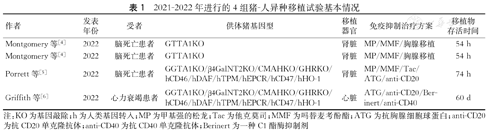
自1954年Murray完成第一例肾移植并取得成功后,肾移植在历代移植人的努力下迅猛发展,如今已成为治疗终末期肾脏病的最佳手段。但肾脏的供需不平衡,一直制约着肾移植的开展。《中国器官移植发展报告(2020)》显示,2020年中国肾移植等待者共有78 324人,但当年仅实施肾移植11 037例[1]。虽然患者在等待的过程中可以通过透析来维持生命,但其生活质量和存活率远不及肾移植受者[2]。在这种困境下,异种移植的提出成为解决器官供需不平衡的这一严重问题的最佳替代方案之一[3]。近年来,随着基因编辑领域CRISPR-Cas9技术的突破及新型免疫抑制剂的应用,再辅以免疫耐受诱导策略,使得异种移植在临床前试验中取得了巨大突破并开始向临床试验迈进。2021年9月和2022年3月,美国的Montgomery等[4]将基因编辑猪的肾脏连同胸腺移植给了2位脑死亡的人类患者。2021年12月美国Porrett等[5]将敲除3大主要异种抗原以及生长激素受体(growth hormone receptor,GHR)的10基因基因编辑猪的双侧肾脏异位移植给了1位脑死亡患者。2022年1月Griffith等[6]将敲除3大主要异种抗原以及生长激素受体(growth hormone receptor,GHR)的10基因基因编辑猪的心脏原位移植给了1例57岁心力衰竭患者,完成了世界首例基因编辑猪-人的心脏移植。2021-2022年进行的4组猪-人异种移植试验基本情况详见表1。这些振奋人心的成就预示着异种肾移植在不久的将来或许会进入临床试验阶段并应用于临床。本文结合近几年异种肾移植的相关文献报道和近期猪到人肾移植和心脏移植案例对异种肾移植进行综述回顾总结并展望其临床转化应用。
点击查看表格
表1

2021-2022年进行的4组猪-人异种移植试验基本情况

表1

2021-2022年进行的4组猪-人异种移植试验基本情况

作者发表年份受者供体猪基因型移植器官免疫抑制治疗方案移植物存活时间
Montgomery等[4]2022脑死亡患者GTTA1KO肾脏MP/MMF/胸腺移植54 h
Porrett等[5]2022脑死亡患者GGTA1KO/β4GalNT2KO/CMAHKO/GHRKO/hCD46/hDAF/hTPM/hEPCR/hCD47/hHO-1肾脏MP/MMF/Tac/ATG/anti-CD2074 h
Griffith等[6]2022心力衰竭患者GGTA1KO/β4GalNT2KO/CMAHKO/GHRKO/hCD46/hDAF/hTPM/hEPCR/hCD47/hHO-1心脏ATG/anti-CD20/Berinert/anti-CD4060 d

注:KO为基因敲除;h为人类基因转入;MP为甲基强的松龙;Tac为他克莫司;MMF为吗替麦考酚酯;ATG为抗胸腺细胞球蛋白;anti-CD20为抗CD20单克隆抗体;anti-CD40为抗CD40单克隆抗体;Berinert为一种C1酯酶抑制剂

一、异种肾移植临床前动物研究
(一)猪是异种肾移植的最佳供体

异种移植的供体选择经历了上百年的探索。1905年,一位法国医生将兔肾移植给了一位肾功能衰竭的儿童并存活了16 d。20世纪60年代,Reemtsma等[7]选择黑猩猩作为肾脏来源进行了13次黑猩猩-人肾移植,并帮助一位患者存活了9个月。然而后续的研究人员认为,非人灵长类动物(nonhuman primates,NHP)存在伦理、繁殖困难、器官大小差异等问题,不适合作为临床异种移植的器官来源[8]。相较之下,猪不仅繁殖成熟快,且体型和生理特点与人类相近,种间感染风险相对较低;最重要的一点是猪更易进行基因编辑,故更适合作为供体[9]。二十一世纪以来,各种基因编辑猪相继出现,作为供体用于异种移植的临床前研究。

(二)非人灵长类动物是临床前研究的最佳受体

NHP因其基因型与人类相近,是开展异种肾移植研究和评估其临床转化安全性及有效性最理想的动物模型。其中,新世界猴(new world monkeys,NWMs)因个体太小,不适合作为猪肾的受体[10]。旧世界猴(old world monkeys,OWMs)则是异种肾移植临床前研究最合适的受体,其中猕猴(恒河猴与食蟹猴)和狒狒是最常用的异种移植受体,二者在临床前研究中均获得了很长的存活时间[11,12]。在使用猕猴作为异种肾移植受体的研究中,受体的最长存活时间已经达到了557 d[12]

二、异种肾移植面临的挑战

虽然猪是异种肾移植的最佳供体,但基于猪与人和NHP的种间差异,异种肾移植仍面临着诸多挑战。目前已确认的挑战包括:异种间免疫屏障导致的排斥反应、凝血功能障碍等生理功能不相容和种间感染风险等。

(一)免疫屏障与排斥反应

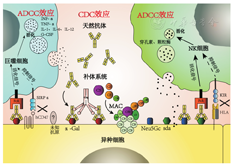
免疫屏障包括先天性免疫屏障和适应性免疫屏障,先天性免疫屏障的关键组成部分是天然抗体、补体系统和巨噬细胞/自然杀伤(natural killer,NK)细胞,其相互作用介导了异种排斥反应(图1)。NHP体内存在针对猪细胞的α-1,3半乳糖(α-1,3Gal,αGal;GGTA1产物),以及N-羟乙酰神经氨酸(Neu5Gc;CMAH产物)和Sda(β4GalNT2产物)2种非Gal抗原的天然抗体。同时,猪的补体调节蛋白不能有效抑制人补体系统的激活,当天然抗体与α-Gal抗原、非Gal抗原结合并激活补体系统后,可引起补体依赖的细胞毒作用(complement-dependent cytotoxicity,CDC)导致的强烈抗体介导补体依赖的超急性排斥反应(hyperacute rejection,HAR)或较为延迟的急性体液异种排斥反应(acute humoral xenograft rejection,AHXR),最终导致移植肾出血和血栓形成。巨噬细胞与NK细胞在异种排斥中的作用同样重要,他们都可以通过抗体依赖途径或直接识别猪细胞上α-Gal等异种抗原后激活。其中,活化的巨噬细胞通过释放各种促炎细胞因子、补体因子等诱导移植肾损伤;而NK细胞则可以产生直接的细胞毒作用或通过与抗体结合引起抗体依赖的细胞介导的细胞毒作用(antibody-dependent cell-medicated cytotoxicity,ADCC)[13,14]。另外,由于猪不表达人CD47和人类白细胞抗原(human leukocyte antigen,HLA),这使得巨噬细胞失去了SIRPα-CD47抑制通路的抑制,而NK细胞则无法获得HLA抑制信号从而能够持续发挥作用[13]

点击查看大图
图1
异种肾移植面临的先天性免疫屏障(包括天然抗体、补体系统和巨噬细胞/NK细胞)
点击查看大图

注:ADCC效应指抗体依赖的细胞介导的细胞毒作用;CDC效应指补体依赖的细胞毒作用;INF-α:干扰素α为TNF-α:肿瘤坏死因子α;G-CSF为粒细胞集落刺激因子;SIRP-α为信号调节蛋白α;C1-C9为补体;MAC为膜攻击复合物;FcR为Fc受体;KIR为杀伤细胞免疫球蛋白样受体;HLA为人类白细胞抗原;虚线部分为异种细胞未表达的分子或未知的抗原;"×"表示信号通路阻断

图1
异种肾移植面临的先天性免疫屏障(包括天然抗体、补体系统和巨噬细胞/NK细胞)

适应性免疫屏障主要是T细胞和B细胞效应。T细胞可通过直接和间接激活途径激活并产生效应T细胞。其中,直接激活是指宿主的T细胞受体(T cell receptor,TCR)直接识别供体抗原呈递细胞(antigen-presenting cell,APC)表达的猪白细胞抗原(swine leukocyte antigen,SLA),继而引发对猪肾血管内皮的细胞毒作用;间接激活是指宿主T细胞识别由宿主的APC提呈的猪异种抗原,活化产生效应,并通过CD154-CD40共刺激信号诱导呈递抗原的B细胞活化产生抗体以及可活化吞噬细胞/NK细胞的细胞因子,引起排斥反应[15]。适应性免疫屏障引起的严重延迟性异种移植排斥反应(delayed xenograft rejection,DXR)和急性细胞性异种排斥反应(acute cellular xenograft rejection,ACXR),同样是异种肾移植长期存活的障碍[16]

(二)凝血功能障碍等生理功能不相容

猪与人或NHP间存在的生理学差异,导致异种肾移植存在生理功能不相容的问题。而生理功能不相容的主要原因是某些分子不相容,如猪凝血-抗凝系统与NHP凝血系统中的分子不相容导致猪的抗凝血因子无法有效阻止血液凝固导致凝血系统紊乱形成血栓,而引起移植肾功能障碍;猪肾分泌的肾素不能分解人血管紧张素原,从而可能导致一些狒狒移植了猪肾后出现了间歇性低血容量和脱水表现;猪促红细胞生成素(erythropoietin,EPO)不能识别人类或NHP的EPO受体导致贫血,但研究表明其可通过注射重组人EPO成功纠正[17]。Tatsu等[18]的研究发现,移植器官自身参与了异种移植后的移植物生长,并认为当猪肾体积与受体动物体重的比率大于25 cm3/kg时,肾功能将会出现损害。移植后蛋白尿和低蛋白血症引发的肾病综合征,同样可以导致移植失败。有研究指出,成年猪在环境和身体压力下以及新生猪的近端肾小管发育未成熟,可产生不伴随低蛋白血症的轻、中度蛋白尿[17]。而重度蛋白尿多与抗体介导的排斥反应导致的血栓形成和感染相关,但在有的研究中,狒狒在没有任何抗体或补体激活的情况下也出现了肾病综合征[19]。后续研究证明,蛋白尿与肾小球中CD80的上调以及CD47在猪和狒狒间的不兼容导致巨噬细胞功能紊乱有关[20,21]

(三)可能的种间感染风险

由于供体猪是在生物安全隔离条件下饲养的,因此绝大多数病原体可以从其体内清除。以往种间感染的研究主要针对猪携带的病毒如猪巨细胞病毒(porcine cytomegalovirus,PCMV)、猪嗜淋巴疱疹病毒(porcine lymphotropic herpesvirus,PLHV)和猪内源性逆转录病毒(porcine endogenous retrovirus,PERV)等。在猪-NHP的肾移植研究中,PCMV被证实只在肾移植过程中引起感染,而PLHV具有物种特异性,不会引起宿主的全身感染[22,23]。PERV是一种以前病毒DNA形式整合入猪基因组中的逆转录病毒,分为PERV-A、PERV-B、PERV-C三种类型,并在体外试验中被证实可以感染多种人类细胞。但越来越多的研究显示,在临床前和早期临床异种移植试验中没有发生PERV传播[24]。而且PERV基因敲除的"13基因编辑猪"已被成功开发,同时也可成功鉴定与筛选出未经CRISPR/Cas9处理的PERV pol基因缺陷小型猪[25]。所以,目前异种移植领域专家共识认为,PERV实际传播的风险不仅很小并且可控。

在目前已经报道的4组猪-人异种移植案例中,供体猪在移植前病原学检测PERV中PERV-A和PERV-B呈阳性,PERV-C、PCMV与PLHV呈阴性。移植后4位受者体内均没有检测到PERV,但心脏异种移植的患者在第20天mcfDNA检测中出现PCMV阳性并且PCMV水平在随后的几周内升高;同时该例患者的肺迷走神经标本中也检测到可与PCMV发生抗体交叉反应的人类疱疹病毒6型(human herpes virus-6,HHV-6)[26]。PCMV阳性与供体猪术前病原学筛查结果矛盾,但mcfDNA中检测到PCMV能否诊断受者PCMV感染尚不明确,患者具体的死亡原因是否和PCMV感染后和HHV-6之间交叉反应有关并未得到论证。

三、异种肾移植取得的进展
(一)基因编辑猪

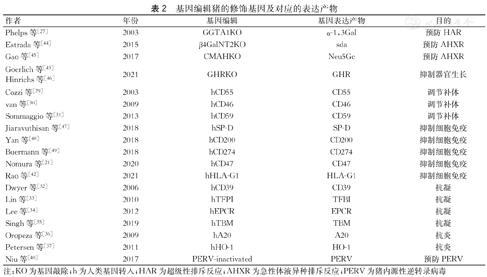
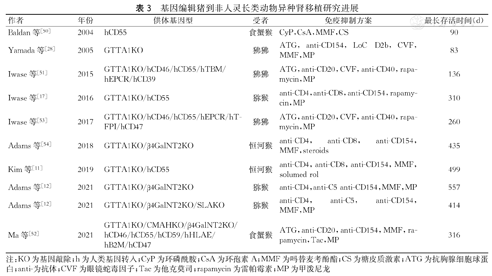
人和NHP体内针对α-Gal的天然抗体可引起HAR和AHXR。2002年,有2个小组研究出了第一头α-Gal基因敲除(α-GalKO)猪[27];并在接下来的GalKO猪-狒狒异种肾移植试验中,成功避免了HAR且将受体的存活时间延长至83 d[28](表2表3)。得益于CRISPR-Cas9的出现,多种基因可以实现快速敲除与转入;在新型免疫抑制剂如抗CD154单克隆抗体的加持下,NHP的存活时间也突破了上限。2019年,GGTA1KO/hCD55猪-恒河猴异种肾移植试验中,受体存活了499 d[11];2021年,GGTA1KO/β4GalNT2KO猪-恒河猴异种肾移植实验中,受体存活了557 d[12](表3)。目前对猪进行的主流基因编辑包括(表2):(1)行GGTA1/CMAH/β4GalNT2三基因敲除,尽可能降低供体免疫原性;(2)转入hCD55和hCD46等补体调节蛋白基因[29,30,31],保护肾移植物免受补体介导的损伤;(3)转入hEPCR等凝血调节蛋白基因,预防移植物中的血栓形成和受体消耗性凝血病[32,33,34,35];(4)引入hCD47基因[21],抑制巨噬细胞活化并缓解受体蛋白尿;(5)转入hA20和hHO-1等抗炎蛋白基因,以避免全身炎症反应的发生[36,37]。具有至少以上9种基因编辑的猪被认为是异种移植初步临床试验的最佳肾脏来源[38,39]。但随着PERV基因可以通过CRISPR-Cas9技术敲除,目前已在此前基础上研发出了敲除PERV基因的13基因编辑猪,即PERV-KO/GalT-KO/β4GalNT2-KO/CMAH-KO/hCD46/hCD55/hCD59/hβ2M/hHLA-E/hCD47/hTHBD/hTFPI/hCD39,以预防PERV的感染[40,41](表2)。此外,最新的研究表明,转入HLA-G1基因的GTTA1KO/hHLAG1猪在体外试验中可成功抑制人和猴抗猪T、B和NK细胞反应[42]。已进行的4组猪-人异种移植案例中,Montgomery等[4]的2例肾移植试验采用α-Gal单基因敲除猪,而Porrett等[5]的肾移植试验和Griffith等[6]的心脏移植试验还采用了进一步敲除生长激素受体GHR基因的10基因编辑猪以抑制猪器官的生长[43]

点击查看表格
表2

基因编辑猪的修饰基因及对应的表达产物

表2

基因编辑猪的修饰基因及对应的表达产物

作者年份基因编辑基因表达产物目的
Phelps等[27]2003GGTA1KOα-1,3Gal预防HAR
Estrada等[44]2015β4GalNT2KOsda预防AHXR
Gao等[45]2017CMAHKONeu5Gc预防AHXR
Goerlich等[43]2021GHRKOGHR抑制器官生长
Hinrichs等[46]
Cozzi等[29]2003hCD55CD55调节补体
van等[30]2009hCD46CD46调节补体
Sommaggio等[31]2013hCD59CD59调节补体
Jiaravuthisan等[47]2018hSP-DSP-D抑制细胞免疫
Yan等[48]2018hCD200CD200抑制细胞免疫
Buermann等[49]2018hCD274CD274抑制细胞免疫
Nomura等[21]2020hCD47CD47抑制细胞免疫
Rao等[42]2021hHLA-G1HLA-G1抑制细胞免疫
Dwyer等[32]2006hCD39CD39抗凝
Lin等[33]2010hTFPITFBI抗凝
Lee等[34]2012hEPCREPCR抗凝
Singh等[35]2019hTBMTBM抗凝
Oropeza等[36]2009hA20A20抗炎
Petersen等[37]2011hHO-1HO-1抗炎
Niu等[40]2017PERV-inactivatedPERV预防PERV

注:KO为基因敲除;h为人类基因转入;HAR为超级性排斥反应;AHXR为急性体液异种排斥反应;PERV为猪内源性逆转录病毒
点击查看表格
表3

基因编辑猪到非人灵长类动物异种肾移植研究进展

表3

基因编辑猪到非人灵长类动物异种肾移植研究进展

作者年份供体基因型受者免疫抑制方案最长存活时间(d)
Baldan等[50]2004hCD55食蟹猴CyP,CsA,MMF,CS90
Yamada等[28]2005GTTA1KO狒狒ATG,anti-CD154,LoC D2b,CVF,MMF,MP83
Iwase等[51]2015GTTA1KO/hCD46/hCD55/hTBM/hEPCR/hCD39狒狒ATG,anti-CD20,CVF,anti-CD40,rapamycin,MP136
Iwase等[17]2016GTTA1KO/hCD55猕猴anti-CD4,anti-CD8,anti-CD154,rapamycin,MP310
Iwase等[53]2017GTTA1KO/hCD46/hCD55/hEPCR/hTFPI/hCD47狒狒ATG,anti-CD20,CVF,anti-CD40,rapamycin,MP260
Adams等[54]2018GTTA1KO/β4GalNT2KO恒河猴anti-CD4,anti-CD8,anti-CD154,MMF,steroids435
Kim等[11]2019GTTA1KO/hCD55恒河猴anti-CD4,anti-CD8,anti-CD154,MMF,solumed rol499
Adams等[12]2021GTTA1KO/β4GalNT2KO猕猴anti-CD4,anti-C5 anti-CD154,MMF,MP557
Adams等[12]2021GTTA1KO/β4GalNT2KO/SLAKO猕猴anti-CD4,anti-C5,anti-CD154,MMF,MP414
Ma等[52]2021GTTA1KO/CMAHKO/β4GalNT2KO/hCD46/hCD55/hCD59/hHLAE/hB2M/hCD47食蟹猴ATG,anti-CD20,anti-CD154,MMF,rapamycin,Tac,MP316

注:KO为基因敲除;h为人类基因转入;CyP为环磷酰胺;CsA为环孢素A;MMF为吗替麦考酚酯;CS为糖皮质激素;ATG为抗胸腺细胞球蛋白;anti-为抗体;CVF为眼镜蛇毒因子;Tac为他克莫司;rapamycin为雷帕霉素;MP为甲泼尼龙

虽然目前基因编辑猪已使异种移植突破了许多障壁,但仍存在新表位产生[55]、不合理的基因表达[56]和大量潜在的未知异种抗原[57]等问题有待解决。

(二)免疫抑制策略

除使用基因编辑的供体猪外,受体的免疫抑制治疗对于异种移植的成功也是不可或缺的。在应用皮质类固醇、他克莫司、吗替麦考酚酯(mycophenolate mofetil,MMF)等传统免疫剂基础上,在T细胞与B细胞耗竭、补体抑制和共刺激信号通路阻断等方面,研究者们还应用了有很多新型免疫抑制剂来抑制T、B细胞介导的适应性免疫排斥反应[39]。其中,抗CD4单克隆抗体与抗胸腺细胞球蛋白(anti-thymocyte globulin,ATG)常用于T细胞耗竭,在异种移植中取得了不错的效果[58]。抗CD20单抗则常用于B细胞耗竭,其中利妥昔单抗取得了不错的效果;阻断CD154/CD40通路的抗CD154单抗和抗CD40单抗使受体的存活时间有了很大突破。Eculizumab和C1酯酶抑制剂等补体抑制剂已接受过临床试验,在异种肾移植的应用中最具前景[59]。在ABO血型不合的同种异体心脏移植小鼠模型中,抗C5的Tesidolumab单抗可用于预防早期抗体介导的排斥反应(antibody-mediated rejection,AMR)[60]。在存活了557 d的猪-NHP肾移植试验结果证实,Tesidolumab单抗与抗CD4单抗CD4R1以及抗CD154单抗的联合应用,使受体实现了长期存活[12]

在Griffith等[6]的首次临床异种心脏移植尝试中,不仅ATG、利妥昔单抗与补体C1酯酶抑制剂的联合运用,取得了不错的效果;还应用了新型抗CD40单抗KPL-404。Muralidharan等[61]此前的研究证实,KPL-404可以有效抑制B细胞CD40下游信号的激活,且体外实验结果显示没有诱导表达CD40细胞的耗竭,证明KPL-404可靶向识别B细胞CD40,所以安全性更佳。Marken等[62]此前的体外试验也证明,KPL-404不仅可以抑制人类B细胞激活,同时不会诱导血小板活化、聚集或致密颗粒释放;Muralidharan等[61]的体内试验也未观察到血小板减少,故KPL-404被用于了首次异种移植临床试验。

(三)胸腺移植的诱导免疫耐受策略

免疫耐受诱导策略很早就成为了异种移植免疫抑制的重要辅助手段。在Montgomery等[4]的2组猪-人肾移植案例中,猪胸腺在术前约2个月被植入肾包膜下用于诱导免疫耐受。在第1批GTTA1KO猪的异种肾移植试验中,胸腺与GTTA1KO肾脏共移植的受体狒狒耐受了免疫排斥且存活时间从29 d延长到了83 d[28](表3)。但这批接受胸腺移植的狒狒都出现了严重蛋白尿。严重的蛋白尿与肾小球足细胞CD80表达上调以及CD47分子不兼容,会导致巨噬细胞对肾小球内皮细胞和足细胞损害有关。目前已有研究表明,CTLA4-Ig可以抑制足细胞CD80的表达[20]。同时,转入hCD47(图1)的基因编辑猪也被研发[21]。带血管胸腺与肾脏联合移植,搭配运用抗CTLA-4单抗,以及转入hCD47的基因编辑猪作肾脏供体,受体狒狒的蛋白尿情况得到了改善,多个受体获得了>6个月的存活时间[21]。Montgomery等[4]的研究由于因随访时间太短,诱导T细胞抑制的结果不明显,但胸腺结构和血运重建情况良好,证明胸腺移植运用于临床是具有可行性。

四、潜在临床异种肾移植受者的选择

4组猪-人异种移植案例的受者的挑选都经过伦理和法律严格审查,最终挑选了3位脑死亡患者作为异种肾脏的受者,1例终末期心肌病患者作为异种心脏的受者。在此之前,Cooper等[63]曾建议,将肾移植等待名单上需等待较长时间但又经不起长时间等待以及不适合接受同种肾移植的患者纳入异种肾移植考虑范围,如B、O血型者、年龄较大者以及HLA高致敏者。值得注意的是,即使受者接受的猪肾因新产生的抗SLA抗体出现而被排斥,目前有限的证据仍表明这不会影响后期同种异体肾移植的成功进行[64,65]。因此,异种肾移植在未来临床运用中可有效充当同种异体移植前过渡的治疗手段。

HLA高致敏患者因其极难获得同种肾移植机会而具有接受异种肾移植的伦理学优势,同时也是异种肾移植潜在的最大受益群体而备受关注。此前的体外研究也显示,HLA高致敏受者血清对GTTA1KO/β4GalNT2KO或GTTA1KO/β4GalNT2KO/CMAHKO供体猪细胞的免疫反应并不比普通受者血清更为强烈,HLA高致敏受者似乎不会增加猪肾移植排斥反应的风险[66]。这预示着HLA高致敏患者很有希望通过异种肾移植获得移植机会。但也有体外研究显示,部分HLA高致敏患者血清中含有低水平的可与SLA-I类抗原结合的IgG抗体,提示可能有少数个体的抗HLA抗体和SLA间存在交叉反应[67,68]

总之,目前国际上对于同种异体HLA致敏是否会增加异种器官移植免疫风险仍尚无定论,还有待进一步研究。

五、总结与展望

最近的4组猪-人异种移植案例是总结异种移植几十年来研究成果后所做出的伟大尝试。虽然结果没有非常理想,但证明了猪对人器官移植的短期可行性。新型基因编辑猪及免疫抑制剂的应用和胸腺移植诱导免疫耐受策略均在试验中起到了不错的效果,但仍有很多需要深入探索的地方,如:CMAH基因敲除后产生发新抗原、转基因的表达水平和效果的验证、未知抗原的寻找与敲除等。

关于临床异种肾移植受者的选择,目前看来HLA高致敏患者群体似乎是最适合的群体。但目前对于同种异体HLA致敏是否会增加异种器官移植免疫风险尚无定论,还需进一步对HLA与SLA间的交叉反应进行相关研究。异种肾移植临床试验在不久的将来或许可以得到开展,但异种肾移植受者的选择标准还有待进一步完善。

一方面,临床前猪-NHP异种肾移植试验的成果总体比较乐观,期待异种肾移植临床试验可以得到很好的结果。但另一方面,即使异种肾移植不能达到同种肾移植一样的长期治疗效果,其短期治疗效果或许可以作为同种异体肾移植过渡的桥梁。

利益冲突
利益冲突

所有作者声明无利益冲突

参考文献
[1]
黄洁夫中国器官移植发展报告-2020[M].北京中国科学技术出版社2022.
HuangJF.China organ transplantation development report-2020[M].BeijingChina Science and Technology Press2022.
[2]
JagdaleA, CooperDKC, IwaseH, et al.Chronic dialysis in patients with end-stage renal disease:relevance to kidney xenotransplantation[J].Xenotransplantation201926(2):e12471.DOI:10.1111/xen.12471.
[3]
MeierRPH, MullerYD, BalaphasA, et al.Xenotransplantation:back to the future?[J].Transpl Int201831(5):465-477.DOI:10.1111/tri.13104.
[4]
MontgomeryRA, SternJM, LonzeBE, et al.Results of two cases of pig-to-human kidney xenotransplantation[J].N Engl J Med2022386(20):1889-1898.DOI:10.1056/NEJMoa2120238.
[5]
PorrettPM, OrandiBJ, KumarV, et al.First clinical-grade porcine kidney xenotransplant using a human decedent model[J].Am J Transplant202222(4):1037-1053.DOI:10.1111/ajt.16930.
[6]
GriffithBP, GoerlichCE, SinghAK, et al.Genetically modified porcine-to-human cardiac xenotransplantation[J].N Engl J Med2022387(1):35-44.DOI:10.1056/NEJMoa2201422.
[7]
ReemtsmaK, McCrackenBH, SchlegelJU, et al.Renal heterotransplantation in man[J].Ann Surg1964160(3):384-410.DOI:10.1097/00000658-196409000-00006.
[8]
CooperDKC, HaraH, IwaseH, et al.Clinical pig kidney xenotransplantation:how close are we?[J].J Am Soc Nephrol202031(1):12-21.DOI:10.1681/ASN.2019070651.
[9]
LuTY, YangBC, WangRL, et al.Xenotransplantation:current status in preclinical research[J].Front Immunol2020103060.DOI:10.3389/fimmu.2019.03060.
[10]
LiQ, ShaikhS, IwaseH, et al.Carbohydrate antigen expression and anti-pig antibodies in New World capuchin monkeys:relevance to studies of xenotransplantation[J].Xenotransplantation201926(3):e12498.DOI:10.1111/xen.12498.
[11]
KimSC, MathewsDV, BreedenCP, et al.Long-term survival of pig-to-rhesus macaque renal xenografts is dependent on CD4 T cell depletion[J].Am J Transplant201919(8):2174-2185.DOI:10.1111/ajt.15329.
[12]
AdamsAB, LovasikBP, FaberDA, et al.Anti-C5 antibody tesidolumab reduces early antibody-mediated rejection and prolongs survival in renal xenotransplantation[J].Ann Surg2021274(3):473-480.DOI:10.1097/SLA.0000000000004996.
[13]
MaedaA, KogataS, ToyamaC, et al.The innate cellular immune response in xenotransplantation[J].Front Immunol202213858604.DOI:10.3389/fimmu.2022.858604.
[14]
Puga YungG, SchneiderMKJ, SeebachJD.The role of NK cells in pig-to-human xenotransplantation[J].J Immunol Res201720174627384.DOI:10.1155/2017/4627384.
[15]
ShahJA, LanaspaMA, TanabeT, et al.Remaining Physiological Barriers in Porcine Kidney Xenotransplantation:potential Pathways behind Proteinuria as well as Factors Related to Growth Discrepancies following Pig-to-Kidney Xenotransplantation[J].J Immunol Res201820186413012.DOI:10.1155/2018/6413012.
[16]
YamadaK, AriyoshiY, PomposelliT, et al.Co-transplantation of vascularized thymic graft with kidney in pig-to-nonhuman Primates for the induction of tolerance across xenogeneic barriers[J].Methods Mol Biol20202110151-171.DOI:10.1007/978-1-0716-0255-3_11.
[17]
IwaseH, KleinEC, CooperDK.Physiologic aspects of pig kidney transplantation in nonhuman Primates[J].Comp Med201868(5):332-340.DOI:10.30802/AALAS-CM-17-000117.
[18]
TanabeT, WatanabeH, ShahJA, et al.Role of intrinsic (graft) versus extrinsic (host) factors in the growth of transplanted organs following allogeneic and xenogeneic transplantation[J].Am J Transplant201717(7):1778-1790.DOI:10.1111/ajt.14210.
[19]
KimSC, WakweW, HigginbothamLB, et al.Fc-silent anti-CD154 domain antibody effectively prevents nonhuman primate renal allograft rejection[J].Am J Transplant201717(5):1182-1192.DOI:10.1111/ajt.14197.
[20]
RivardCJ, TanabeT, LanaspaMA, et al.Upregulation of CD80 on glomerular podocytes plays an important role in development of proteinuria following pig-to-baboon xeno-renal transplantation-an experimental study[J].Transpl Int201831(10):1164-1177.DOI:10.1111/tri.13273.
[21]
NomuraS, AriyoshiY, WatanabeH, et al.Transgenic expression of human CD47 reduces phagocytosis of porcine endothelial cells and podocytes by baboon and human macrophages[J].Xenotransplantation202027(1):e12549.DOI:10.1111/xen.12549.
[22]
DennerJThe porcine cytomegalovirus (PCMV) will not stop xenotransplantation[J].Xenotransplantation202229(3):e12763.DOI:10.1111/xen.12763.
[23]
DennerJPorcine lymphotropic herpesviruses (PLHVs) and xenotranplantation[J].Viruses202113(6):1072.DOI:10.3390/v13061072.
[24]
DennerJWhy was PERV not transmitted during preclinical and clinical xenotransplantation trials and after inoculation of animals?[J].Retrovirology201815(1):28.DOI:10.1186/s12977-018-0411-8.
[25]
MaYY, JiaJT, FanR, et al.Screening and identification of the first non-CRISPR/Cas9-treated Chinese miniature pig with defective porcine endogenous retrovirus pol genes[J].Front Immunol202212797608.DOI:10.3389/fimmu.2021.797608.
[26]
FiebigU, HolzerA, IvanusicD, et al.Antibody cross-reactivity between porcine cytomegalovirus (PCMV) and human herpesvirus-6 (HHV-6)[J].Viruses20179(11):317.DOI:10.3390/v9110317.
[27]
PhelpsCJ, KoikeC, VaughtTD, et al.Production of alpha 1,3-galactosyltransferase-deficient pigs[J].Science2003299(5605):411-414.DOI:10.1126/science.1078942.
[28]
YamadaK, YazawaK, ShimizuA, et al.Marked prolongation of porcine renal xenograft survival in baboons through the use of alpha1,3-galactosyltransferase gene-knockout donors and the cotransplantation of vascularized thymic tissue[J].Nat Med200511(1):32-34.DOI:10.1038/nm1172.
[29]
CozziE, VialC, OstlieD, et al.Maintenance triple immunosuppression with cyclosporin A,mycophenolate sodium and steroids allows prolonged survival of primate recipients of hDAF porcine renal xenografts[J].Xenotransplantation200310(4):300-310.DOI:10.1034/j.1399-3089.2003.02014.x.
[30]
van der WindtDJ, BottinoR, CasuA, et al.Long-term controlled normoglycemia in diabetic non-human Primates after transplantation with hCD46 transgenic porcine islets[J].Am J Transplant20099(12):2716-2726.DOI:10.1111/j.1600-6143.2009.02850.x.
[31]
SommaggioR, Pérez-CruzM, BrokawJL, et al.Inhibition of complement component C5 protects porcine chondrocytes from xenogeneic rejection[J].Osteoarthr Cartil201321(12):1958-1967.DOI:10.1016/j.joca.2013.09.002.
[32]
DwyerKM, MysoreTB, CrikisS, et al.The transgenic expression of human CD39 on murine islets inhibits clotting of human blood[J].Transplantation200682(3):428-432.DOI:10.1097/01.tp.0000229023.38873.c0.
[33]
LinCC, EzzelarabM, HaraH, et al.Atorvastatin or transgenic expression of TFPI inhibits coagulation initiated by anti-nonGal IgG binding to porcine aortic endothelial cells[J].J Thromb Haemost20108(9):2001-2010.DOI:10.1111/j.1538-7836.2010.03950.x.
[34]
LeeKFE, LuB, RousselJC, et al.Protective effects of transgenic human endothelial protein C receptor expression in murine models of transplantation[J].Am J Transplant201212(9):2363-2372.DOI:10.1111/j.1600-6143.2012.04122.x.
[35]
SinghAK, ChanJL, DiChiacchioL, et al.Cardiac xenografts show reduced survival in the absence of transgenic human thrombomodulin expression in donor pigs[J].Xenotransplantation201926(2):e12465.DOI:10.1111/xen.12465.
[36]
OropezaM, PetersenB, CarnwathJW, et al.Transgenic expression of the human A20 gene in cloned pigs provides protection against apoptotic and inflammatory stimuli[J].Xenotransplantation200916(6):522-534.DOI:10.1111/j.1399-3089.2009.00556.x.
[37]
PetersenB, RamackersW, Lucas-HahnA, et al.Transgenic expression of human heme oxygenase-1 in pigs confers resistance against xenograft rejection during ex vivo perfusion of porcine kidneys[J].Xenotransplantation201118(6):355-368.DOI:10.1111/j.1399-3089.2011.00674.x.
[38]
CooperDKC, HaraH, IwaseH, et al.Justification of specific genetic modifications in pigs for clinical organ xenotransplantation[J].Xenotransplantation201926(4):e12516.DOI:10.1111/xen.12516.
[39]
YuXH, DengWY, JiangHT, et al.Kidney xenotransplantation:recent progress in preclinical research[J].Clin Chimica Acta202151415-23.DOI:10.1016/j.cca.2020.11.028.
[40]
NiuD, WeiHJ, LinL, et al.Inactivation of porcine endogenous retrovirus in pigs using CRISPR-Cas9[J].Science2017357(6357):1303-1307.DOI:10.1126/science.aan4187.
[41]
ZhangX, WangL, ZhangH, et al.Preliminary report of preclinical trial of multi-genome engineering pig-to-macaque heart,liver and kidney transplantation[J].Organ Transplant202112(1):51-56.DOI:10.3969/j.issn.1674-7445.2021.01.008.
[42]
RaoJS, HosnyN, KumbhaR, et al.HLA-G1+ expression in GGTA1KO pigs suppresses human and monkey anti-pig T,B and NK cell responses[J].Front Immunol202112730545.DOI:10.3389/fimmu.2021.730545.
[43]
GoerlichCE, GriffithB, HannaP, et al.The growth of xenotransplanted hearts can be reduced with growth hormone receptor knockout pig donors[J].J Thorac Cardiovasc Surg2023165(2):e69-e81.DOI:10.1016/j.jtcvs.2021.07.051.
[44]
EstradaJL, MartensG, LiP, et al.Evaluation of human and non-human primate antibody binding to pig cells lacking GGTA1/CMAH/β4GalNT2 genes[J].Xenotransplantation201522(3):194-202.DOI:10.1111/xen.12161.
[45]
GaoBS, LongC, LeeW, et al.Anti-Neu5Gc and anti-non-Neu5Gc antibodies in healthy humans[J].PLoS One201712(7):e0180768.DOI:10.1371/journal.pone.0180768.
[46]
HinrichsA, RiedelEO, KlymiukN, et al.Growth hormone receptor knockout to reduce the size of donor pigs for preclinical xenotransplantation studies[J].Xenotransplantation202128(2):e12664.DOI:10.1111/xen.12664.
[47]
JiaravuthisanP, MaedaA, TakakuraC, et al.A membrane-type surfactant protein D (SP-D) suppresses macrophage-mediated cytotoxicity in swine endothelial cells[J].Transpl Immunol20184744-48.DOI:10.1016/j.trim.2018.02.003.
[48]
YanJJ, KooTY, LeeHS, et al.Role of human CD200 overexpression in pig-to-human xenogeneic immune response compared with human CD47 overexpression[J].Transplantation2018102(3):406-416.DOI:10.1097/TP.0000000000001966.
[49]
BuermannA, PetkovS, PetersenB, et al.Pigs expressing the human inhibitory ligand PD-L1 (CD 274) provide a new source of xenogeneic cells and tissues with low immunogenic properties[J].Xenotransplantation201825(5):e12387.DOI:10.1111/xen.12387.
[50]
BaldanN, RigottiP, CalabreseF, et al.Ureteral stenosis in HDAF pig-to-primate renal xenotransplantation:a phenomenon related to immunological events?[J].Am J Transplant20044(4):475-481.DOI:10.1111/j.1600-6143.2004.00407.x.
[51]
IwaseH, LiuH, WijkstromM, et al.Pig kidney graft survival in a baboon for 136 days:longest life-supporting organ graft survival to date[J].Xenotransplantation201522(4):302-309.DOI:10.1111/xen.12174.
[52]
MaD, HiroseT, LassiterG, et al.Kidney transplantation from triple-knockout pigs expressing multiple human proteins in cynomolgus macaques[J].Am J Transplant202222(1):46-57.DOI:10.1111/ajt.16780.
[53]
IwaseH, HaraH, EzzelarabM, et al.Immunological and physiological observations in baboons with life-supporting genetically engineered pig kidney grafts[J].Xenotransplantation201724(2):10.1111/xen.12293.DOI:10.1111/xen.12293.
[54]
AdamsAB, KimSC, MartensGR, et al.Xenoantigen deletion and chemical immunosuppression can prolong renal xenograft survival[J].Ann Surg2018268(4):564-573.DOI:10.1097/SLA.0000000000002977.
[55]
AriyoshiY, TakeuchiK, PomposelliT, et al.Antibody reactivity with new antigens revealed in multi-transgenic triple knockout pigs may cause early loss of pig kidneys in baboons[J].Xenotransplantation202128(1):e12642.DOI:10.1111/xen.12642.
[56]
TakeuchiK, AriyoshiY, ShimizuA, et al.Expression of human CD47 in pig glomeruli prevents proteinuria and prolongs graft survival following pig-to-baboon xenotransplantation[J].Xenotransplantation202128(6):e12708.DOI:10.1111/xen.12708.
[57]
EisensonDL, HisadomeY, YamadaKProgress in xenotransplantation:immunologic barriers,advances in gene editing,and successful tolerance induction strategies in pig-to-primate transplantation[J].Front Immunol202213899657.DOI:10.3389/fimmu.2022.899657.
[58]
SamyKP, ButlerJR, LiP, et al.The role of costimulation blockade in solid organ and islet xenotransplantation[J].J Immunol Res201720178415205.DOI:10.1155/2017/8415205.
[59]
QiRC, QinWJ.Role of complement system in kidney transplantation:stepping from animal models to clinical application[J].Front Immunol202213811696.DOI:10.3389/fimmu.2022.811696.
[60]
ParkS, LeeJG, JangJY, et al.Induction of accommodation by anti-complement component 5 antibody-based immunosuppression in ABO-incompatible heart transplantation[J].Transplantation2019103(9):e248-e255.DOI:10.1097/TP.0000000000002808.
[61]
MuralidharanS, NjengaM, GarronT, et al.Preclinical immunopharmacologic assessment of KPL-404,a novel,humanized,non-depleting antagonistic anti-CD40 monoclonal antibody[J].J Pharmacol Exp Ther2022381(1):12-21.DOI:10.1124/jpet.121.000881.
[62]
MarkenJ, MuralidharanS, GiltiayNV.Anti-CD40 antibody KPL-404 inhibits T cell-mediated activation of B cells from healthy donors and autoimmune patients[J].Arthritis Res Ther202123(1):5.DOI:10.1186/s13075-020-02372-z.
[63]
CooperDKC, HaraH, IwaseH, et al.Pig kidney xenotransplantation:progress toward clinical trials[J].Clin Transplant202135(1):e14139.DOI:10.1111/ctr.14139.
[64]
HaraH, NguyenH, WangZY, et al.Evidence that sensitization to triple-knockout pig cells will not be detrimental to subsequent allotransplantation[J].Xenotransplantation202128(4):e12701.DOI:10.1111/xen.12701.
[65]
LiQ, HaraH, ZhangZQ, et al.Is sensitization to pig antigens detrimental to subsequent allotransplantation?[J].Xenotransplantation201825(3):e12393.DOI:10.1111/xen.12393.
[66]
ZhangZQ, HaraH, LongC, et al.Immune responses of HLA highly sensitized and nonsensitized patients to genetically engineered pig cells[J].Transplantation2018102(5):e195-e204.DOI:10.1097/TP.0000000000002060.
[67]
ByrneGW.Does human leukocyte antigens sensitization matter for xenotransplantation?[J].Xenotransplantation201825(3):e12411.DOI:10.1111/xen.12411.
[68]
LadowskiJM, HaraH, CooperDKC.The role of SLAs in xenotransplantation[J].Transplantation2021105(2):300-307.DOI:10.1097/TP.0000000000003303.
 
 
展开/关闭提纲
查看图表详情
回到顶部
放大字体
缩小字体
标签
关键词