
We reported a case of a 32 years old male presenting with a perforating gunshot injury in craniocerebral region 3 h after the assault. The bullet entered above the right zygomatic arch, travelling through the coronal plane, and exited from the left zygomatic arch. The patient was fully conscious at presentation and developed facial nerve palsy during his hospital stay. Non-contrast CT scan of the head revealed fractures of the right orbit, bilateral maxilla, bilateral pterygoid plates, ethmoid air cells, vomer and left zygoma, and without any cerebral damage. He was treated conservatively and the facial palsy was resolved. The patient survived without any complications. Such case has not been described in the available literature till date.



1008-1275/© 2021 Chinese Medical Association. Production and hosting by Elsevier B.V. This is an open access article under the CC BY license (http://creativecommons.org/licenses/by/4.0/).
Gunshot injury in the craniocerebral region is one of the most lethal forms of head trauma. With the increase in prevalence of firearms in society, a gunshot injury both in form of homicidal and suicidal injuries has increased tremendously. The overall mortality in civilian gunshot wounds in the head is reported to be 93%, with 88% of the victims dying within 3 h after injury.1 Maximum mortality in such cases occurs at the site of injury. Predictive factors for survival following gunshot injury are anatomical organs damaged, path through which a bullet follows the body, type and speed of a bullet and Glasgow Coma Scale (GCS) in gunshot injury to head. The treatment strategy for such injuries needs an individualized approach as there is no set protocol for management of these injuries. Clinical examinations of head and neck region with X-ray and CT play a vital role in diagnosing the extent of injury. We here reported a case of a 32 years old male, who suffered a perforating gunshot injury to the craniocerebral region and was fortunate enough to survive without any residual symptoms.
A 32 years old male with alleged history of homicidal gunshot injury in the right craniocerebral region was presented in the emergency department. The patients sustained the injury 3 h ago. He was shot with a locally made pistol at a point-blank range in the right supra-zygomatic region. The bullet traversed in a coronal plane crossing the cranial cavity and perforated through the left zygomatic region. The patient had transient unconsciousness for the initial 1 h after injury, and became fully conscious thereafter. He presented with severe headache and vomiting, and the wound sites, nose and oral cavity were bleeding. However, it was only mild bleeding from various sites. There was no history of convulsion or weakness in any part of the body.
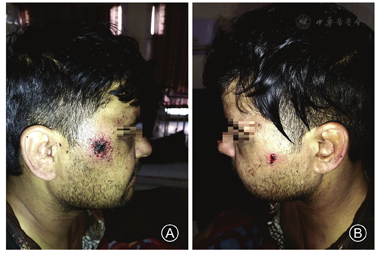
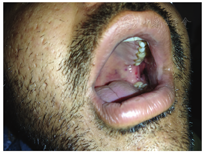
On the initial assessment, the patient was alert and conscious of the time and place. And the GCS was 15/15, pulse rate 90 beats/min and blood pressure 130/80 mmHg. He had sustained entry and exit wounds on the right and left cranial regions respectively. The right side wound was located just above the right zygomatic bone, rounded in shape, measuring 1.5 cm × 1.5 cm, covered with crusted blood, having beveled in margins. There was singeing of the surrounding skin due to gunpowder burn indicative of close range fire at the entry site along with black eye (Fig. 1A). The left side exit wound was overlying left zygomatic bone, oval in shape with irregular beveled out margins, measuring 1.5 cm × 2 cm (Fig. 1B). On oral cavity examination and rhinoscopy, the patient had a diffuse hematoma of hard as well as soft palate extending on to the left cheek (Fig. 2). There was no fresh oral or nasal bleed. In examination of ears, there was a small traumatic perforation in the right tympanic membrane. There was no neurological deficit at the time of presentation. The patient was hospitalized for investigations and monitoring.
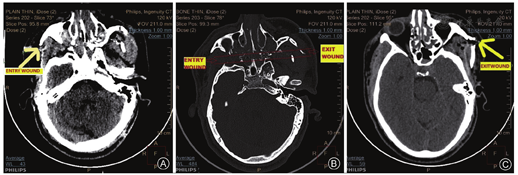
On radiological investigations, non-contrast CT scan of head revealed fractures in the posterolateral wall of the right orbit near the entry wound, medial wall of the right maxillary sinus, bilateral pterygoid plates, ethmoid air cells, vomer, medial as well as lateral wall of the left maxillary sinus and left zygoma, which were corresponding to exit wound of a gunshot injury (Fig. 3). Surprisingly, there was no damage to duramater and underlying brain tissue. All other radiological and blood investigations were within normal limits.
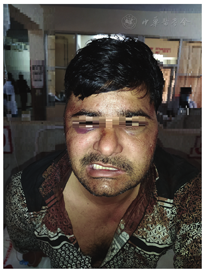
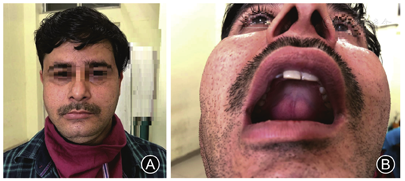
The patient was given the conservative treatment of antibiotics, analgesics and anticonvulsants. On the second day, he developed mild deviation of angle of mouth on the right side, indicating right facial nerve palsy (Fig. 4). The bleeding from nose and oral cavity stopped of its own. The patient was discharged on day 3 since he was asymptomatic.
On follow-up at 4 weeks, the patient was found to be doing well without any neurological deficit or wound sepsis. The right facial nerve palsy, palatal hematoma and black eye were resolved spontaneously (Fig. 5).
Gunshot injuries can lead to a significant morbidity and even instant mortality especially when involving head and neck region due to the close proximity to vital neural tissue and major vasculature. Such cases have almost 90% mortality before patients reach a hospital; and out of those who manage to arrive at a hospital, 50% die in the emergency room.1,2 Gunshot wounds are classified as penetrating, perforating and avulsive. A penetrating wound is one in which there is only an entrance wound. A perforating wound is one in which there is both an entry and exit wounds. An avulsive wound also has both entry and exit wounds but with substantial loss of tissue .3 In head and neck region, vital neural tissue and major vasculature lie in a close compact space. Any bullet passing through this region may lead to major vascular and/or neural tissue damage simultaneously. The anatomy of bone, soft tissue, nervous and vascular makes the management of gunshot wounds on the craniocerebral region further challenging. Although initially stable, many patients require early airway control and urgent work-up for vascular and intracranial injuries .4 It is important to provide immediate as well as intense resuscitation, but simultaneously, the patient should always be evaluated for predictors of mortality. The aim is to provide an individualized treatment approach, because every such injury is different and unique.5 The type and extent of tissue damage in gunshot wounds varies from small wounds to large gaping ones and this in turn depends on the type of weapon, the velocity of the missile and the distance from which it is fired .6
In craniocerebral gunshot injury fired at close range, burning and implantation of gun powder results in a tattoo on the surrounding skin. Fracture on the underlying bone is common when bullet has a high velocity of at least 65 m/s. When the bullet traverses flat and cancellous bones of the cranium, it produces a type of drill-hole wound.7 The presence of perforating injury also indicates more severe impact and associated damage in comparison to penetrating injury. Moreover, in such cases, the location of an entry wound and the projectile path are other important factors deciding occurrence of significant injuries or death. Lateral penetrating craniocerebral gunshot wounds arouse more damages than anteroposterior injuries. In the former, both cerebral hemispheres are damaged simultaneously, while in the latter only one hemisphere is injured.8 Thus in our case, the cutaneous tattooing, rounded wounds with lateral entry and exit, and fractures of all bones in the path of the bullet clearly indicate a high speed perforating bullet injury, fired at a very close range.
While passing through the cranium, the bullet leads to a fragmentation and fracture of the bones causing severe damage as well as frightful deformity. Also, the small fragments of broken bones as secondary missiles pierce the adjoining vital tissues and cause a further damage.7 Fortunately, our patient only had undisplaced fractures of multiple cranial bones, without any significant deformity or tissue loss.
In a gunshot injury, the high speed bullet causing damage along its path besides, leads to extensive collateral damage to adjacent vital structures due to an additional temporary cavitation effect. The high pressure sonic wave lasting for few microseconds radiates outwards from the point of primary impact of the bullet, which leads to cavitation effect.9 In this case, there was a very high like-lihood of damaging the adjoining brain tissue and major vessels in this mechanism, but fortunately no damage at all occurred. There were only transient facial nerve palsy and tympanic membrane perforation, which were resolved spontaneously without any need of surgical intervention.
In conclusion, perforating craniocerebral gunshot injuries do not have a set protocol for management. Clinical examination along with advanced radiological techniques like CT scan and MRI can delineate the extent of damage and help in treatment planning. Most of the cases with such injuries generally have very grave outcomes usually in form of instant mortality. However, this case illustrates that despite of having a very rare and grievous gunshot injury in craniocerebral region, the patient is possible to survive and without any residual damage.
Peer review under responsibility of Chinese Medical Association.
Consent was obtained from the patient for publication of the case and photographs.
The authors have no personal, financial or institutional interest in any of the drugs, materials or devices described in this article.


